




By: Behnam Ghasemi
The global embroidery machinery landscape is experiencing an unprecedented structural realignment. For decades, high-end textile facilities relied almost exclusively on Japanese and European hardware. Today, domestic innovations from premium Chinese manufacturers are disrupting that monopoly. Standing tall at the center of this paradigm shift is Zhejiang Zhaoshan Mechanism-Electricity Co., Ltd. (ZSM).
During the prestigious 21st International Textile, Clothing & Printing Industry Expo (ITCPE 2026) in Guangzhou, Behnam Ghasemi, Editor-in-Chief of Kohan Textile Journal, sat down with Mr. Johnny Zhang, Overseas Sales Manager at ZSM, to review the company’s multi-functional line-up and dissect the economic realities redefining global textile procurement.
Versatility in Hardware: From Single-Head Customization to Industrial Mixed Machinery
As global apparel demands fluctuate between heavy mass production and nimble boutique customization, ZSM has constructed a diversified machinery ecosystem to serve both ends of the manufacturing spectrum.
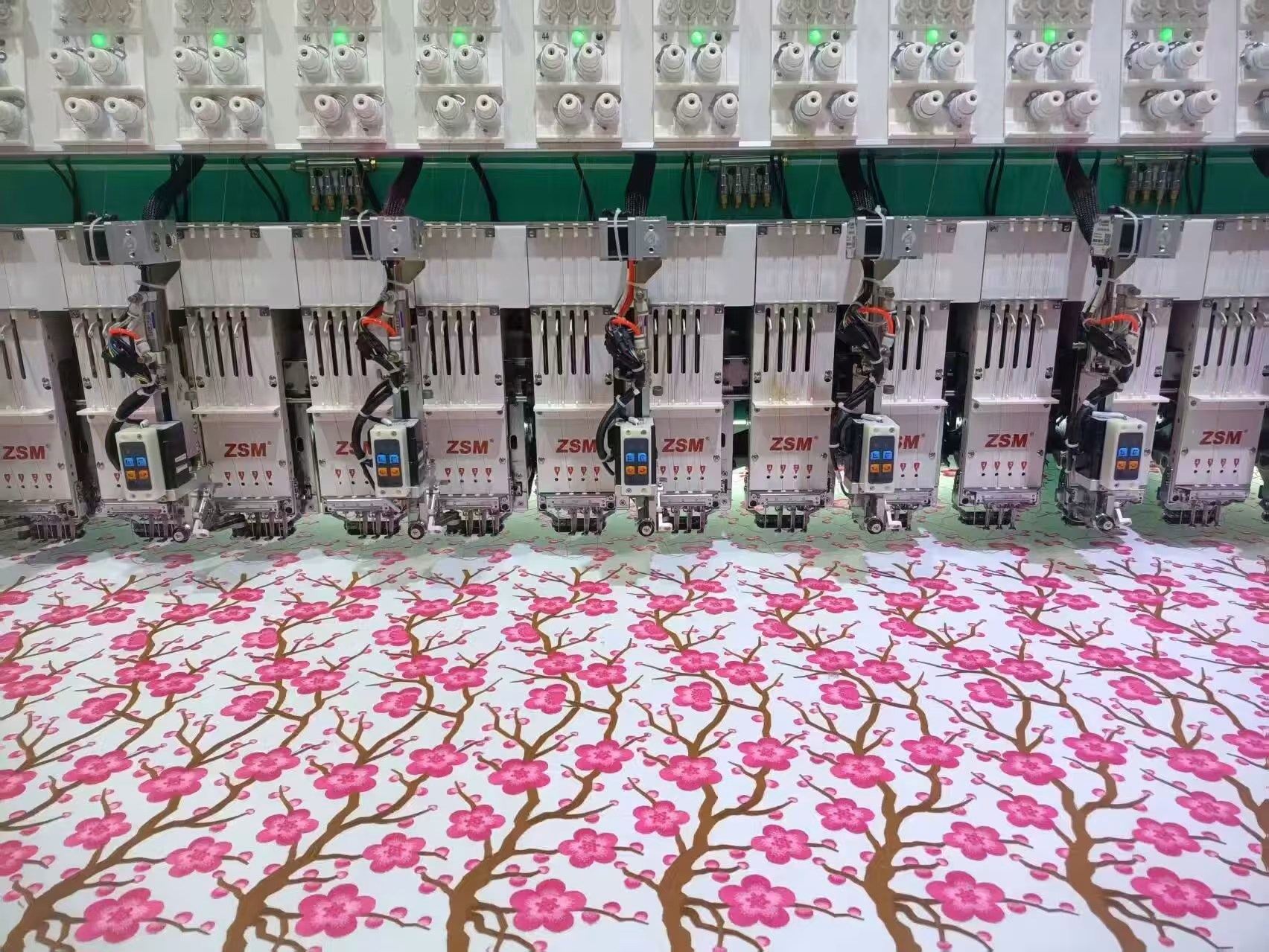
At ITCPE 2026, ZSM’s exhibition booth drew substantial crowds with its operational super high-speed multi-head flat machines and complex flat chenille mixed systems. Simultaneously, the company showcased highly versatile single-head setups engineered specifically for complex embroidery on finished garments, caps, and t-shirts.
“We brought a completely multi-functional model layout this year to demonstrate total flexibility to our buyers,” Mr. Johnny noted. “Whether a factory requires ultra-fast flat output or specialized sequin punch accents, our self-developed systems accommodate it seamlessly.”
A Seven-Year ITCPE Anchor: Deepening Domestic and Regional Trade
ZSM is no stranger to the Guangzhou industrial platform. The company has maintained a continuous exhibitor presence at ITCPE since 2018.
“We have returned to this exhibition consistently for nearly eight years because it serves as an invaluable localized engine,” Mr. Johnny explained. “ITCPE allows us to systematically develop strong commercial relationships with garment manufacturers clustered in nearby regional industrial hubs. Concurrently, it draws in targeted international trade groups.”
ZSM’s global market reach spans extensive textile corridors, including key target markets such as:
- South Asia: India, Pakistan, and Bangladesh
- Southeast Asia: Vietnam
- Middle East & North Africa: Turkey and Egypt
While Mr. Johnny acknowledged that North African and Middle Eastern attendance at this specific regional installation is steady but specialized, ZSM keeps a direct pipeline open to these core regions via dedicated export channels.

Read more : Zhejiang Mechanical Electricity Unveils Latest Innovations
When pressed on how Chinese embroidery brands managed to break out of the “copying” stigma over the past decade, Mr. Johnny highlighted heavy internal capital investment and a meticulous focus on quality control (QC).
Breaking Dependence via Self-Sufficiency
For ZSM, true technological dominance came from eliminating third-party part reliance. Unlike assemblers who source foundational components, ZSM designs and builds its own core systems in-house.
“The primary key to our progress is independent R&D,” stated Mr. Johnny. “We built an internal technical team and put substantial capital toward designing our own head systems—the absolute heart of an embroidery machine. We are no longer copying legacy brands like Tajima or Barudan. We are on the same quality tier, and in certain performance parameters, we are exceeding them.”
The Three-for-One Economic Reality
This technical maturation, combined with logical manufacturing economics, offers international buyers an unbeatable return on investment (ROI):
- Precision Output: ZSM’s stitch refinement and fabric-handling capabilities now safely match premium Japanese alternatives.
- Unrivaled Cost-Efficiency: Factory owners can realistically purchase three high-performance ZSM machines for the exact capital expenditure required to buy a single traditional Japanese machine.
- Bulletproof After-Sales Support: ZSM has built robust localized technical service structures to eliminate down-time anxieties for international factory owners.

Read more : CBL Embroidery Machinery Showcases Cutting-Edge Innovation and Strategic Vision at ITCPE 2025
Editor’s Insight: Redefining Value and AI Autonomy in Modern Embroidery
The clear, underlying message from ZSM at ITCPE 2026 is that the traditional economic calculations governing textile hardware have changed forever. For years, Western and Middle Eastern buyers justified paying massive price premiums for Japanese hardware under the assumption that it was the only way to achieve continuous mechanical stability and superior stitch precision. ZSM has shattered that myth.
By achieving complete manufacturing independence—particularly in the self-development of their intricate mechanical head configurations—ZSM has effectively democratized high-precision embroidery. When a manufacturer can triple their factory floor capacity without sacrificing output quality, classical brand loyalty transforms into an unnecessary financial liability.
Furthermore, Mr. Johnny’s forward-looking projection regarding AI integration outlines the true horizon of the garment trade. The next phase of embroidery automation will transcend mere mechanical acceleration; it will revolve around digital autonomy. A system where an integrated vision camera can scan an off-the-shelf garment, instantly compute an optimized layout, auto-generate a digital design matrix, and sew the finished pattern without human digitizing intervention is no longer science fiction.
As industrial platforms like ITCPE 2026 demonstrate, the deep integration of proprietary manufacturing, aggressive internal R&D spending, and smart AI control systems is positioning Chinese OEMs not just as major players, but as the absolute directors of global textile innovation.













