As textile manufacturers worldwide seek to reduce production costs while improving sustainability, intelligent process control technologies are becoming essential investments. From chemical application and moisture management to AI-powered automation, mills are increasingly adopting solutions that optimize resource consumption without compromising fabric quality.
During ITM 2026 in Istanbul, Behnam Ghasemi, Editor-in-Chief of Kohan Textile Journal, spoke with Mr. Emre Gürel, Sales Manager at GES Group, about the company’s latest innovations, the role of artificial intelligence in textile finishing, and the future of the textile industry across Türkiye, the Middle East, and Africa.
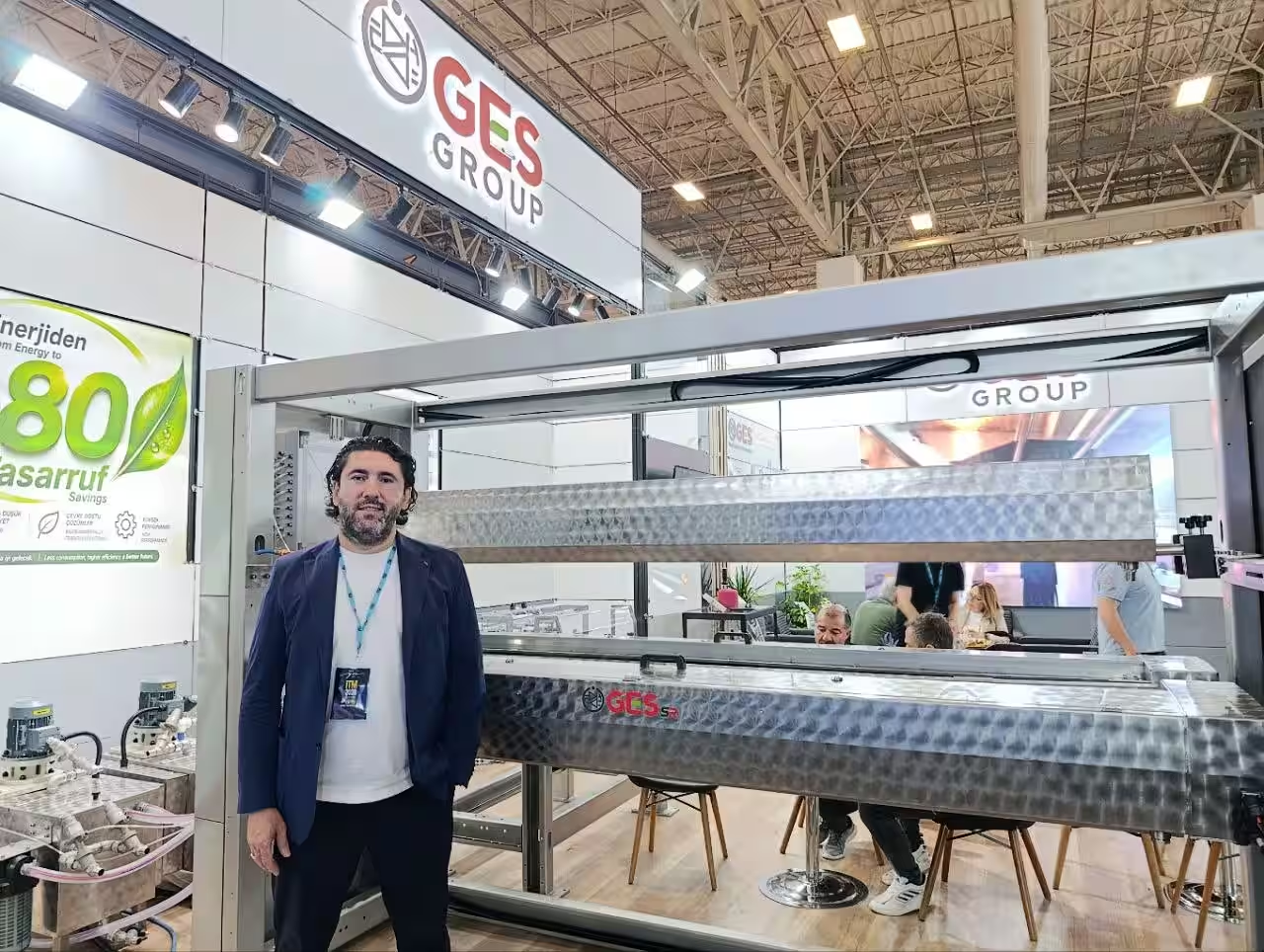
35 Years of Innovation in Textile Process Control
Kohan Textile Journal: Could you briefly introduce GES Group and tell us about the company’s background?
Emre Gürel: My name is Emre Gürel, Sales Manager at GES Group.GES was established in 1991 to serve the textile industry. For more than 35 years, we have focused on developing technologies that improve textile production quality while significantly reducing energy and resource consumption.
Today, we manufacture a wide range of intelligent process control systems for textile finishing, including chemical spraying systems, fabric moisture management equipment, moisture measurement and control devices, metal detectors, static eliminators, and portable moisture meters.We currently export directly to more than 20 countries worldwide and continue expanding our international presence.
AI-Powered Chemical Spraying: A New Generation of Sustainable Dyeing
Kohan Textile Journal: What are the key innovations you are presenting at ITM 2026?
Emre Gürel: One of our most important innovations is our GES Chemical Spraying System combined with Smart Rotor technology.This is a unique solution that utilizes artificial intelligence to optimize chemical application during textile processing. The system has been designed to maximize efficiency while minimizing resource consumption.
Compared with conventional processes, it can deliver up to 80% energy savings, 50% chemical savings, and approximately 15% water savings, making it a revolutionary solution for textile dyeing and finishing operations.
Our goal is to help textile manufacturers achieve both higher production quality and greater sustainability through intelligent automation.
Moisture Control Improves Quality and Productivity
Kohan Textile Journal: Besides your chemical spraying technology, what other solutions does GES offer?
Emre Gürel: Another important product family is our fabric moisture management systems.These systems are widely used before and after sanforizing as well as on fabric inspection machines, where accurate moisture control directly influences fabric quality and production efficiency.
In addition, we provide moisture measurement and automatic control systems for stenter machines. These devices continuously monitor the fabric’s moisture content at the machine outlet and automatically adjust machine speed to maintain the desired moisture level.
As a result, manufacturers achieve better fabric quality, improved machine performance, higher production efficiency, and lower energy consumption.Beyond these technologies, we also manufacture metal detection systems, static neutralizers, and portable moisture measuring devices to support various textile production processes.
The Textile Industry Will Continue to Grow Through Innovation
Kohan Textile Journal: How do you see the future of the textile industry?
Emre Gürel: Although the textile industry is currently experiencing a slower period both in Türkiye and globally, it remains one of the world’s most essential industries.
For Türkiye in particular, textiles continue to represent one of the country’s most important industrial sectors.
We expect market conditions to improve significantly by 2027 as investment activity gradually returns. Textile production will always remain necessary, and we believe technological innovation will play a key role in the industry’s recovery.
Africa Is Becoming an Important Textile Destination
Kohan Textile Journal: What is your opinion about the future of the Middle East and Africa?
Emre Gürel: The Middle East continues to develop as an important textile market, but we also see remarkable progress across Africa.During ITM 2026, we welcomed visitors from Nigeria and several other African countries, demonstrating the growing interest in textile manufacturing throughout the continent.
As textile investments increase in Africa, we strongly believe Turkish textile machinery manufacturers will continue expanding their presence there.Wherever textile manufacturing develops, Turkish machinery suppliers will always have an important role to play, and we intend to strengthen our position in these emerging markets in the coming years.
Editor’s Insight
GES Group demonstrates how digital process control is becoming one of the most effective pathways toward sustainable textile manufacturing. Rather than relying solely on larger machinery investments, manufacturers are increasingly adopting intelligent monitoring systems that optimize chemical application, moisture control, and energy consumption. As sustainability regulations become stricter worldwide, AI-driven process optimization technologies like those developed by GES are expected to become standard equipment in modern dyeing and finishing plants.
Read more: Türkiye’s Textile Industry: A 100-Year Journey of Transformation and Global Strength