






As textile manufacturers increasingly focus on quality consistency, sustainability, and digital product development, objective fabric evaluation has become more important than ever. At ITM 2026 in Istanbul, Kohan Textile Journal spoke with Markus Amthor, Global Business Development Manager at emtec Electronic GmbH, about the company’s innovative Textile Sensation Analyzer (TSA), the evolution of tactile measurement technology, and the future of textile testing.
Transforming Subjective Fabric Feel into Measurable Data
Could you please introduce your company and its background?
Markus Amthor: emtec Electronic GmbH was founded in the early 1990s in Leipzig, Germany, and today employs around 35 people.
Initially, our company focused on developing quality control and laboratory testing instruments for the paper industry. Our portfolio includes charge analysis systems, zeta potential analyzers, ash content measurement devices, and several other testing instruments used primarily in the wet-end section of paper production.
Around twenty years ago, we introduced the Tissue Softness Analyzer (TSA), an innovation entirely developed by emtec. Today, more than 600 units have been installed worldwide and are widely used by leading tissue manufacturers.
Due to growing interest from textile manufacturers, we adapted this technology approximately five years ago for textile applications, resulting in what is now known as the Textile Sensation Analyzer (TSA).
What exactly does the Textile Sensation Analyzer measure?
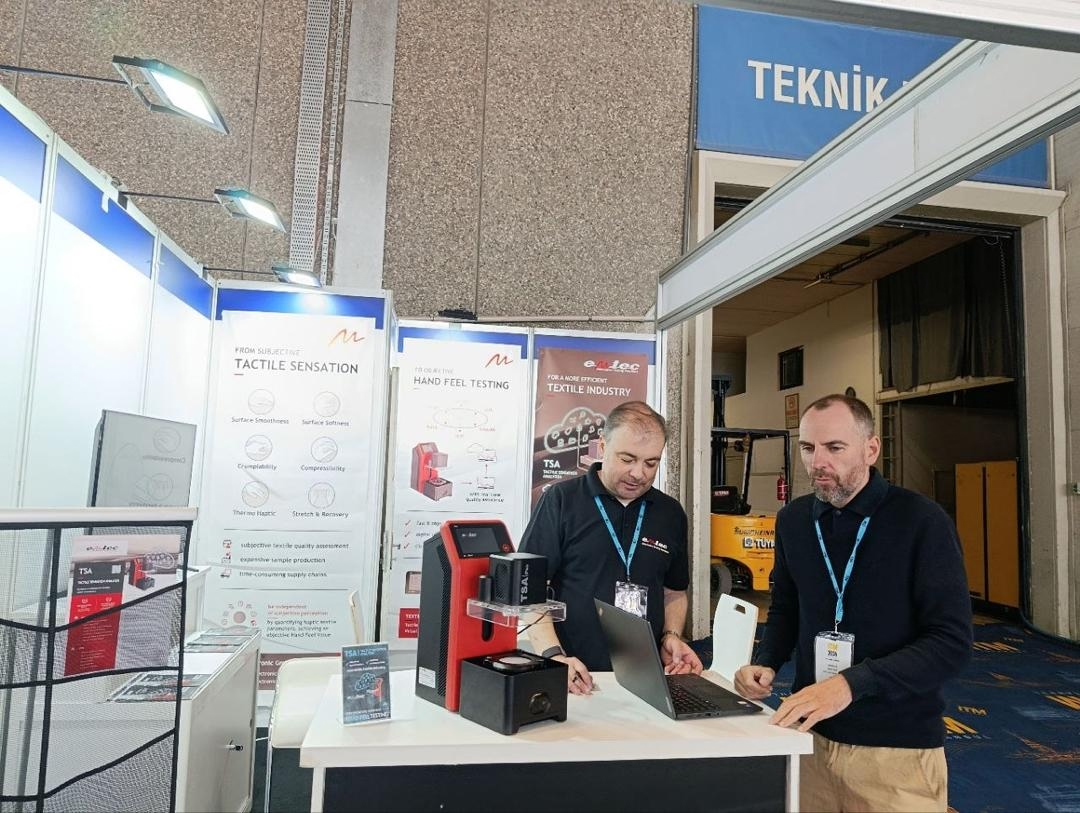
Markus Amthor: The Textile Sensation Analyzer objectively measures what has traditionally been a completely subjective property—the hand feel of a textile.
When people evaluate a fabric, they naturally rub it between their fingers. During this process, they perceive surface roughness, smoothness, softness, flexibility, and many other characteristics. However, these perceptions vary from person to person depending on gender, culture, experience, and individual sensitivity.
Our instrument simulates the movement of the human hand and fingers, transforming these subjective impressions into measurable physical values.
The system uses a highly sensitive rotating drum mounted on a precision balance. Built-in microphones detect micro-vibrations generated while the fabric moves across the surface.
Higher sound levels generally indicate rougher surfaces or stiffer fibers, while lower decibel values correspond to smoother surfaces and softer fibers.
What additional parameters can the instrument evaluate?
Markus Amthor: Besides softness and surface roughness, the system also measures several important mechanical properties.
By applying controlled vertical forces between 10 and 60 grams, it evaluates:
- Flexibility
- Plasticity
- Fabric stiffness
- Mechanical resistance
Our newest generation of the instrument also incorporates thermo-haptic analysis, allowing us to evaluate thermal conductivity.
The surface is heated, and laser sensors monitor temperature changes over time to determine heat transfer characteristics.
In addition, the instrument can measure air permeability using the Bendtsen methodology through vacuum technology.
An optional high-resolution digital camera can also capture detailed images of the textile surface for documentation and analysis.
Read More: ITM 2026 Results Confirm Global Industry Confidence
How widely is this technology being used today?
Markus Amthor: The Textile Sensation Analyzer is already being used by numerous textile manufacturers around the world.
In Türkiye alone, we currently have two customers, while globally the number continues to grow as more companies recognize the value of objective quality measurement during product development.
How do you see the future of the textile industry?
Markus Amthor: The textile industry faces significant challenges, particularly regarding water consumption and environmental protection.
Textile manufacturing requires large amounts of water and chemicals, so reducing resource consumption has become a global priority.
Our contribution focuses on improving efficiency during product development.
Today, brands often exchange numerous fabric samples between Asia, Europe, and North America before approving the desired hand feel. This process requires multiple shipments, consumes time, and generates unnecessary transportation costs and carbon emissions.
Using the Textile Sensation Analyzer, companies can objectively evaluate fabric hand feel without relying solely on physical sample exchanges, helping reduce shipment volumes, development time, and resource consumption.
What is your view on the textile industry’s development in the Middle East and Africa?
Markus Amthor: The Middle East certainly offers growth opportunities for the textile sector.
However, more broadly, we observe that textile manufacturing continues shifting from one region of the world to another.
We witnessed this twenty years ago when production moved from Western Europe to Asia. Today we see similar shifts toward other emerging regions.
Personally, I do not believe that continuously relocating manufacturing is necessarily the ideal long-term solution. These movements are usually driven by labor costs rather than sustainable industrial development.
Unfortunately, we also see that Türkiye’s textile industry has come under increasing pressure in recent years, and production volumes have declined compared with previous decades.











