

BW Converting will introduce textile manufacturers to the capabilities and production benefits of the company’s Baldwin TexCoat® G4 precision spray finishing system at the 33rd Apparel Sourcing Show, taking place Aug. 18-20 at the Tikal Futura Convention Center in Guatemala City. BW Converting will participate through its local agent, Maprimaq, at booths 25 and 26.
The Apparel Sourcing Show is the only trade show in Central America dedicated specifically to the apparel and textile industry in the DR-CAFTA region. The event brings together the region’s complete supply chain, including yarn, textiles, inputs, machinery and specialized services, creating an important forum for manufacturers seeking new ways to strengthen productivity and competitiveness.
“Textile producers throughout Central America are facing the same challenge we see across the global market: They need to increase output and maintain high finishing standards while gaining tighter control over water, energy and chemistry costs,” said Rick Stanford, Vice President of Global Business Development, Textiles, BW Converting. “TexCoat G4 gives mills a practical way to address those priorities by increasing the productivity of an existing finishing line rather than requiring a major expansion of production capacity.”
The TexCoat G4 uses non-contact precision spray technology to apply a controlled and uniform amount of chemistry to one or both sides of the fabric. Because the system applies only the amount required, it can reduce wet pick-up by up to 50 percent compared with conventional finishing methods. The lower moisture load can decrease water consumption and reduce the energy required for drying by as much as 50 percent.
Read More: BW Converting to present its Baldwin TexCoat® G4 and Corona Pure at ITM 2026
The system also recycles chemistry during fabric and chemical changeovers, supporting zero chemical waste from the changeover process. Automated cleaning routines, rapid job changeovers and recipe control help mills maintain production uptime while improving consistency and traceability.
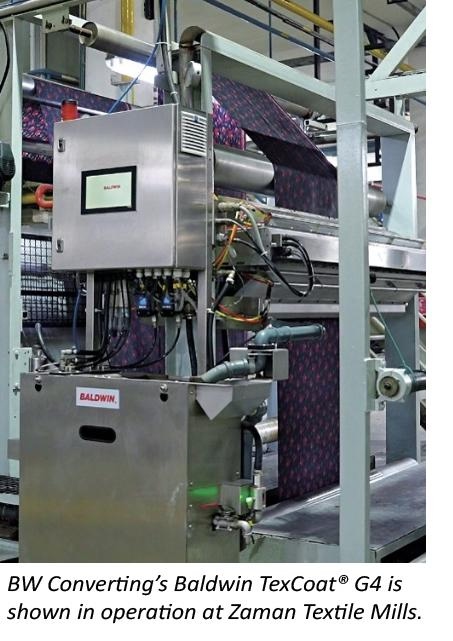
Results reported by Zaman Textile Mills in Pakistan illustrate the business impact the technology can deliver in a production environment.
“Compared with machines not equipped with TexCoat G4, we have achieved 30 percent more production with the system’s aerosol spray technology,” said Atif Siddiqui, Technical Director, Zaman Textile Mills. “Chemical usage has also decreased by up to 50 percent compared to our earlier methods. Compared with the conventional method, TexCoat G4 improves the hand feel of the fabric and the overall quality of the finished product.”
Zaman also reported that the system’s precise application remained consistent across the full fabric width during long production runs. The reduced amount of finishing solution applied to the fabric allowed the mill to increase machine speed and production output while lowering utility and chemical costs.
Existing Finishing Lines Can Increase Output
Designed for integration with existing textile finishing equipment, TexCoat G4 provides mills with a pathway to greater output without necessarily adding another complete finishing line. Its non-contact application process also avoids bath contamination and chemical dilution in wet-on-wet applications, helping manufacturers maintain more repeatable finishing results across production runs.
Visitors to booths 25 and 26 can meet with Maprimaq representatives to learn how Baldwin TexCoat G4 can support more productive, controlled and resource-efficient textile finishing operations.