

Written By: Muhammad Asad – He works with Combat wear Factory, a manufacturer of rash guards, fight wear and martial arts uniforms in Sialkot, Pakistan, producing for brands, academies and teams.
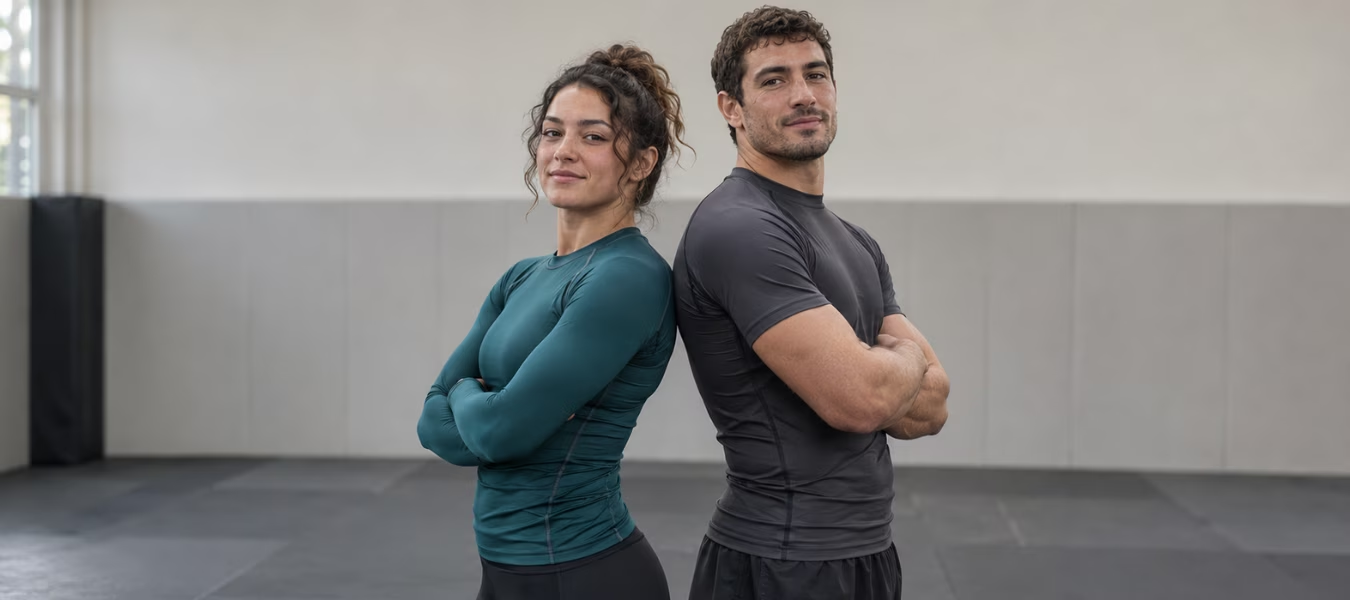
A rash guard looks like a simple garment: a close-fitting stretch top, usually printed, worn for jiu-jitsu, submission grappling, MMA training or surfing. In grappling it has one of the hardest working lives of any piece of sportswear.
It is pulled, twisted and dragged across mats, soaked in sweat, stretched far beyond its resting size many times a session, and then washed several times a week. Fabrics and constructions that perform well in running or gym wear can fail quickly under that combination.
This article looks at rash guards and grappling compression wear from the production side: which fabrics are used, what they need to withstand, how seams and decoration affect durability, and which checks are worth making before a bulk order.
1. The Job Description
Before choosing a fabric, it helps to list what the garment actually has to do in grappling:
- Stretch in every direction and recover fully, so the garment stays close to the body and does not give an opponent loose fabric to hold.
- Resist abrasion from mats and from contact with other bodies and uniforms.
- Move sweat away from the skin and dry quickly between sessions.
- Keep a printed design sharp after repeated stretching and washing.
- Avoid seams that chafe or split under load.
- Hold its shape in the waist and hem so it does not ride up during scrambles.
Most of the technical decisions below trace back to one of these requirements.
Read more: Spandex Fiber Demand Rises with Sustainability and Sportswear Growth
2. Fibre Choice: Polyester-Elastane vs Nylon-Elastane
Almost all rash guards are knitted from a synthetic base yarn combined with elastane (spandex).
Polyester-elastane is the most common choice. Polyester is strong, holds its shape, dries quickly and, crucially, accepts sublimation printing, which is how most all-over rash guard designs are made. It is also generally less expensive than nylon.
Nylon-elastane has a softer, smoother handle and is often considered more abrasion-resistant, which is why it appears in premium compression wear. The trade-off is that nylon does not take sublimation dyes, so all-over prints are much harder to achieve.
Designs on nylon garments are usually limited to solid colours with transfers, screen prints or small decorated areas.
The elastane share is a balancing act. More elastane gives more stretch and a tighter compression feel; too little and the garment bags out after a few sessions.
Rash guard fabrics commonly sit somewhere in the range of roughly ten to twenty per cent elastane, depending on the stretch and handle the brand wants. The exact blend is less important than testing how the specific fabric behaves after stretching and washing.
3. Fabric Weight and Structure
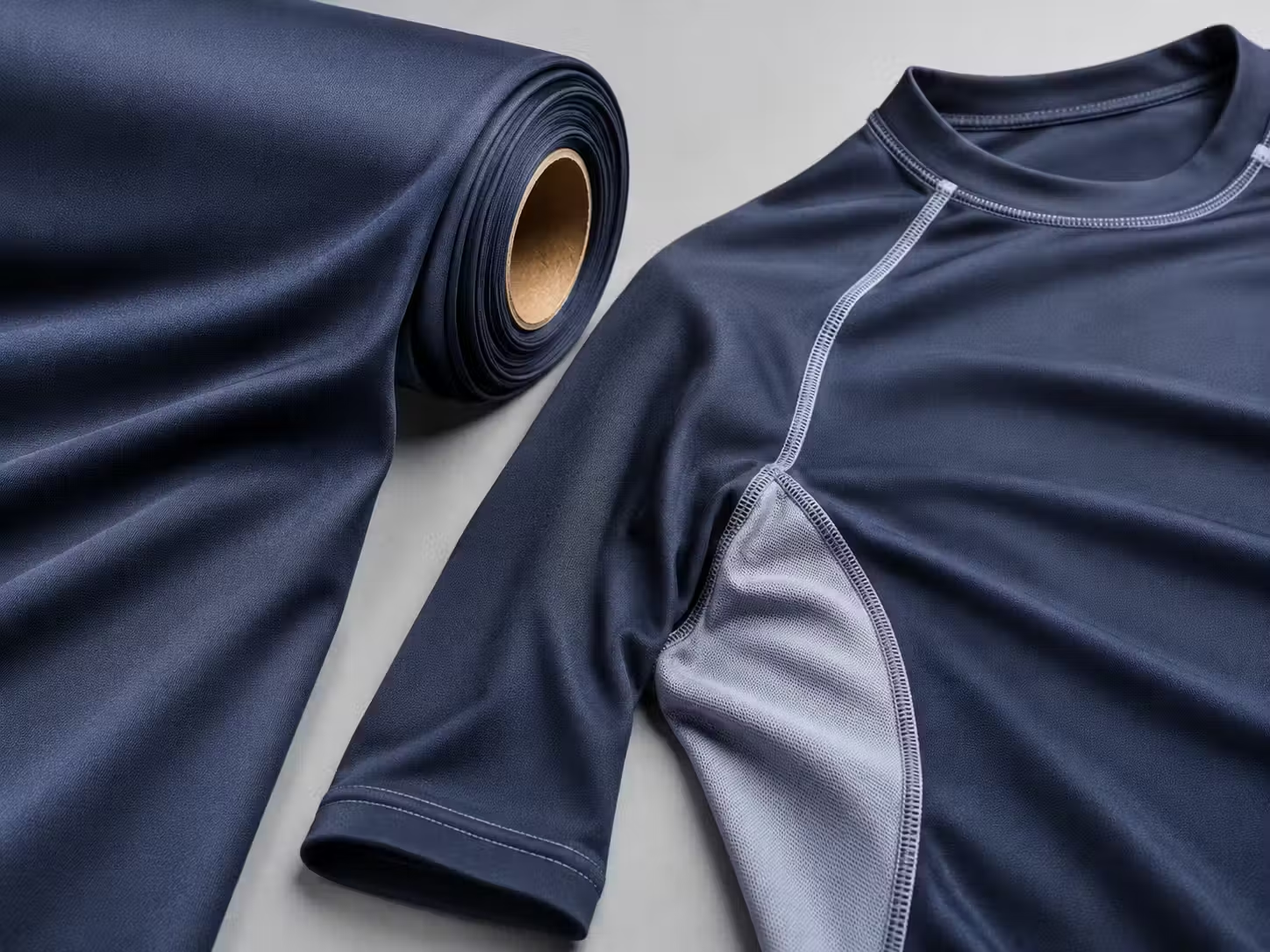
Rash guard fabrics are usually described by weight in grams per square metre (gsm). Lighter fabrics feel cooler and more comfortable; heavier fabrics generally offer more compression, better opacity and better abrasion resistance. For grappling, a mid-weight fabric is a common compromise, but the knit structure matters as much as the number.
Two points are worth checking on any candidate fabric:
- Opacity under stretch. A fabric that looks fine on the roll can become see-through when stretched over shoulders and thighs. Stretch a sample over a hand or a form and look at it in daylight.
- Surface and pilling. Grappling rubs fabric against mats, uniforms and skin. A fabric with a smooth, tight surface tends to pill less. A simple rub test against a rough surface, or a standardised abrasion test if the budget allows, will show problems early.
4. Stretch and Recovery: The Property That Fails First
The most common complaint about a worn-out rash guard is not a hole but a loss of shape: a baggy torso, a hem that no longer grips, sleeves that hang loose. That is a recovery problem.
Elastane recovers well when it is new, but it is damaged by heat, chlorine and some detergents and softeners, and by being held at high stretch for long periods. In production, recovery can be checked by stretching a marked section of fabric, holding it, releasing it and measuring how close it returns to its original length, both before and after several wash cycles.
In use, the most effective protection is cold washing and air drying, which brings us to care instructions later in this article.
5. Seams: Flatlock, Coverstitch and Overlock
Seam construction has a direct effect on comfort and durability in grappling.
Flatlock seams join the panels edge to edge with a flat stitch on both sides. They are the most common choice for rash guards because they lie flat against the skin and reduce chafing under pressure. A well-made flatlock seam also stretches with the fabric.
Overlock seams are strong and economical but create a ridge on the inside of the garment. On a loose T-shirt that is harmless; on a compression garment pressed into the skin by an opponent’s weight, it can rub.
Coverstitch is often used on hems and sleeve openings, giving a neat, stretchable finish.
Whatever the construction, stretch at the seam should match stretch in the fabric. If the stitch runs out of stretch before the fabric does, the thread breaks and the seam opens, often at the underarm or shoulder, which are the most heavily loaded points in grappling.
Many rash guards also use a silicone gripper or an elasticated band at the hem to stop the garment riding up. It is worth checking that the gripper is evenly applied and does not peel after washing.
6. Sublimation on Stretch Fabric
Sublimation is the standard way to put full-colour designs on polyester rash guards. The dye is printed onto transfer paper, then turned into gas under heat and pressure and absorbed into the polyester fibres. Because the colour sits in the fibre rather than on top of it, a good sublimated print does not crack or peel.
Stretch fabrics bring a few specific issues:
- Grin-through. Elastane does not take sublimation dye the way polyester does. When a printed garment is stretched, small white or pale flecks can appear where the elastane shows through, especially on dark designs.
- Distortion. Designs are printed flat but worn stretched. Logos and lettering placed over the shoulders, chest or upper arms can look stretched on the body. Good pattern work places key artwork away from the highest-stretch zones or pre-distorts it.
- Colour consistency. Sublimation colour depends on the fabric, the paper, the ink and the press conditions. Approving a physical strike-off on the actual production fabric is far more reliable than approving a screen image.
- White at the seams. If panels are printed before cutting and sewing, small unprinted areas may show at seams when the garment is stretched. Allowing the print to extend beyond the seam line helps.
7. Practical Checks Before a Bulk Order
For brands, academies and teams ordering custom rash guards, a few simple checks on the approved sample can prevent most problems:
- Stretch the garment over the shoulders and chest and look for see-through areas and grin-through on the print.
- Pull firmly on the underarm and shoulder seams and check that the stitching stretches with the fabric.
- Wash the sample several times on the care label instructions and measure the length, chest and sleeve before and after.
- Check the hem gripper or band after washing.
- Compare the printed colours with the approved artwork in daylight, not only under shop lighting.
- Record the approved fabric, weight, blend, seam type and print settings so reorders match.
8. Care Instructions That Protect the Fabric
Many rash guards wear out because of how they are washed rather than how they are used. Care labels and customer guidance should cover:
- Wash cold, inside out, as soon as possible after training.
- Avoid fabric softener, which can coat synthetic fibres and reduce moisture management.
- Avoid bleach, which damages elastane.
- Air dry rather than tumble dry, since heat is one of the main causes of lost stretch.
- Do not leave a wet rash guard in a closed bag, where bacteria and odour build up quickly.
Conclusion
A grappling rash guard has to stretch, recover, resist abrasion, manage sweat and keep a printed design looking right, all under conditions that would damage ordinary activewear.
Getting it right depends less on any single specification and more on a combination of choices: a suitable synthetic-elastane knit, flat and stretchable seams, careful print placement, physical sample approval and honest care instructions.
For producers and brands, the most valuable habit is testing the garment the way it will actually be used, stretched, rubbed and washed, before committing to a bulk order.