

Most woven apparel is designed to look good and survive normal wear. A judo or jiu-jitsu jacket has a different brief. It is gripped by the collar and sleeves, pulled hard in several directions at once, dragged across mats, soaked in sweat and washed after almost every session.
The fabric has to be thick enough to resist tearing and give a fair grip, yet comfortable enough to train in for an hour or more.
That brief is why martial arts uniforms use some of the heaviest cotton wovens in everyday apparel, and why they bring production problems that lighter garments rarely show.
This article covers three of them: choosing the weave, choosing the weight, and keeping finished sizes consistent when the fabric is going to shrink.
1. Why weave structure comes first
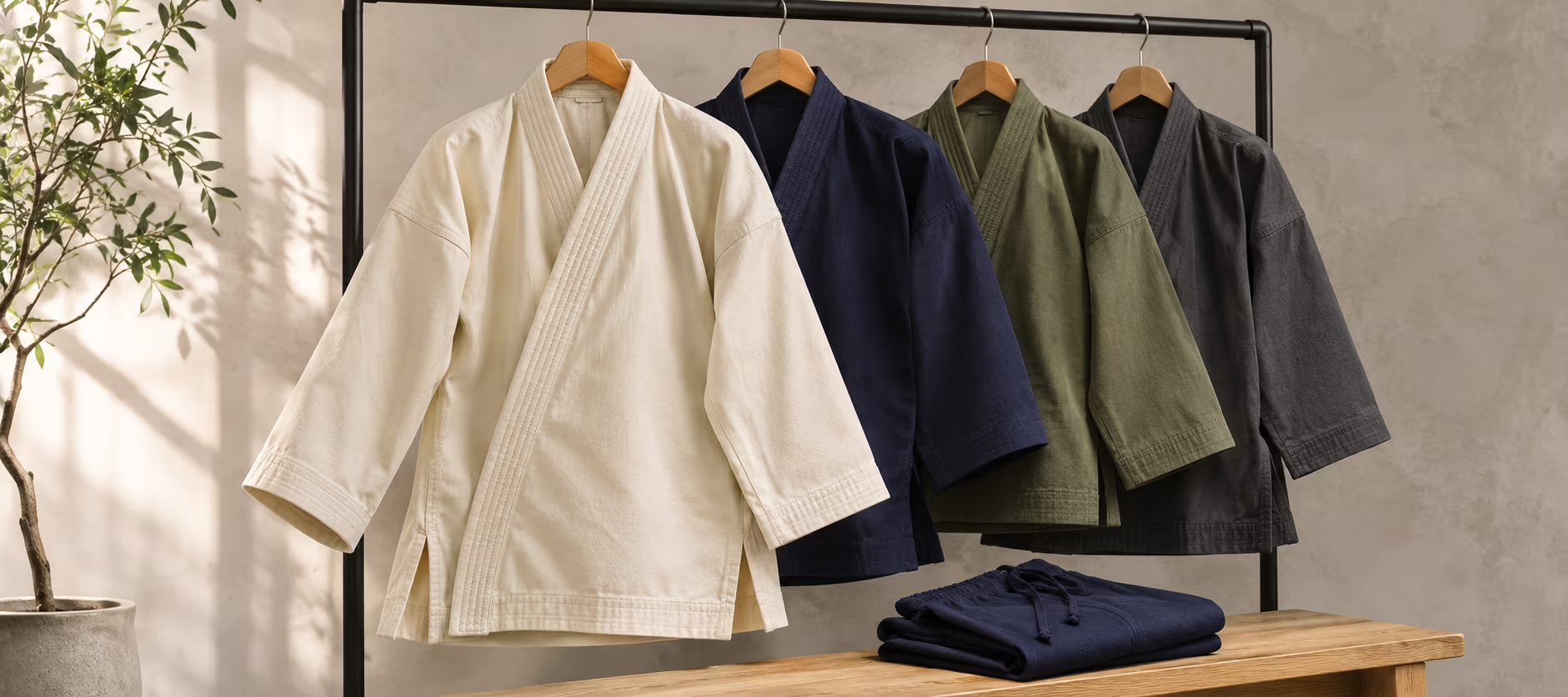
Buyers often ask for a uniform by weight alone, but the weave decides much of how the fabric behaves. The main structures seen in grappling and judo uniforms are:
- Single weave. A lighter, more open construction. It is cooler and easier to move in, cheaper to produce and quicker to dry, but it gives less resistance to tearing and less substance to grip. It is common in entry-level and kids’ uniforms and in hot climates.
- Double weave. A dense, heavy construction traditionally associated with judo. It is very strong and hard for an opponent to grip, but it is hot, stiff when new and slow to dry. The weight also makes it more expensive to ship.
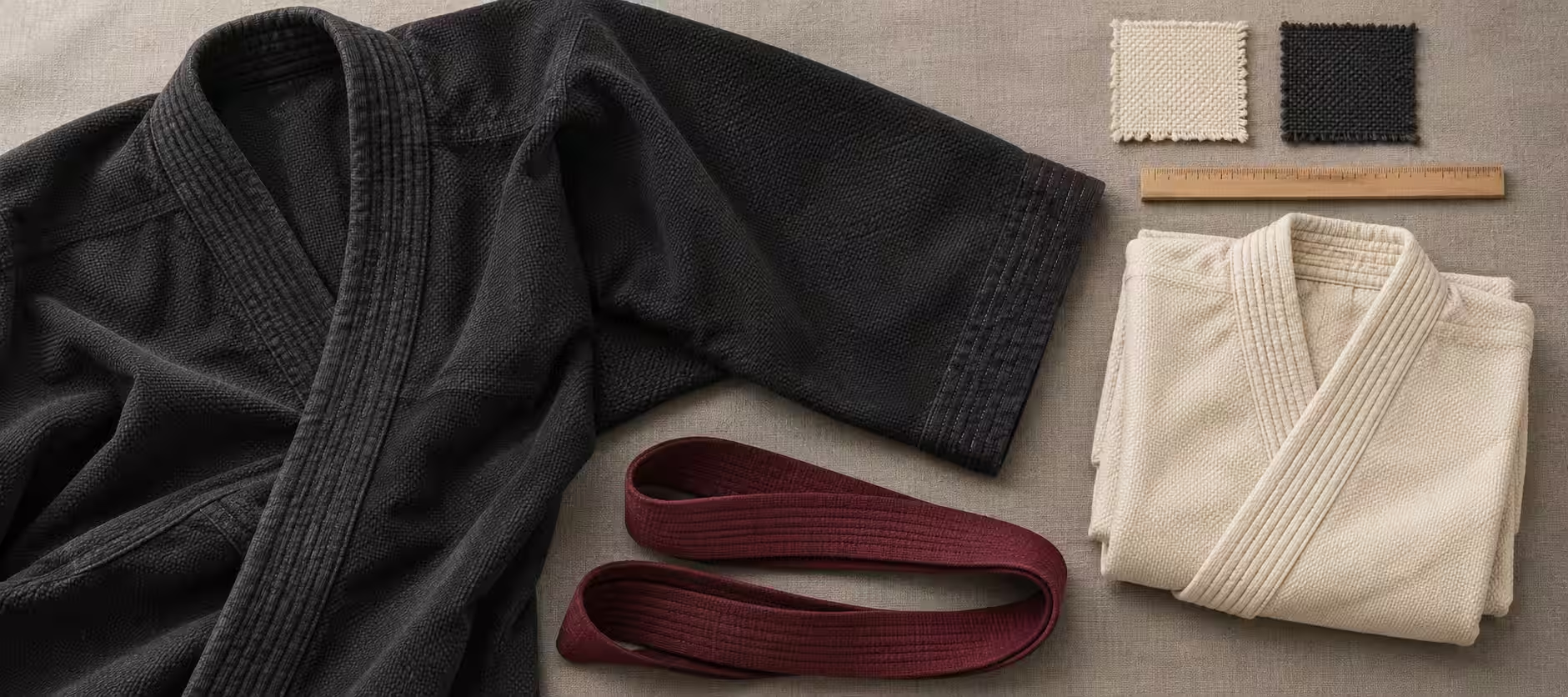
- Pearl weave. Widely used in Brazilian jiu-jitsu jackets. The surface has a small, regular texture that gives good strength for its weight. Many brands treat it as a sensible middle ground between a light single weave and a heavy double weave.
- Honeycomb, gold weave and other textured weaves. These are variations that aim for a particular balance of weight, strength and softness. Names are not fully standardised between mills, so two fabrics sold under the same name can behave differently.
Because the names vary, a fabric description should always be backed by a physical swatch and a test of the actual roll, not just the label on the quotation.
2. Choosing the weight (GSM)
Fabric weight is quoted in grams per square metre (gsm). For martial arts uniforms the numbers are high compared with shirting or even denim, and the right figure depends on the use:
- Training uniforms for beginners and children are usually lighter, so they are comfortable, affordable and easy to wash and dry.
- Everyday adult training jackets usually sit in a mid-weight range, often a pearl or similar weave.
- Competition jackets for gripping sports are often heavier, and some competitions set their own rules on fabric, fit and thickness. Producers should always check the current rules of the relevant federation rather than relying on what was acceptable a few seasons ago.
Two practical points are easy to miss:
- Weight is measured at a specific stage. Greige fabric, washed fabric and finished garment fabric can give different gsm readings. When a buyer and a supplier agree on a weight, they should agree on when and how it is measured, for example after washing, cut from a set position on the roll.
- Jacket and trousers are different fabrics. Trousers are usually made from cotton drill, canvas, ripstop or a cotton-polyester blend rather than the jacket weave. They will not behave in exactly the same way, especially in shrinkage, so they need their own specification and their own tests.
3. Why heavy cotton shrinks
Cotton yarn is held under tension during spinning, weaving and finishing. When the fabric is wetted and heated, the fibres swell and relax, the weave closes up and the fabric becomes shorter.
Heavy, textured weaves contain a lot of yarn and a lot of crimp, so they can shrink more than people expect. Most of the movement usually happens in the warp (length) direction, which is why sleeves and trouser legs are where customers notice it.
Pre-shrinking reduces this movement but does not remove it completely. Fabric that has been pre-shrunk at one temperature can still relax further if a customer later washes it hotter or tumble dries it. That is not a defect in itself, but it has to be planned for.
4. Measuring shrinkage before cutting
The most useful habit in heavy woven production is to measure shrinkage on the actual fabric lot before the cutting plan is finalised. A simple routine looks like this:
- Cut a test piece from each new fabric lot, mark a measured square in both warp and weft directions, and record the measurements.
- Wash and dry the piece in the way the finished garment is expected to be treated (for example, the care label method, and separately a harsher method that reflects real customer behaviour).
- Re-measure and calculate the percentage change in each direction.
- Repeat for at least one more cycle, because heavy cotton can keep moving after the first wash.
Recognised test methods exist for dimensional change on laundering, and they are worth using where a buyer or a lab requires them. Even a simple in-house version of the routine above, done consistently, catches the biggest surprise: a new fabric lot that behaves differently from the last one.
5. Building shrinkage into the pattern
Once the expected shrinkage is known, there are two main approaches:
- Garment-wash after sewing. The uniforms are made slightly oversized and then washed as finished garments, so most of the shrinkage happens before they reach the customer. This gives more predictable final sizes, but it adds a process, handling time and the risk of uneven results if the wash is not controlled.
- Pattern allowance. The fabric is pre-shrunk, and the pattern is graded with an allowance for the remaining shrinkage, so the garment reaches its intended size after the customer’s first few washes. This depends heavily on accurate shrinkage data for each fabric lot.
Whichever method is used, the size chart should say clearly whether its measurements are before or after washing. Many sizing complaints are really a mismatch between what the chart shows and what the customer measures at home.
6. Construction details that matter with heavy fabric
Heavy cotton is hard on sewing as well as on the wearer:
- Needle size, thread strength and stitch density need to suit the fabric thickness, especially where several layers meet at the collar and lapel.
- The collar is usually filled and stitched with multiple rows so it keeps its shape and resists gripping. Its filling material and stitching should be specified, not left to habit.
- Stress points such as the underarm, the side vents and the lower edge of the lapel benefit from reinforcement patches or bar tacks.
- Trouser knees are often reinforced, because that is where wear appears first.
7. A short pre-bulk checklist
Before approving bulk production of heavy woven uniforms, it is worth confirming:
- The weave, weight and measurement method agreed in writing, with a reference swatch.
- Shrinkage test results for the actual fabric lot, in both directions, over more than one wash.
- Whether the size chart describes measurements before or after washing.
- Separate specifications and shrinkage figures for jacket and trousers.
- Collar construction, stitching rows and reinforcement points on the approved sample.
- Care instructions that match the way the fabric was tested.
Read more: Rash Guards and Compression Wear for Grappling: What the Fabric Has to Survive
Conclusion
Heavy woven cotton gives martial arts uniforms their strength and their feel, but it also makes them one of the more demanding products for sizing consistency.
Most of the problems that reach the customer, from short sleeves to uneven trousers, can be traced back to a weave or weight that was not clearly specified, or to shrinkage that was not measured on the actual fabric lot.
Treating the weave, the weight and the shrinkage routine as part of the specification, rather than as background details, is what keeps one production run matching the next.