
The UCC 672-ME combines electronic three-way needle selection on cylinder and dial with highest design flexibility, production efficiency and application-driven textile innovation.
Terrot Textilmaschinen GmbH, the German circular knitting machinery manufacturer and a premium engineering provider within the Santoni China Group, will present its high-performance circular knitting technologies at ITMA ASIA + CITME 2026 in Shanghai, China, highlighting the application potential of its UCC 672-ME.
Designed for premium mattress ticking, upholstery textiles and other demanding fabric applications, the double-electronic circular knitting machine combines independently programmable three-way needle selection on both cylinder and dial with high production output and extensive patterning capabilities.
This technology enables manufacturers to develop differentiated, double-sided fabric structures while supporting flexible production strategies in an increasingly competitive global textile market.
Terrot’s participation underscores its continued commitment to advancing high-end textile engineering and delivering application-driven solutions that help global textile manufacturers improve productivity, fabric quality and operational flexibility.
As one of Asia’s key international platforms for textile machinery and manufacturing innovation, ITMA ASIA + CITME provides an important opportunity to engage with textile manufacturers, brands, sourcing specialists and industry decisionmakers from across the global market.
Terrot will demonstrate how advanced circular knitting technology, combined with application expertise and flexible machine configurations, enables manufacturers to optimize production processes, respond to evolving market demands and develop differentiated fabrics for premium mattress, upholstery and other specialized textile applications.
Visitors are invited to experience Terrot’s latest innovations at the Santoni China Group stand H4.1 C39.
Read more: Santoni China Group to Exhibit at ITMA ASIA + CITME 2026
Specification of Exhibition Machine Model UCC 672-ME
Diameter 38” | C6/3 frame | Gauge E20 | 88 feeders | electronic needle selection in 3-way technology in cylinder and dial | Set up with special cooling yarn mattress design | Excellent support and comfort thanks to distinct zones | High-tech ventilation provided by specialized knit structures on both sides.
Engineering Flexibility into the Fabric
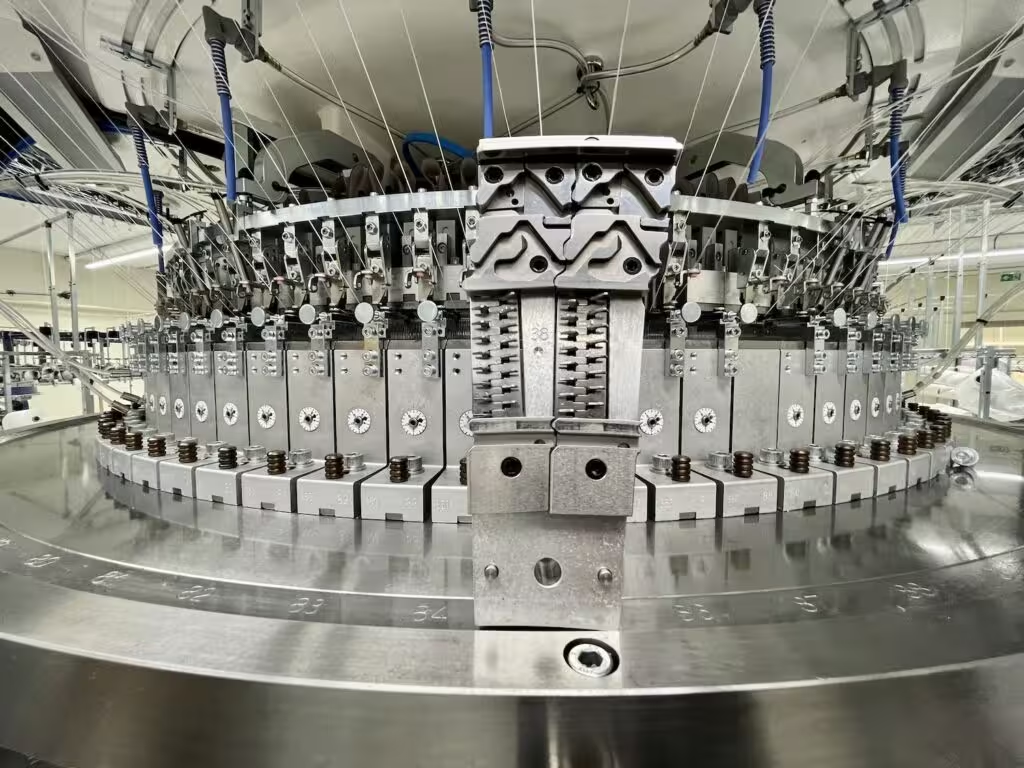
At the heart of the UCC 672-ME is its electronic three-way selection technology on both needle systems. By independently controlling knit, tuck and miss actions at every feeder on the cylinder and dial, the machine enables a high degree of design freedom across both fabric surfaces.
Manufacturers can develop intricate jacquard patterns, pronounced three-dimensional textures, ventilation zones and reversible structures without relying on conventional mechanical pattern limitations.
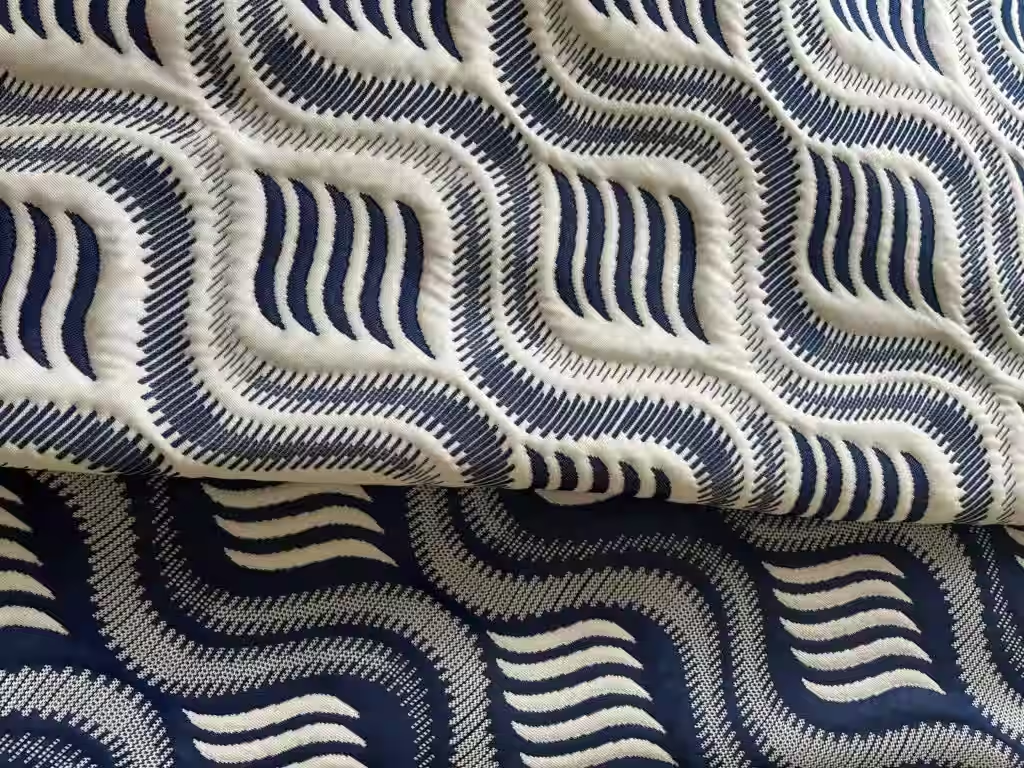
For mattress-cover applications, this flexibility can also be used to develop distinct fabric zones and specialized knit structures on both sides, with the potential to combine supportive fabric construction and comfort-oriented design with ventilation-focused effects. The resulting skin contact, cooling sensation and ventilation performance depend on yarn selection, fabric engineering and finishing.
This capability is particularly relevant to premium mattress covers, where surface design increasingly contributes to product differentiation alongside comfort, breathability and functional performance.
The same platform also supports upholstery textiles, spacer fabrics, shoe upper materials and selected outerwear applications, allowing manufacturers to address multiple market segments with a versatile production asset.
The UCC 672-ME is available in machine diameters from 34 to 42 inches. Its documented configurations include an 88-feeder setup at 38 inches and a 100-feeder setup at 42 inches.
The 38-inch configuration operates at speeds of up to 19 rpm, while the 42-inch configuration reaches up to 17 rpm. With up to 2.4 feeds per inch, the machine is engineered to combine production output with detailed fabric construction.
From Pattern Development to Industrial Production
The UCC 672-ME is designed to shorten the path between fabric concept, sampling and repeatable production. Its divided dial cam system allows needle changes without fully removing the needle selection units, helping reduce setup times. Manufacturers can also switch between knit and tuck structures without replacing machine parts, supporting faster sample changes and more responsive product development.
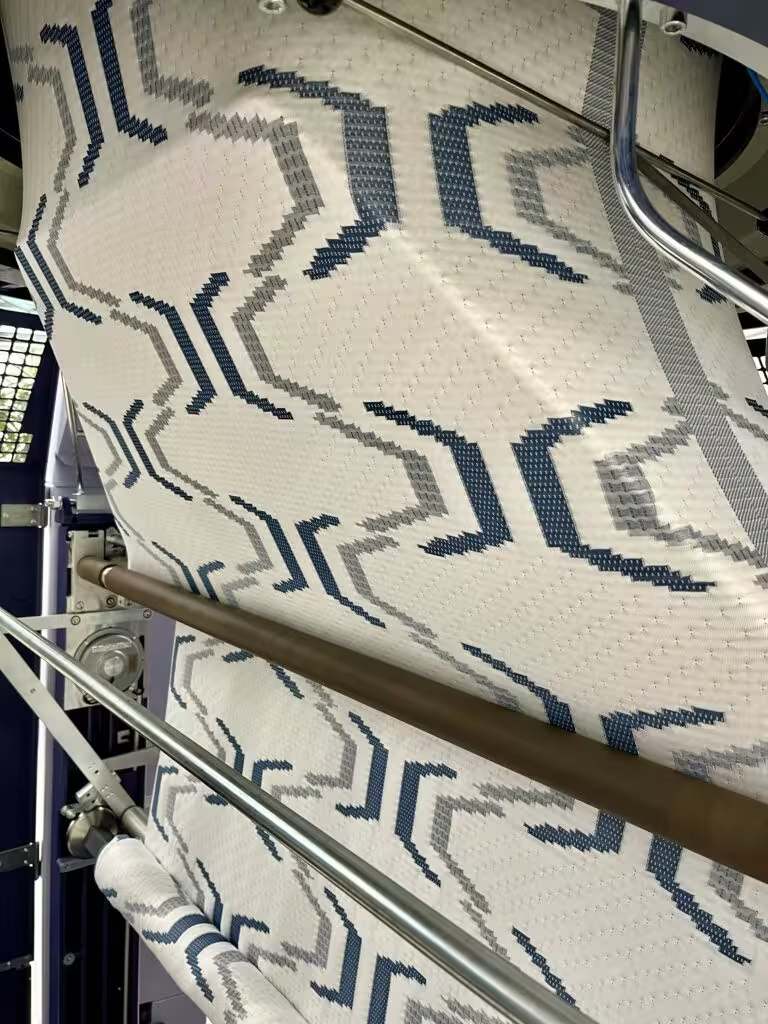
High-quality lay-in yarn carriers with integrated yarn guidance facilitate the reliable processing of long floating threads. The machine’s take-down configurations accommodate fabric widths of up to 1,708 mm and roll diameters of up to 1,050 mm, with options designed to address specific production requirements, including the prevention of center lines.
PAINT TERROT pattern and design software supports the development of fabric styles and pattern layouts, connecting digital design preparation with machine production. Together, these features provide manufacturers with greater scope to manage short development cycles, differentiated collections and changing customer specifications without sacrificing production consistency.
Application Focus: Premium Mattress Ticking and Technical Fabric Structures
The UCC 672-ME addresses a market in which fabric construction is becoming an increasingly important component of finished product value. Mattress manufacturers can use their patterning capabilities to develop raised jacquard surfaces, multi-color effects, structured zones and distinctive tactile finishes.
Depending on yarn selection and fabric engineering, these structures can support product concepts focused on comfort, ventilation and visual differentiation.
The mattress-cover sample concept associated with the machine specifically highlights stable fabric construction, skin-friendly material choices, a cooling effect and ventilation.
Specialized knit structures on both fabric sides can be designed to create differentiated zones and support comfort, while the double-sided electronic jacquard setup provides the structural design flexibility for mattress applications. These are application targets; the realized properties must be validated on the finished fabric under the intended use conditions.
For upholstery manufacturers, the machine offers opportunities to combine intricate surface designs with robust textile constructions. Its wider application range also includes spacer fabrics and footwear uppers, where three-dimensional structures and carefully controlled fabric properties can contribute to functional product development.
The platform is suited to the processing of appropriately specified yarns and inlay constructions. Final fabric performance depends on yarn characteristics, machine configuration, pattern design and downstream finishing. This application-led approach enables customers to evaluate the technology against their own material requirements and production objectives.
Production Performance with Measurable Reference Data
Terrot’s technical documentation provides production examples for a 38-inch UCC 672-ME in E20 gauge, equipped with 88 feeders and operating at 19 rpm, calculated at 85% efficiency.
The examples include mattress fabrics with reported production outputs of approximately 682 and 787 meters per day, and an upholstery fabric example at approximately 731 meters per day.
These figures are illustrative production references and provide a practical basis for evaluating the relationship between machine configuration, fabric weight, production speed and output in specific applications.
The sample collection also identifies a high-tech mattress-cover fabric as a key item for ITMA ASIA 2026, linking the UCC 672-ME’s cylinder-and-dial three-way electronic needle selection directly to a mattress application.
For textile manufacturers assessing investment decisions, this distinction is commercially important: machine performance must be evaluated against the intended fabric portfolio, achievable operating efficiency, setup requirements and the value of product differentiation.
Sustainability Through Manufacturing Flexibility
Sustainability in textile manufacturing increasingly requires attention to material choices, resource consumption, production efficiency and product longevity. The UCC 672-ME supports this discussion through its flexible patterning architecture, reduced setup requirements for selected changes and potential to manufacture a broad range of fabric structures on one platform.
The broader application portfolio described in Terrot’s mattress-fabric materials includes cotton, polyester, viscose, Tencel™ and technical yarns, subject to suitable specifications and machine configuration. Recycled and bio-based fibers can also form part of relevant fabric-development programs where material properties and processing requirements permit.
Supply Chain Innovation Within the Santoni China Group
As a premium provider within the Santoni China Group, Terrot operates within a broader industrial context shaped by international sourcing, regional production strategies and demand for increasingly specialized textile machinery.
For customers, supply chain resilience depends not only on equipment availability but also on application expertise, technical support, reliable production processes and the ability to adapt manufacturing to changing market requirements.
Terrot’s focus on engineering, application advisory and production-oriented machine development supports this customer-facing approach. By connecting knitting technology with pattern development and fabric-specific testing, the company helps manufacturers assess new product concepts against practical production requirements.
Market Context: Differentiation, Digitalization and Circularity
Across the global textile market, manufacturers face pressure to combine product innovation with cost discipline and shorter development cycles.
In premium mattress and upholstery segments, visual design, tactile quality and functional fabric characteristics can strengthen product differentiation. Digital pattern preparation and electronically controlled knitting systems provide tools to respond to these demands with greater design flexibility.
At the same time, sustainable textiles, recycled fibers, traceability and circular-economy principles are receiving increasing attention from customers, brands and regulators.
Requirements vary by market and product category, making material documentation, supply chain transparency and substantiated environmental claims important considerations for manufacturers.
Smart fabrics and technical textiles present further opportunities for application-specific development, although their feasibility depends on the required functions, yarn systems and downstream integration.
In this environment, equipment flexibility is commercially relevant when it enables manufacturers to test new structures, broaden product portfolios and adapt production to changing customer specifications.
Against this backdrop, Terrot positions the UCC 672-ME as an engineering platform for manufacturers seeking to combine performance, application expertise and design innovation. The company’s guiding claim, “We know circular knitting,” and supporting statement, “For those who set higher standards,” reflect its focus on specialized circular knitting technology and customer-specific manufacturing requirements.
Executive Perspective
“For premium fabric manufacturers, differentiation begins with control over the structure of the fabric itself. The UCC 672-ME’s three-way selection on both cylinder and dial gives customers the freedom to develop complex designs on both sides of the fabric while retaining a clear focus on industrial production requirements,” said Martin Vorsatz, Managing Director of Terrot Textilmaschinen GmbH.
“Manufacturers are looking for equipment that can support product differentiation without unnecessarily complicating their operations. Flexible patterning, efficient changeovers and a broad application range can contribute to a stronger investment case when they are aligned with the customer’s target markets and production model,” added Michael Lau, Head of Research & Development.
“Our application focus is to translate the machine’s technical capabilities into fabric solutions that work with the customer’s own yarns, design objectives and production conditions. Testing structures in a relevant manufacturing context is essential to evaluating quality, process stability and commercial potential,” said Thomas Fischer, Head of Application Advisory at Terrot Textilmaschinen GmbH.
Beyond the Machine: The Terrot Advantage
Terrot’s approach extends beyond machine engineering to encompass expertise, performance, partnership, application, innovation and trust. For customers, the objective is to connect technical capability with practical manufacturing outcomes:
fabric structures that meet market requirements, development processes that respond to customer needs and production configurations aligned with commercial priorities.
As textile manufacturers reassess investment priorities in a changing global market, technologies that combine design freedom, production flexibility and application-specific engineering are positioned to play a role in the development of premium fabrics and more adaptable manufacturing strategies.
At ITMA ASIA 2026, the UCC 672-ME provides a concrete example of this approach. Its dual-sided electronic three-way selection addresses a specific technical challenge in double-jersey circular knitting, creating scope for more sophisticated fabric design while maintaining a focus on industrial usability.
Read more: Terrot Highlights Egypt’s Potential as a Circular Knitting and Export Hub
Integrated Ecosystem Approach
Aligned with the Santoni China Group theme, “Machines Evolved · Intelligence Delivered,” Terrot’s technologies form part of a fully integrated ecosystem that extends beyond standalone machinery. Customers benefit from the interplay of mechanical engineering, material expertise, and digital solutions, enabling greater transparency, efficiency, and scalability across production workflows.