


Africa’s textile and apparel industry has significant long-term growth potential, but converting that potential into internationally competitive production will require more than access to cotton, labour and growing consumer markets.
In an interview with Kohan Textile Journal, Boris Abadjieff of the VDMA Textile Machinery Association discusses the opportunities and structural challenges shaping textile investment across Africa, the role of German machinery manufacturers in building more integrated value chains, and the lessons emerging from VDMA’s recent textile machinery delegation to Kenya.
Abadjieff, whose work at VDMA covers sales support, international textile machinery exhibitions, German pavilions, business delegations and webtalks, also explains how the association is preparing to connect manufacturers and decision-makers from Africa and the Middle East with German technology suppliers, research institutions and potential partners ahead of ITMA 2027 in Hanover.
Africa’s Textile Industry Has Significant Long-Term Growth Potential
Based on VDMA’s engagement across the continent, how do you assess the overall growth potential of Africa’s textile and apparel industry over the next decade?
Africa’s textile and apparel industry has significant long-term growth potential. A young and expanding population, rising domestic demand, urbanisation, regional trade integration and the continent’s proximity to both European and Middle Eastern markets can support the development of stronger local value chains.
Several countries are also seeking to reduce their dependence on imports, create industrial employment and move from raw-material exports towards higher-value textile and apparel production. This creates promising opportunities for modern, resource-efficient machinery, automation, training and technology partnerships.
At the same time, growth will not be uniform across Africa and should not be taken for granted. The prospects in each country depend heavily on political stability, legal certainty, transparent and predictable regulation, access to finance and effective investment incentives.
Equally important are reliable energy supplies at competitive prices, transport and logistics infrastructure, the availability of raw materials such as locally produced cotton, sufficient and responsibly managed water for wet processing, and access to skills and modern technologies. These conditions differ considerably from one African market to another.
In our view, the strongest growth is therefore likely to occur where governments and industry pursue a consistent long-term strategy, improve the investment climate and build competitive textile ecosystems rather than isolated production steps.
Overall, we remain positive: Africa has the potential to become a more important textile and apparel production region over the next decade, provided that these framework conditions are addressed through sustained cooperation between policymakers, local manufacturers, investors, technology suppliers and international partners.
Read More: VDMA Textile Machinery with new Executive Board
Egypt and Morocco Stand Out Among Africa’s Textile Markets
What are Africa’s strongest competitive advantages in textiles—such as raw materials, labour, demographics, trade access and proximity to major markets—and which countries currently offer the most promising opportunities?
At present, Egypt stands out as one of the most dynamic textile markets in Africa. The country benefits from a long-established textile industry, a substantial domestic market and a strong cotton tradition, while major investments are being made in modernising production capacities.
Morocco is also developing very positively. Its geographical proximity to the European Union, short delivery times, established trade links and integration into European supply chains make it particularly attractive for flexible and nearshore production.
From VDMA’s perspective, two of Africa’s greatest strengths are the availability of raw materials and its predominantly young population. In several countries, locally grown cotton can provide the basis for building more integrated value chains, while a young and growing workforce offers considerable potential for industrial employment, skills development and rising domestic consumption.
Further advantages include competitive labour costs in selected markets, preferential access to important export markets, expanding regional trade under the African Continental Free Trade Area and the opportunity to serve growing consumer markets within Africa itself.
Another important strength is the possibility of building new production capacities with modern, energy- and resource-efficient technologies rather than relying exclusively on older industrial structures.
Besides Egypt and Morocco, opportunities can also emerge in countries that combine a suitable raw-material base with reliable infrastructure, investor-friendly policies, skills development and access to regional or international markets. However, the competitive profile and level of industrial maturity differ significantly from country to country, so opportunities must always be assessed on an individual market basis.
Infrastructure, Financing and Skills Remain Major Barriers
What are the main weaknesses preventing African countries from developing complete textile value chains, particularly in areas such as energy, infrastructure, financing, skills and access to modern machinery?
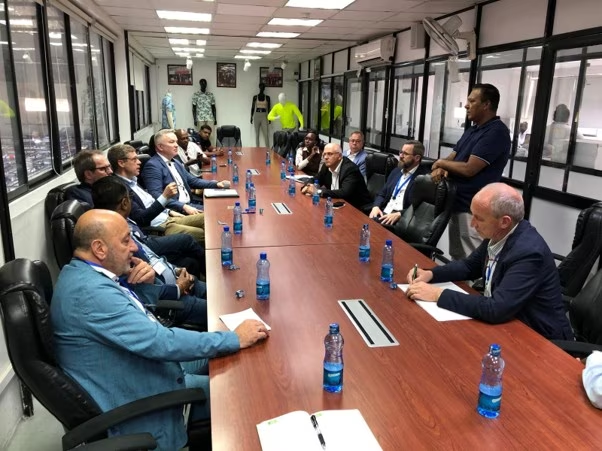
The main weaknesses vary considerably from country to country. In some markets, political instability, corruption and insufficient legal certainty make long-term industrial investment more difficult. Other major constraints include unreliable energy and water supplies, high energy prices and weaknesses in transport and industrial infrastructure.
The large-scale import of used clothing is another serious challenge, as it can put substantial pressure on local textile and apparel producers and reduce incentives to invest in domestic manufacturing.
Financing is equally critical. Where inflation and interest rates are high, the cost of borrowing can severely restrict access to external finance for capital-intensive textile machinery. Yet precisely these investments are needed in countries such as Kenya and Ethiopia to close gaps in the textile value chain.
Developing integrated production from spinning through weaving or knitting, dyeing and finishing to apparel and home textiles would offer important advantages: it could reduce foreign-exchange requirements, improve quality control, shorten lead times and strengthen security of supply. A stronger upstream textile industry would also enhance the competitiveness of downstream garment manufacturing and help safeguard and create urgently needed industrial jobs.
At the same time, African producers must compete with established suppliers from Asia and other regions. Building complete and internationally competitive value chains therefore requires not only modern machinery, but also reliable framework conditions, skilled personnel, efficient infrastructure and a coherent long-term industrial strategy.
German Textile Machinery Can Support Integrated African Value Chains
How can German textile machinery manufacturers support Africa in moving beyond raw-material and garment exports towards spinning, weaving, knitting, dyeing, finishing and higher-value textile production?
VDMA member companies can support African textile manufacturers far beyond the supply of machinery, components and software. Their technologies combine high resource efficiency in energy, water and materials with productivity, durability, consistent quality and reliable after-sales service.
Drawing on extensive process expertise, they can advise customers on the design of complete production lines, the optimisation of existing plants, automation and digitalisation, quality management and the selection of the most suitable technology for local raw materials, products and operating conditions.
Many companies also offer product and application trials at their technology centres in Germany, enabling customers to test fibres, fabrics and processes before making major investment decisions.
Training for operators and maintenance personnel, commissioning support, preventive maintenance concepts, spare-parts availability and remote services can further help manufacturers achieve stable production and a high level of machine availability.
Read More: The Walter Reiners Foundation of The VDMA: Awards For Outstanding Achievements
German suppliers can also contribute to feasibility studies, energy and water audits, recycling and circular-economy solutions, and cooperation with local training institutions. In this way, they can act as long-term technology partners in building competitive, resource-efficient and increasingly integrated textile value chains in Africa.
As in many markets, building long-term, trust-based business relationships in Africa requires patience, perseverance and a high degree of flexibility. German and European companies should take this into account in their market approach and long-term engagement.
Kenya Shows Industrial Potential but Needs Long-Term Investment Certainty
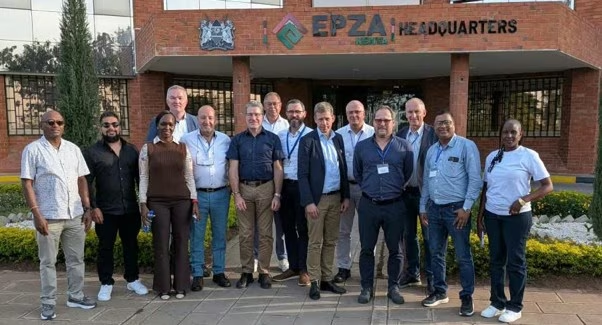
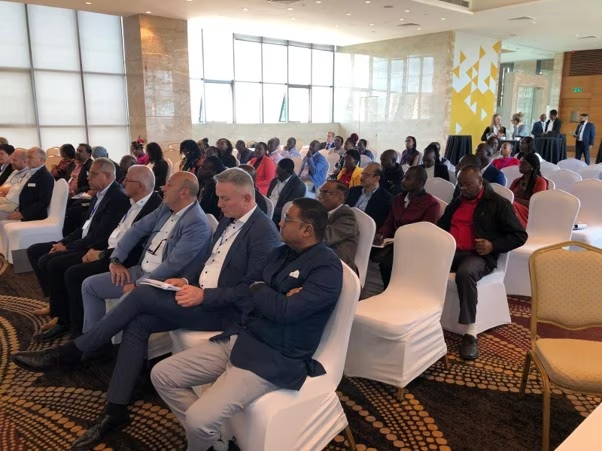
VDMA’s recent German textile machinery delegation to Kenya brought together representatives from eight member companies:
- Erhardt+Leimer GmbH
- Trützschler Group
- Textechno Herbert Stein GmbH & Co. KG
- Thies GmbH & Co. KG
- BRÜCKNER Textile Technologies
- KERN LIEBERS
- A. Monforts Textilmaschinen GmbH & Co. KG
- Xetma Vollenweider GmbH.
Following the recent German textile machinery delegation to Kenya, what did you learn about the country’s industrial capabilities and challenges, and how realistic is Kenya’s ambition to become a stronger textile manufacturing hub in East Africa?
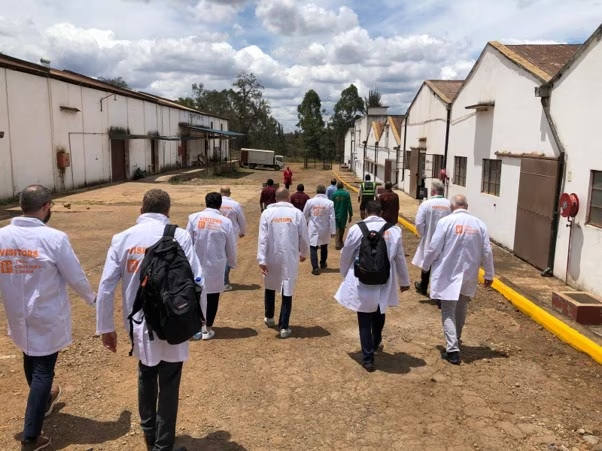
The delegation confirmed that Kenya has a genuine industrial base and considerable ambition to strengthen its textile and apparel sector. The various company visits also demonstrated how differently Kenyan manufacturers are positioned.
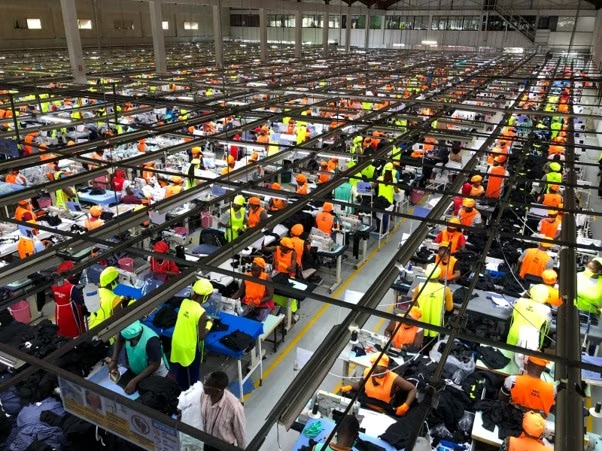
Some companies mainly serve the domestic market or neighbouring countries, while others are integrated into international apparel groups and export primarily to the United States. This diversity reflects both the capabilities already present in Kenya and the different conditions under which companies operate.
For export-oriented manufacturers, the continuation of the African Growth and Opportunity Act (AGOA) beyond 2028 appears to be of existential importance. A long-term extension would preserve preferential access to the US market and could provide a powerful incentive for further investment in Kenya.
If companies can rely on this market access over a sufficiently long period, they are more likely to consider backward integration and invest in upstream capacities ranging from spinning and weaving or knitting to dyeing and finishing.
Such decisions require a high degree of planning certainty because textile machinery and integrated textile production are highly capital-intensive and investments must be calculated over many years.
Predictable trade conditions therefore need to be accompanied by reliable energy supplies, competitive financing, suitable infrastructure, skills development and a consistent industrial policy.
If these framework conditions are addressed and long-term access to key export markets is secured, Kenya has a realistic opportunity to deepen its textile value chain, reduce its dependence on imported yarns and fabrics, create industrial jobs and strengthen its position as a textile manufacturing hub in East Africa.
The German government could also provide valuable support, for example through GIZ (German Society for International Cooperation, the main development agency of Germany).
From VDMA’s perspective, textile-related development projects should take a broader value-chain approach and address upstream textile production—not only garment manufacturing.
Supporting investment, skills and sustainable production in spinning, weaving, knitting, dyeing and finishing would help strengthen the industrial base on which a competitive apparel sector ultimately depends.
ITMA 2027 to Connect Africa and the Middle East with German Textile Technology
With ITMA 2027 taking place in Hanover, Germany, what initiatives is VDMA planning to attract textile manufacturers and decision-makers from Africa and the Middle East? Will there be dedicated delegations, factory visits or networking programmes for these regions?
ITMA is the world’s leading trade fair for textile machinery and is therefore also of outstanding importance for textile manufacturers and decision-makers from Africa and the Middle East.
ITMA 2027 in Hanover will give visitors the opportunity to experience the entire textile value chain in one place—from spinning, weaving and knitting to dyeing, finishing, garment manufacturing, automation, digitalisation, recycling and resource-efficient production.
For companies planning to modernise their plants, close gaps in their value chains or invest in higher-value production, the fair offers a unique platform to compare technologies, discuss concrete projects with machinery manufacturers and establish long-term partnerships.
In close coordination with its partners, VDMA intends to welcome delegations from around the world, including Africa and the Middle East. Even before the fair opens, these delegations will be guided to the production sites and technology centres of exhibiting VDMA member companies as well as to renowned German textile research institutes.
This will give participants first-hand insights into modern manufacturing, practical applications, research and development, and the performance of German textile technology under real operating conditions.
During ITMA itself, VDMA will support dialogue and networking between international manufacturers, technology suppliers, research organisations and other industry partners.
The objective is not simply to attract visitors to Hanover, but to help African and Middle Eastern companies prepare their visits effectively, identify suitable technologies and contacts, and turn their participation into concrete investment and cooperation projects.
For Africa in particular, ITMA 2027 can provide an important impetus for building more competitive, integrated and resource-efficient textile value chains.
Editor’s Note
The interview highlights a central issue for Africa’s textile development: the opportunity is substantial, but competitive growth depends on building complete industrial ecosystems rather than isolated production capacity.
Reliable energy, financing, infrastructure, skills and access to modern technology will all influence how successfully individual markets can move from raw-material production and garment assembly towards integrated textile manufacturing.
Read More: Kenya’s Apparel Industry Gains Trade Certainty as US Senate Backs AGOA Extension to 2028
For German textile machinery suppliers, this transition also creates opportunities to build longer-term technology partnerships in areas ranging from spinning, weaving and knitting to dyeing, finishing, automation and resource-efficient production.
With ITMA 2027 in Hanover approaching, VDMA’s delegation and networking initiatives could provide another platform for connecting African and Middle Eastern manufacturers with German technology, research and industrial expertise.