


Kusters Calico has built its position in textile machinery around one of the most demanding areas of textile production: wet processing.
From singeing and mercerizing to bleaching, washing, dyeing and finishing, the company develops machinery and process concepts for both woven and knitted fabrics, with a strong emphasis on process control, resource efficiency and consistent fabric quality.
Based in India, Kusters Calico Machinery Pvt. Ltd. manufactures textile processing ranges as well as machinery for the flexible packaging industry. Its textile portfolio covers several stages of preparation, dyeing and finishing, allowing mills to combine individual machines into complete processing lines according to their production requirements.
The company states that it has representation in more than 25 countries, supported by an international network for sales, installation, commissioning and after-sales service.
But what exactly does Kusters Calico offer to textile manufacturers, and where do its technologies fit into a modern dyeing and finishing plant?
From Singeing to Finishing: A Broad Wet Processing Portfolio
One of the distinguishing characteristics of Kusters Calico is the breadth of its wet-processing portfolio.
Its textile machinery programme includes singeing, mercerizing, vacuum treatment, continuous bleaching, bleaching and dyeing steamers, washing systems, CPB dyeing equipment, finishing padders and specialised solutions for knitted fabrics.
Rather than focusing on a single machine, the portfolio addresses multiple stages of fabric preparation and processing. This makes it possible to configure lines for different fabrics, process sequences and production capacities.
Among the technologies presented by the company are:
- Singeing systems
- Mercerizing ranges
- Vacuum Slot technology
- Contidos dosing systems
- Bleaching steamers
- Dyeing steamers
- Compacta, Super Flush and Flush Master washing concepts
- Steep Master
- S-Roll dye padders for CPB dyeing
- S-Roll finishing padders
- Woven processing layouts
- Open-width knitted fabric processing systems
- Water Jet washing
- Knit bleaching systems
- Twin Shaft Applicators
- Knit drum washing with tension control
- Knit dye padders
This range shows that Kusters Calico is positioned primarily around continuous wet processing rather than isolated finishing operations.
Read More: Continuous Wet Processing Is the Future of Sustainable Textile Manufacturing
Singeing: Preparing a Cleaner Fabric Surface
Singeing is one of the first preparation processes for many woven fabrics. Its purpose is to remove protruding fibres from the fabric surface by exposing them to a controlled flame.
The Kusters Calico concept combines pre-brushing, the singeing unit and post-brushing.
Before singeing, four nylon/Mexican-fibre brushes lift protruding fibres to improve their exposure to the flame. After treatment, brushing and beater rollers are used to remove ash and burnt particles, supported by vacuum channels.
The burner itself is designed to provide a uniform flame across the fabric width, with adjustable flame intensity, automatic ignition, flame-failure protection and rapid flame extinguishing.
Depending on the fabric, the system can operate in different configurations.
In the standard singeing position, the flame meets the freely guided fabric at a right angle. For temperature-sensitive materials, singeing can take place while the fabric passes over a water-cooled roller. A tangential arrangement is also available for fabrics that cannot tolerate direct flame exposure.
The catalogue specifies working widths from 1,600 to 3,400 mm, roll face widths from 1,800 to 3,600 mm, and fabric speeds of up to 120 m/min.
Mercerizing: Chain and Chainless Concepts
Mercerizing remains an important treatment particularly for cotton fabrics, influencing properties such as dimensional behaviour, dye affinity, appearance and subsequent processing.
Kusters Calico presents both chain and chainless mercerizing concepts.
In the chainless configuration, stainless-steel housing sections and roller arrangements guide the fabric through impregnation and stabilisation. Counter-flow washing, circulation systems and water-spray pipes are incorporated to support caustic recovery and removal.
The chain mercerizing concept uses two 12-metre chain rails and can work with pin, clip or combination arrangements. The catalogue describes self-lubricated chains, width adjustment through geared motors, photocell-based edge guiding and multiple water-spray pipes for chemical removal.
The system also incorporates a lye recuperator. According to the company, this can allow wash water from subsequent washing sections to be reused where appropriate, creating an opportunity to improve chemical and water management within the overall process.
Vacuum Slot: Removing Water Without Conventional Squeezing
One of the more interesting technologies in the portfolio is the Vacuum Slot.
Instead of relying solely on mechanical squeezing, vacuum is applied across the fabric to remove liquid.
Kusters Calico lists potential applications including dewatering, washing, finishing, dyeing and lint removal.
In washing processes, the principle can help separate highly contaminated liquor, increase the concentration gradient in subsequent washing stages and potentially recover sizing materials or chemicals.
Another important consequence is lower residual moisture before downstream drying.
Reducing the amount of water carried by fabric into a dryer or stenter can directly influence the thermal load required in the next process. This makes dewatering technology particularly relevant when mills are looking beyond individual machine efficiency and considering energy consumption across the entire finishing line.
The company also highlights the absence of conventional squeezing as an advantage for fabric handle, particularly in certain fibre compositions.
Continuous Bleaching and Steamer Technology
Bleaching is another major part of the Kusters Calico portfolio.
The company’s bleaching ranges combine chemical application, heating, steaming and controlled dwell time. The objective is to provide sufficient reaction time while maintaining controlled fabric transport.
Kusters Calico offers different steamer configurations, including Two-Level Steamers and Rollerbed Steamers.
The Two-Level Steamer uses tight-strand fabric guidance and multiple driven pulling rollers with pendulum compensators to maintain low fabric tension, particularly for sensitive materials.
The Rollerbed concept combines tight-strand sections with a rollerbed that provides fabric storage and reaction time within a relatively compact machine configuration.
The catalogue shows examples of continuous bleaching lines operating at speeds of up to 120 m/min, while two-step continuous bleaching layouts are shown at up to 100 m/min.
Precise Chemical Dosing with Contidos
Chemical preparation and dosing have a major influence on reproducibility in continuous wet processing.
Kusters Calico’s Contidos Dosing System for Bleaching continuously produces treatment liquor from water and separately dosed auxiliaries.
Components are blended in a mixer before being delivered to the padder or shaft applicator, with auxiliary quantities determined according to the process recipe and fabric weight.
A similar principle is applied to CPB – Cold Pad Batch – dyeing.
In the CPB configuration, dye solution and auxiliaries are prepared separately before homogeneous mixing and delivery to the dye padder. The system incorporates liquor pick-up measurement, consumption recording, automatic operation and dosing control.
The company also highlights rapid colour changes and reduced liquor losses as objectives of the system.
For modern dyehouses, this type of controlled dosing is increasingly important because chemical accuracy is connected not only to colour reproducibility but also to waste reduction and process consistency.
Read More: Yarn Dyeing Bobbins: Reforming Instead of Discarding
Dyeing Steamers and Controlled Fabric Tension
For continuous dyeing, Kusters Calico offers dyeing steamers designed to maintain saturated steam conditions while controlling fabric movement and tension.
The system incorporates adjustable pneumatically controlled compensator rollers, while driven components are intended to maintain consistent fabric tension despite variations in machine speed.
Other design elements include temperature-controlled water locks, heated roofs to reduce condensation droplets and specialised inlet and outlet arrangements designed to minimise unnecessary steam losses.
The catalogue specifies working widths from 1,600 to 3,400 mm and fabric contents of 40, 60, 80 or 100 metres, depending on configuration.
Washing Technology: Why Water Efficiency Matters
Washing is one of the most water-intensive stages of textile wet processing, making machine design increasingly important for both operating cost and environmental performance.
The Super Flush concept combines surface washing, penetration and counter-flow liquor circulation.
According to Kusters Calico, the system uses relatively small trough contents and high circulation rates to optimise the relationship between washing performance, water consumption and energy use.
The published technical data lists working widths of 1,600–3,400 mm, fabric content of approximately 20 metres, liquor content of around 530 litres for a 1,800-mm working width, and recommended operating speeds between 10 and 100 m/min.
The system is designed to create turbulent washing in the cascade troughs and at the fabric surface while also promoting penetration through the textile structure.
This is particularly relevant because efficient washing is not simply a question of adding more water. The effectiveness of liquor exchange, concentration gradients, penetration and mechanical action can be equally important.
Dedicated Processing Concepts for Knitted Fabrics
Kusters Calico also separates knitted fabric processing from conventional woven-fabric treatment.
Its Soft Knit concept is based on open-width processing, with the company highlighting advantages such as reduced crush marks, more even dyeing and finishing, lower elongation, reduced pilling and curling, and lower fabric wastage.
The portfolio includes Water Jet washing, knit bleaching, Twin Shaft application, drum washing with tension control and S-Roll dye padders.
The Water Jet concept uses spray technology combined with direct steam injection into the liquor circulation system and wide-jet nozzles. It is intended for washing following bleaching, dyeing and mercerizing.
For bleaching knitted fabrics, the company places particular emphasis on low-tension transport and controlled dwell time. The associated Twin Shaft Applicator is designed to provide uniform chemical application across the fabric width before steaming.
This focus on tension is important because knitted structures can be considerably more sensitive to stretching and deformation during wet processing than many woven fabrics.
Beyond Textile Wet Processing
Kusters Calico’s activities are not limited to conventional textile finishing.
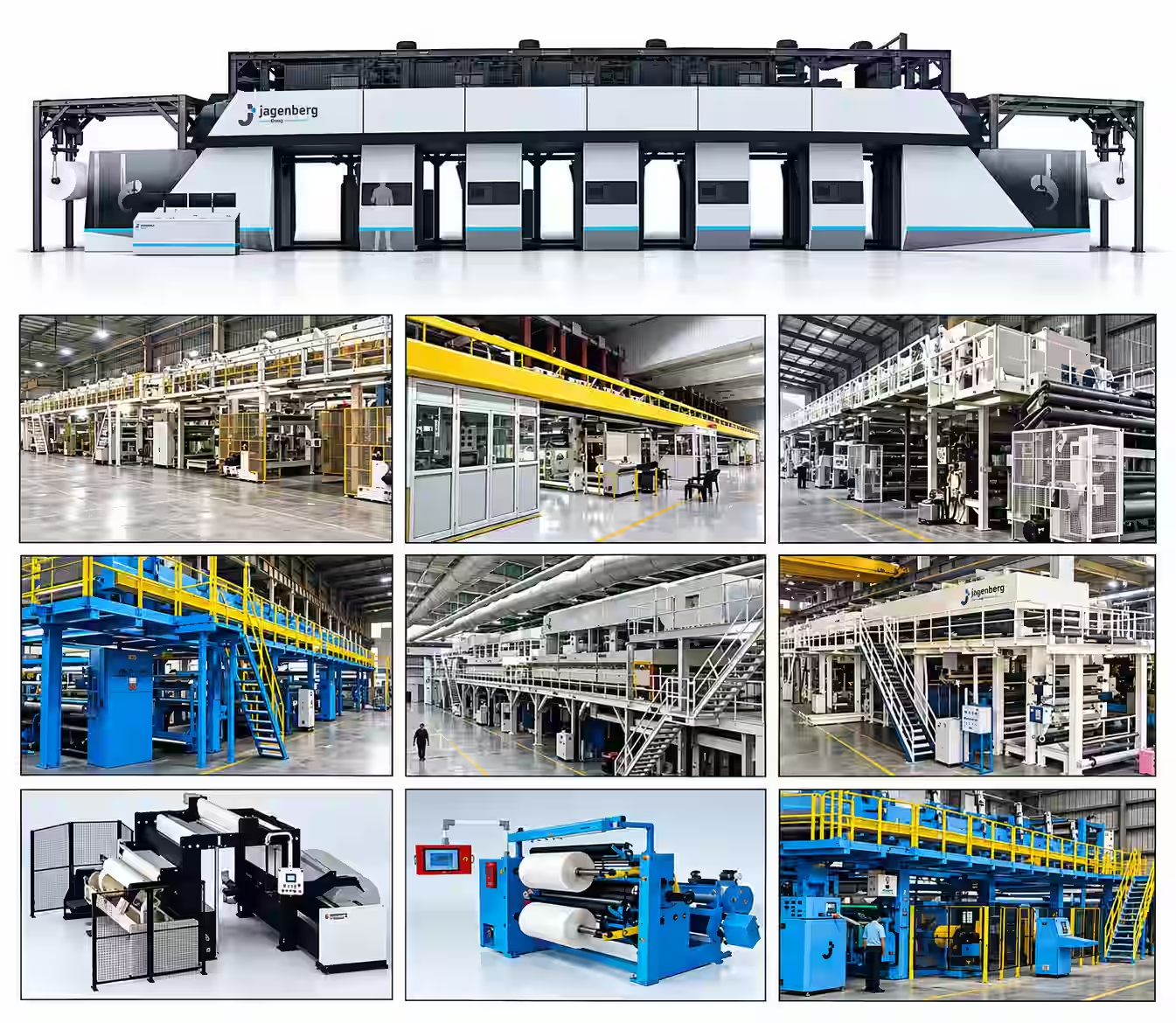
The company also manufactures machinery for coating, lamination and converting applications. Its portfolio includes lacquer coating, PVdC coating, print-receptive coating, extrusion coating, UV coating, barrier coating, silicone and PSA coating lines, optical-film coating, wet and dry lamination, window-film coating, Li-ion coating, photovoltaic coating, rotogravure printing and slitter-rewinder machinery.
This broader engineering background places the company at the intersection of textile processing, coating technology and industrial converting.
Manufacturing and International Presence
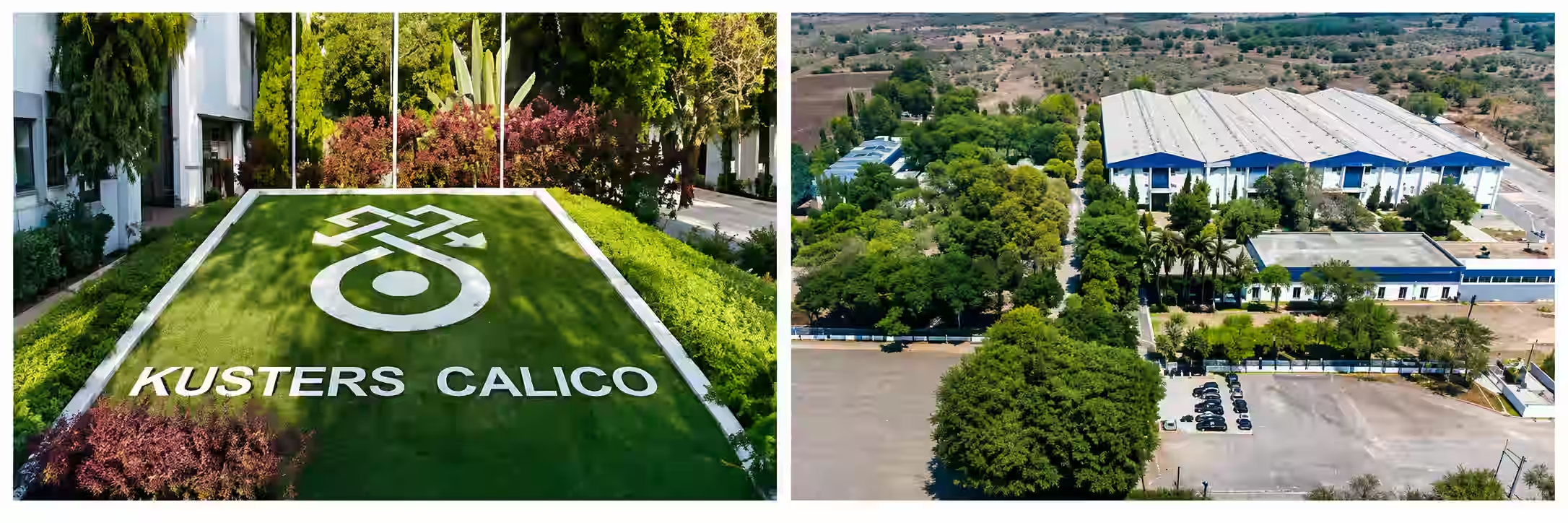
Kusters Calico Machinery Pvt. Ltd. manufactures its equipment in India and describes its approach as combining process know-how, machine design, manufacturing, automation, installation and service.
The company says its machines are installed internationally and that it maintains representation in more than 25 countries.
Its catalogue also emphasises in-house automation, precision manufacturing, internationally sourced components, spare-parts availability and installation and commissioning support as important elements of its business model.
Kusters Calico is presented as part of the Jagenberg Group, within a broader industrial structure covering machinery and plants, automation and drives, and digital solutions.
Where Kusters Calico Fits in the Modern Textile Mill
Perhaps the most important point about Kusters Calico is that its portfolio should not be viewed as a collection of unrelated machines.
Singeing improves the fabric surface before subsequent preparation. Mercerizing changes fabric properties and prepares cotton for further processing. Controlled bleaching establishes the required whiteness and absorbency. Accurate dosing influences reproducibility. Washing removes residual chemicals and unfixed dyestuff. Vacuum extraction reduces the amount of water transferred downstream. Steamers provide controlled reaction conditions, while tension-management systems become increasingly important when processing delicate woven and knitted structures.
Together, these technologies address a central challenge facing today’s dyeing and finishing sector: how to maintain fabric quality while controlling water, chemicals, energy, production time and process variability.
For mills evaluating new wet-processing investments, the discussion is therefore moving beyond maximum machine speed alone. Water consumption, liquor volumes, chemical accuracy, residual moisture, tension control, automation, maintenance and integration between individual process stages increasingly determine the real operating performance of a line.
Kusters Calico’s portfolio reflects this broader approach to textile wet processing, covering the journey from fabric preparation through bleaching, washing, dyeing and finishing while offering separate concepts for both woven and knitted materials.