Direct Drives, Higher Productivity, and Smarter Automation Signal the Next Step for Modern Spinning Mills
At ITM 2026 Istanbul, one message echoed across the spinning machinery halls: productivity alone is no longer enough. Today’s spinning mills demand higher efficiency, lower energy consumption, reduced labor dependency, and greater flexibility—all without compromising yarn quality.
Among the companies presenting a comprehensive response to these challenges was Saurer, one of the world’s most established names in spinning technology. During an exclusive interview at the exhibition, Cem Yalcin, CSO Global Sales at Saurer Group, shared the company’s latest developments, emphasizing that every new machine introduced at ITM was designed to help textile manufacturers produce more efficiently while reducing operational costs.
A New Generation Ring Frame Without Belts
Turkey remains one of Saurer’s strategic markets, making ITM an important platform for launching its latest technologies.
According to Cem Yalcin:
“Turkey is a very important market for us.”
One of the exhibition’s highlights was Saurer’s new SIN 251 ring frame, featuring a completely redesigned drive concept.
Instead of conventional belt transmission, the machine uses a direct electronic drive, operating at speeds of up to 30,000 rpm.
Removing belts offers multiple advantages beyond maintenance reduction. It enables more precise speed control, improved machine stability, and greater operational efficiency. More importantly, Saurer has combined this new drive system with its latest compact spinning technology.
“With the new compact system, we can reduce twist and increase productivity.”
For spinning mills producing finer yarns, this represents a significant opportunity to increase output while maintaining yarn quality.
Lower Twist, Higher Productivity
One of the most notable technical points raised during the interview concerns yarn twist.
In many spinning applications, reducing twist below certain levels has traditionally been difficult without affecting yarn performance.
Yalcin explained that Saurer’s new ring frame allows mills to operate at lower twist values than previously possible.
This capability translates directly into:
- Higher spinning productivity
- Faster production speeds
- Improved mill efficiency
- Greater competitiveness in demanding yarn markets
Rather than simply increasing spindle speeds, Saurer appears focused on optimizing the entire spinning process.
Read more: Saurer Group Strengthens Position in African Market at ITMA Asia + CITME 2024
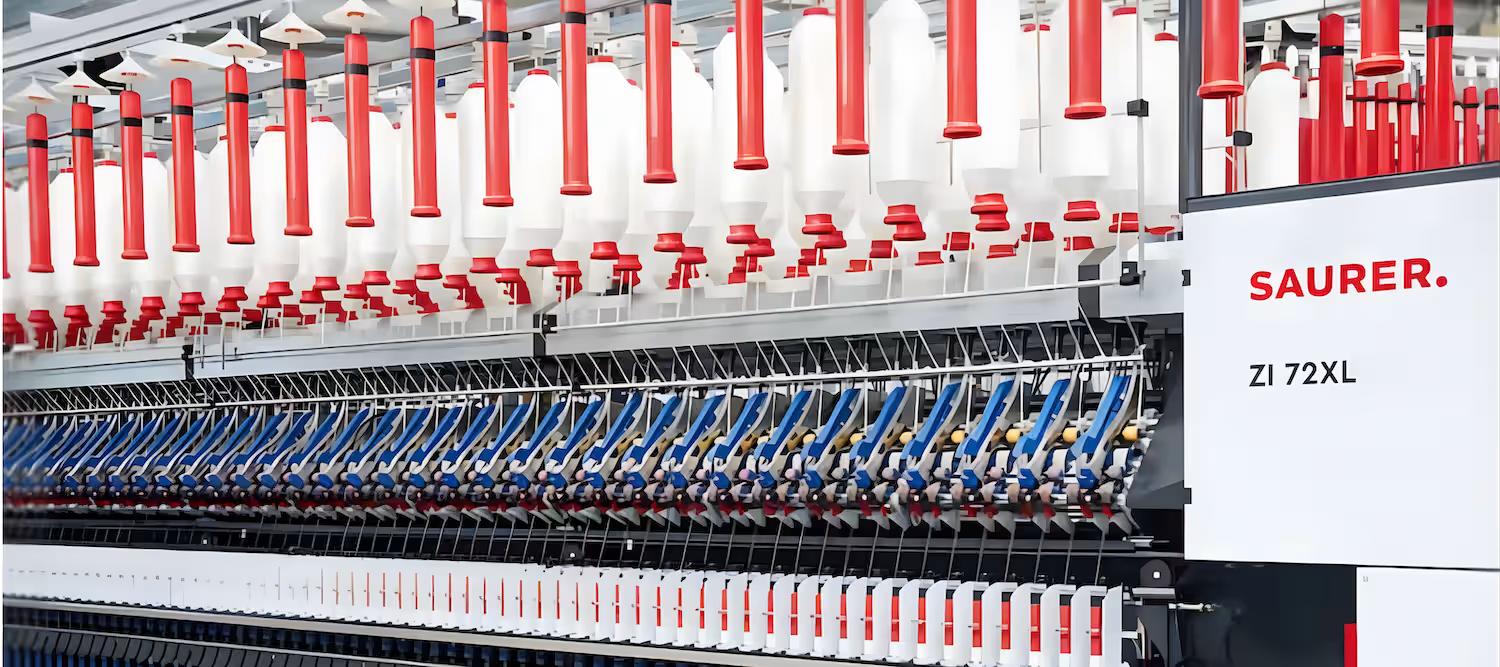
Open-End Spinning Moves to 720 Positions
Saurer also showcased its latest open-end spinning machine, capable of operating with up to 720 spinning positions.
According to Cem Yalcin, the machine combines several improvements into one integrated platform.
“We have energy saving, high flexibility, and integrated automation within the machine, which also allows savings in operators.”
Labor shortages continue to challenge textile manufacturers worldwide. By integrating automation directly into the machine rather than relying on external systems, Saurer aims to reduce manual intervention while increasing overall operational stability.
Yalcin also reaffirmed the company’s confidence in its position within premium open-end spinning.
“In the high-end segment, we are the leader when it comes to open-end, and we continue protecting that position through innovation.”
Carding Performance Meets Cost Efficiency
Another major launch at ITM 2026 was the new Autocoro Card 8 carding machine. Designed for both ring and rotor spinning applications, the machine features what Saurer describes as one of the industry’s largest carding areas.
According to the company, the system is capable of reaching:
- Up to 100 kg/hour for ring spinning applications
- Up to 200 kg/hour for open-end spinning applications
Beyond production capacity, Saurer is also targeting investment efficiency.
As Cem Yalcin noted:
“The carding machine performs extremely well and is very attractive from a price-performance perspective.”
This reflects an increasingly important purchasing criterion in today’s textile industry, where mills seek the highest return on investment rather than simply the highest specifications.
Technology That Addresses Today’s Challenges
Across all three product launches, a common strategy becomes clear. Instead of focusing solely on higher production speeds, Saurer is developing technologies that solve several challenges simultaneously:
- Rising labor costs
- Energy efficiency
- Lower maintenance requirements
- Production flexibility
- Consistent yarn quality
- Faster return on investment
This integrated approach reflects the broader transformation currently taking place in the global spinning industry.
Read more: Saurer: Recycling, Automation and the Journey Toward the Dark Mill
Editor’s Insight
Walking through ITM 2026, one trend became increasingly evident: machine builders are no longer competing only on mechanical performance. Today’s competition revolves around productivity per kilowatt, automation per operator, and profitability per spindle.
Saurer’s latest developments clearly follow this direction. Whether through direct-drive ring frames, larger open-end systems with built-in automation, or high-capacity carding technology, the company is positioning itself to help mills produce more with fewer resources.
In a market where investment decisions are becoming increasingly cautious, technologies that combine productivity, efficiency, and attractive operating economics are likely to define the next generation of successful spinning mills.