Nigeria’s textile industry is facing mounting pressure as imported fabrics from China, India and Pakistan continue to strengthen their presence in the domestic market, highlighting persistent weaknesses in the country’s cotton-to-textile value chain.
The challenge is particularly significant in northern Nigeria, historically the heart of the country’s cotton cultivation and textile manufacturing. States including Kano, Kaduna, Katsina, Zamfara, Gombe and Bauchi once supported an extensive ecosystem connecting cotton farmers, ginneries, textile mills, garment producers, traders and regional markets.
Today, however, imported textiles increasingly compete with locally manufactured fabrics on price, variety and availability.
Suleiman Umar, Managing Director of Tofa Textile Limited in Kano, recently highlighted the growing dependence on imported textiles and the difficulties Nigeria continues to face in rebuilding an integrated cotton and textile value chain.
Despite Nigeria’s comparative advantages in cotton production, the country continues to import substantial volumes of fabrics and finished textile products that could potentially be manufactured domestically.
Read more: Nigerian Government Launches Textile Revival Plan to Create 1.5 Million Jobs
Imported Fabrics Gain Ground in Nigerian Market
Textile traders are seeing increasing volumes of fabrics originating from major Asian manufacturing countries, particularly China, India and Pakistan.
Imported materials have become attractive because of their wide variety, consistent availability and competitive pricing. Nigerian textile manufacturers, meanwhile, must compete against overseas producers operating with larger production scales, more reliable energy supplies and highly developed supply chains.
The result is a difficult cycle for the domestic industry. As imported textiles gain market share, local factories face weaker demand. Falling textile production subsequently reduces industrial demand for locally grown cotton, limiting incentives for farmers and processors to invest.
Over time, this has contributed to the fragmentation of a value chain that once connected northern Nigeria’s cotton-growing regions directly with domestic textile manufacturing.
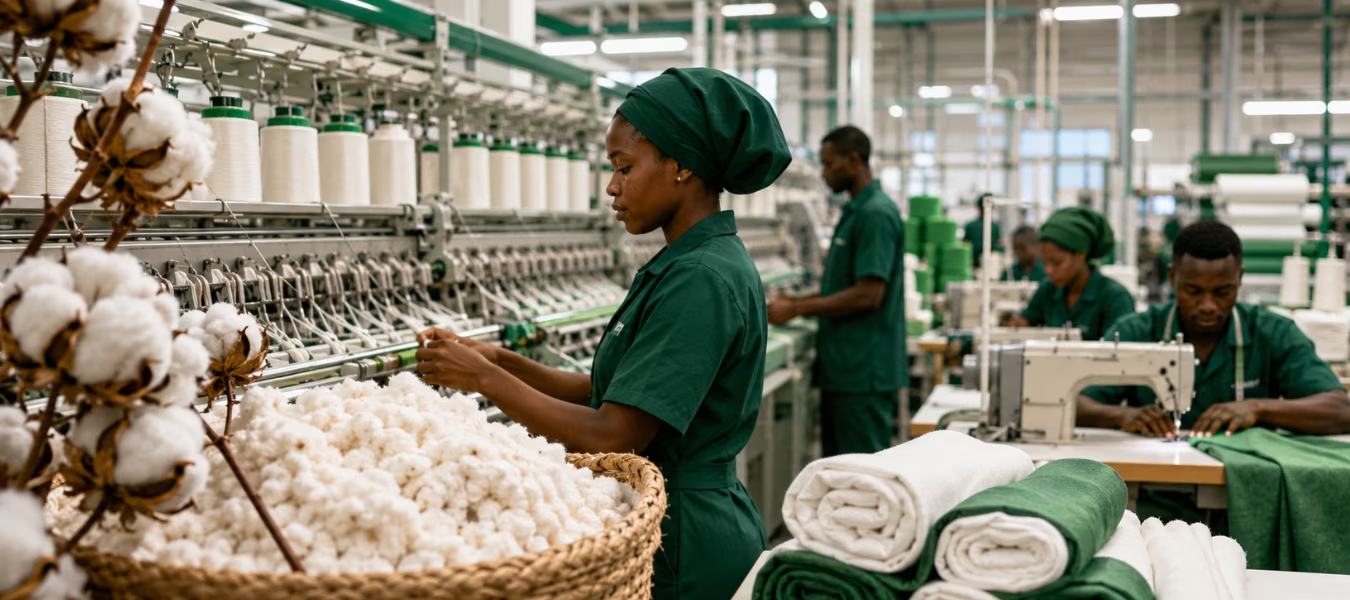
Northern Nigeria Holds Significant Cotton Potential
Northern Nigeria still possesses substantial agricultural advantages.
Its cotton-growing belt extends across states including Zamfara, Katsina, Kano, Adamawa, Gombe, Bauchi, Borno, Kebbi, Sokoto, Yobe, Niger and Kaduna. Recent USDA estimates also indicate that cotton production remains concentrated in northern states, with Zamfara, Katsina, Kano, Adamawa and Gombe among important producers.
However, agricultural capacity alone has not translated into a competitive textile manufacturing sector.
This is becoming increasingly evident when Nigeria is compared with neighbouring Benin, which has been developing an industrial strategy designed to capture more value from domestically produced cotton.
USDA data cited in the source estimate Benin’s cotton cultivation area at approximately 510,000 hectares for the 2025/26 season, with production of around 1.15 million 480-pound bales and an average yield of 491 kilograms per hectare.
Benin Offers an Alternative Textile Model
One of the clearest examples is Benin’s Glo-Djigbé Industrial Zone.
The industrial development is designed to connect multiple stages of textile manufacturing, allowing locally produced cotton to progress through ginning, spinning, weaving and dyeing toward finished products.
Such integration enables a producing country to capture substantially more value domestically rather than relying primarily on the sale or export of cotton as a raw commodity.
Northern Nigeria could pursue a similar strategy by developing industrial corridors connecting cotton farms with ginneries, spinning and textile mills, garment factories, logistics companies and both domestic and export markets.
This approach could also generate employment beyond textile factories, creating opportunities in machinery maintenance, transportation, warehousing, packaging, fashion, design, marketing and retail.
Energy and Machinery Remain Major Challenges
Restricting textile imports alone is unlikely to restore the competitiveness of Nigeria’s textile industry.
Reliable and affordable electricity remains one of the sector’s biggest requirements. Spinning, weaving, dyeing and finishing are energy-intensive processes, and dependence on expensive alternative power sources increases manufacturing costs.
Modernisation is another challenge. Surviving textile companies often have to contend with ageing machinery, expensive spare parts and limited working capital, making it difficult to achieve the productivity levels of larger international competitors.
Access to long-term industrial financing is equally important because textile manufacturing requires significant investment in machinery, energy, raw materials and inventory.
Read more: ONCHEK: Nigerian Startup Rewires Africa’s Fashion Supply Chain Through Local T-Shirt Manufacturing
Rebuilding Nigeria’s Cotton-to-Textile Chain
A sustainable revival will therefore require coordinated investment throughout the value chain.
Cotton farmers need improved varieties, mechanisation, inputs and extension services, while ginneries require investment and reliable customers. Textile manufacturers need modern machinery, competitive energy and financing, while garment producers require quality fabrics, design capabilities and strong distribution networks.
Nigeria’s opportunity extends beyond replacing imported fabrics. A revitalised textile industry could stimulate demand across agricultural machinery, industrial equipment, chemicals, packaging, transportation, warehousing, energy and financial services while creating more dependable markets for cotton farmers.
For northern Nigeria, the long-term objective will be to reconnect the entire industrial chain—from cotton cultivation to fibre, yarn, fabric, garments and eventually Nigerian and African textile brands.
Without that integration, Nigeria risks remaining heavily dependent on imported textiles despite possessing significant cotton resources and a long-established textile heritage.