Interview with Mr. Muktar Dodo, Global Standards Representative in Africa
Africa’s textile and apparel industry is shifting toward greater value addition, regional integration, traceability and sustainable production. With AfCFTA, evolving global sourcing strategies and stricter sustainability requirements reshaping the market, certification is becoming increasingly important.
Three years after our previous conversation, Kohan Textile Journal speaks again with Muktar Dodo, Global Standards Representative in Africa, about Africa’s progress as a sourcing destination, emerging textile hubs, GOTS and GRTS, and the opportunities and challenges shaping the industry toward 2030.

1. What have been the most important changes in Africa’s textile and apparel industry over the past three years?
Over the past three years, Africa’s textile and apparel industry has been undergoing an important shift from exporting raw materials and competing primarily on cost toward value addition, regional integration, sustainability and market-driven standards. The implementation of African Continental Free Trade Area (AfCFTA) has strengthened interest in developing regional textile value chains, while the harmonisation of African standards through the African Organisation for Standardisation (ARSO) is increasingly providing the common technical foundation needed for African producers to compete, conform and connect to larger markets. At the same time, continued uncertainty around preferential access under the African Growth and Opportunity Act (AGOA) has reinforced the importance of diversifying markets and strengthening Africa’s domestic and regional demand.
Sustainability has also moved from being largely a voluntary consideration to becoming an increasingly important factor in regulation, market access and international competitiveness, particularly as major markets such as the EU introduce requirements relating to traceability, chemicals, circularity, due diligence and product information.
The growth of credible certification reflects this trend: in 2025, GOTS-certified facilities worldwide grew by 15.3% to 17,800, with Africa now accounting for approximately 627 certified facilities. The launch of our new Global Responsible Textile Standard (GRTS) further expands opportunities for responsible textile production across different fibre types.
Overall, Africa is increasingly recognising that standards, certification, traceability and sustainability are not simply compliance requirements but tools for attracting investment, adding value to African fibres and connecting the continent’s textile industry to global markets.
2. In our previous interview, you mentioned Africa’s potential to emerge as an important global textile and apparel sourcing hub. Three years later, how do you evaluate this progress, and which countries are currently leading?
Three years on, I would say Africa has made meaningful progress, but it has not yet emerged as a single, integrated global sourcing hub; rather, several distinct sourcing hubs are developing across the continent:
Morocco and Tunisia are particularly well positioned for European near shoring because of their proximity, established manufacturing bases and ability to serve shorter lead-time orders, while Egypt is strengthening its position through scale, cotton resources and increasingly integrated spinning, textile and garment production. Egypt’s ready-made garment exports rose from $2.41 billion in 2023 to $3.39 billion in 2025.
In sub-Saharan Africa, Kenya remains one of the strongest established apparel-export platforms, with textile and apparel exports reaching a record KSh66.9 billion in 2025 and more than 82,000 formal sector workers. Ethiopia has also developed significant manufacturing capacity around its industrial parks and continues to position itself as a regional sourcing destination, although the sector has faced macroeconomic and market-access challenges.
Madagascar and Mauritius remain important established exporters, while Ghana, Benin and other West African countries are increasingly interesting because of their efforts to move from cotton and other fibre production toward local processing and garment manufacturing.
What has changed most is that the conversation is becoming less about simply finding the lowest-cost African production base and more about building sourcing ecosystems that combine competitive manufacturing, proximity to markets, reliable infrastructure, sustainability, standards, traceability and regional market access through AfCFTA.
Kenya’s record performance, Egypt’s export growth and the continued development of Morocco, Tunisia and Ethiopia suggest that the opportunity identified three years ago is becoming more tangible, but Africa’s next step is to connect these individual hubs into stronger continental value chains rather than viewing them as isolated national industries.
3. Following your activities in Nairobi, how do you evaluate Kenya and East Africa’s potential as textile, apparel and sustainable sourcing destinations?
Kenya already has an established apparel manufacturing base and experience serving international buyers, while Tanzania, Uganda and Ethiopia offer opportunities to build complementary regional value chains. Importantly, the region also has access to GOTS-certified organic cotton from countries such as Uganda and Tanzania, providing a strong foundation for developing more sustainable and traceable textile production.
It is encouraging to see growing engagement with credible sustainability standards across the region, with Ethiopia showing particularly strong momentum in GOTS certification, while Kenya has significant scope to further develop its certified manufacturing base and sustainability credentials. I see this as a positive opportunity for countries across East Africa to raise their ambitions and demonstrate leadership in sustainable textile production.
East Africa also benefits from the established AGOA third-country fabric provision, which allows qualifying apparel producers in eligible countries to use fabric sourced outside Africa while retaining preferential access to the U.S. market. This can help manufacturers scale while investment in Africa’s upstream textile capacity develops. Going forward, the opportunity is to combine AGOA and AfCFTA market access with responsibly grown African fibres, investment in manufacturing capacity, infrastructure, skills, standards, traceability and certification. If these elements come together, East Africa can develop from individual apparel manufacturing centres into a more integrated and credible regional hub for sustainable textile sourcing.
4. What are the main challenges still preventing Africa from capturing a larger share of global textile and apparel manufacturing?
The biggest challenges are energy, infrastructure, financing and the depth of local textile supply chains. Many African manufacturers still face high and unreliable energy costs, expensive logistics, limited access to affordable long-term capital, and gaps in spinning, weaving, dyeing and finishing capacity, which means that fabrics and other inputs often must be imported. There are also shortages of specialised technical skills and testing and certification infrastructure, while fragmented markets and regulatory and standards differences can make regional trade more difficult.
At the same time, international buyers increasingly expect traceability, sustainability and social compliance, requiring investment that can be particularly challenging for SMEs. Finally, Africa needs to move beyond competing primarily on low labour costs and build competitiveness around productivity, quality, speed to market, sustainable production and value addition.
The opportunity is significant, but capturing a larger share of global sourcing will require coordinated investment across the entire value chain from fibre production and processing to manufacturing, logistics, standards, and market access.
5. How has GOTS certification developed across Africa since our previous interview? Which countries are currently showing the strongest growth or interest?
I would frame the development of GOTS in Africa regionally, because different parts of the continent play different roles in the textile value chain:
In North Africa, Morocco and Tunisia have relatively established garment-manufacturing bases serving international markets, while Egypt has a more vertically integrated industry, with capabilities extending into spinning, weaving and garment manufacturing.
In the Indian Ocean, Mauritius and Madagascar are also important garment-manufacturing centres with established links to international markets.
In East Africa, Tanzania and Uganda have strong foundations in cotton production and ginning, including access to GOTS-certified organic cotton, creating an opportunity to develop more certified spinning, textile processing and garment manufacturing further downstream. Kenya and Ethiopia also present opportunities to expand certified manufacturing capacity, with Ethiopia showing particularly strong momentum in GOTS certification.
West Africa presents a more varied picture: Benin has activity across different stages of the textile value chain, while Burkina Faso remains more concentrated on ginning, highlighting the potential to move further downstream.
Overall, we are seeing growing interest in GOTS as African producers respond to increasing sustainability, traceability and due-diligence expectations from international buyers. The opportunity now is to connect Africa’s certified fibre production with certified processing and manufacturing capacity so that more value from African fibres is captured within the continent.
6. How are increasingly strict sustainability requirements from international brands affecting African textile manufacturers, particularly SMEs?
The key point I would emphasise is that stricter sustainability requirements are both a challenge and a market-access opportunity for African SMEs. The compliance burden can be significant because buyers increasingly expect evidence on environmental performance, chemicals, labour conditions, traceability and supply-chain due diligence not simply a declaration that a product is “sustainable.”
For a small manufacturer, the costs of audits, documentation, testing, staff capacity and process improvements can be difficult to absorb. This is particularly important in Africa, where many SMEs are still developing their management systems and technical infrastructure. At the same time, credible certification can help SMEs turn these requirements into a competitive advantage by providing internationally recognised evidence of their practices. GOTS, for example, covers environmental, social, chemical and traceability requirements across the textile processing chain and uses independent certification.
Recognizing the burden on smaller operators, Global Standards introduced the Controlled Supply Chain Scheme (CSCS) in 2025, which provides a simplified certification pathway for groups of small-scale operators while maintaining the underlying GOTS requirements. The scheme is specifically intended to reduce certification costs and administrative complexity and prevent smaller operators from being excluded from sustainable supply chains.
Ultimately, the challenge is to ensure that rising sustainability expectations do not become a barrier that excludes African SMEs, but instead become an incentive for capacity building, certification and greater integration into international textile value chains.
7. What are the most important updates to the latest GOTS Standard that textile manufacturers should know about?
In March 2026, Global Standards released GOTS Version 8.0. The updated Standard strengthens requirements for air emissions and waste management, as well as criteria for product safety. It introduces new provisions on circularity, microfibre management and updates in residue testing. Version 8.0 also elevates due diligence obligations and formalises governance requirements, including ESG disclosure, anti-corruption policies and conflict-of-interest safeguards, to support credible, responsible business conduct.
The introduction of mandatory due diligence processes is based on OECD guidelines and provides even greater clarity for companies as they navigate heightening regulatory risks.
This was followed by our July 2026 public launch of the Global Responsible Textile Standard (GRTS), a new standard for the processing of textiles made from fibres certified to third-party standards recognised by GRTS and covering a broad range of plant, animal, synthetic, man-made cellulosic and recycled fibres.
GRTS is rooted in the same robust criteria and processes that define GOTS. It is built directly upon the existing GOTS certification infrastructure and extends the same robust environmental and social assurance to a wider range of non-organic but responsible fibres. GRTS marks the next phase in Global Standards’ mission: to ensure the highest level of social and environmental impact in textile value chains.
8. Could new European sustainability, traceability and due-diligence requirements create additional opportunities for GOTS-certified African manufacturers?
Yes, I believe the tightening of European sustainability, traceability and due-diligence requirements can create significant opportunities for GOTS-certified African manufacturers. GOTS provides a strong foundation because it requires certification across the applicable processing and manufacturing stages, combines environmental and social criteria with independent third-party verification, and incorporates a structured risk-based due-diligence approach. It also provides documented traceability through verified product flows and Transaction Certificates.
These features can give African manufacturers credible, independently verified information to demonstrate to European brands how their products are produced and how risks within their supply chains are being managed. GOTS therefore provides a practical foundation for manufacturers seeking to respond to the increasingly demanding sustainability and due-diligence expectations of the European market.
The opportunity becomes even broader with GRTS, which expands the GOTS approach beyond organic fibres to a wider range of textile materials. GRTS provides a traceable, whole-value-chain approach from farm to finished product and is designed to support companies in addressing evolving regulatory requirements, including areas such as due diligence, sustainability reporting, ecodesign and the Digital Product Passport, and forced labour. For African manufacturers, this creates an opportunity to use internationally recognised certification as part of their broader strategy for accessing and serving European markets.
Importantly, certification should not be viewed as automatic legal compliance with every EU regulation; rather, GOTS and GRTS provide robust frameworks, verification and information that can support manufacturers and their European customers in meeting evolving regulatory and market expectations.
Read More: Africa Textile Talks 2026 to Spotlight Regenerative Textile Futures in Cape Town
9. Which African countries or regions do you believe have the greatest potential to attract new textile and apparel investment over the next five to ten years?
Over the next five to ten years, I see the greatest investment potential not necessarily in individual countries, but in regions where existing capabilities can be connected into stronger textile and apparel value chains.
East Africa has significant potential, particularly around Kenya and Ethiopia’s apparel manufacturing capabilities and Tanzania and Uganda’s cotton and fibre base. West Africa is equally interesting because of its strong cotton production, with countries such as Benin and Burkina Faso having opportunities to attract investment further downstream into spinning, weaving, processing and garment manufacturing. North Africa, particularly Morocco, Tunisia and Egypt, also has a strong platform for further investment because of its established manufacturing capabilities, proximity to European markets and existing relationships with international buyers.
I also see an interesting opportunity to better integrate Mauritius and Madagascar into the wider Southern African fashion and retail ecosystem, particularly South Africa’s established retail market. South Africa’s apparel and footwear retail market was estimated at approximately R235 billion in 2025, with further growth projected over the coming years.
Mauritius and Madagascar already have established garment-manufacturing capabilities and international sourcing experience, so there is an opportunity to connect that manufacturing base more closely with South Africa’s large retail and fashion market, rather than viewing them only as export-oriented production centres.
More broadly, the opportunity is to use AfCFTA to connect Africa’s different strengths: fibre production in one region, textile processing and manufacturing in another, and major consumer and fashion markets such as South Africa providing additional demand. This kind of regional specialisation and integration could make Africa significantly more attractive to investors looking for diversified, sustainable and increasingly integrated sourcing destinations.
10. Looking toward 2030, what is your vision for Africa’s textile and apparel industry?
Looking toward 2030, my vision is for Africa to become a more competitive, integrated and sustainability-driven textile and apparel region, with credible standards and certification playing a central role in that transformation. I would like to see much stronger adoption of GOTS and GRTS across the African value chain, not simply because of the certification itself, but because these standards provide manufacturers and brands with credible systems for substantiating sustainability claims, improving traceability, managing environmental and social risks and responding to increasingly demanding regulatory requirements.
As markets such as the EU introduce stronger requirements around sustainability, due diligence, chemicals, forced labour, circularity and transparency, African manufacturers that can demonstrate independently verified practices will be better positioned to build trust with international buyers and access higher-value markets. GOTS provides an established framework for organic fibres, while GRTS expands this approach to a broader range of fibres, creating a pathway for more of Africa’s textile industry to participate in responsible and traceable global supply chains.
At the same time, I would like to see greater recognition and alignment between African standards developed through ARSO and internationally recognised voluntary sustainability standards and frameworks. This is important because sustainability standards should reflect the realities of the markets and producers they are designed to serve.
Greater recognition and alignment between African and international standards could make compliance more practical and attainable for African producers, while also giving international buyers greater confidence in African supply chains. GOTS provides an established framework for organic fibres, while GRTS expands this approach to a broader range of fibres, creating further opportunities for African fibre standards to participate in responsible and traceable global supply chains.
Ultimately, by 2030 I would like sustainability standards to be viewed across Africa not simply as buyer requirements or compliance costs, but as tools for risk mitigation, credible sustainability claims, regulatory preparedness, market access and competitiveness. If we can combine African standards and certification capacity with internationally recognised VSS frameworks, the continent’s fibre resources, manufacturing capabilities and growing consumer markets, and regional integration through AfCFTA, Africa can establish itself as a trusted and increasingly important sourcing destination for the next generation of global textile and apparel production.
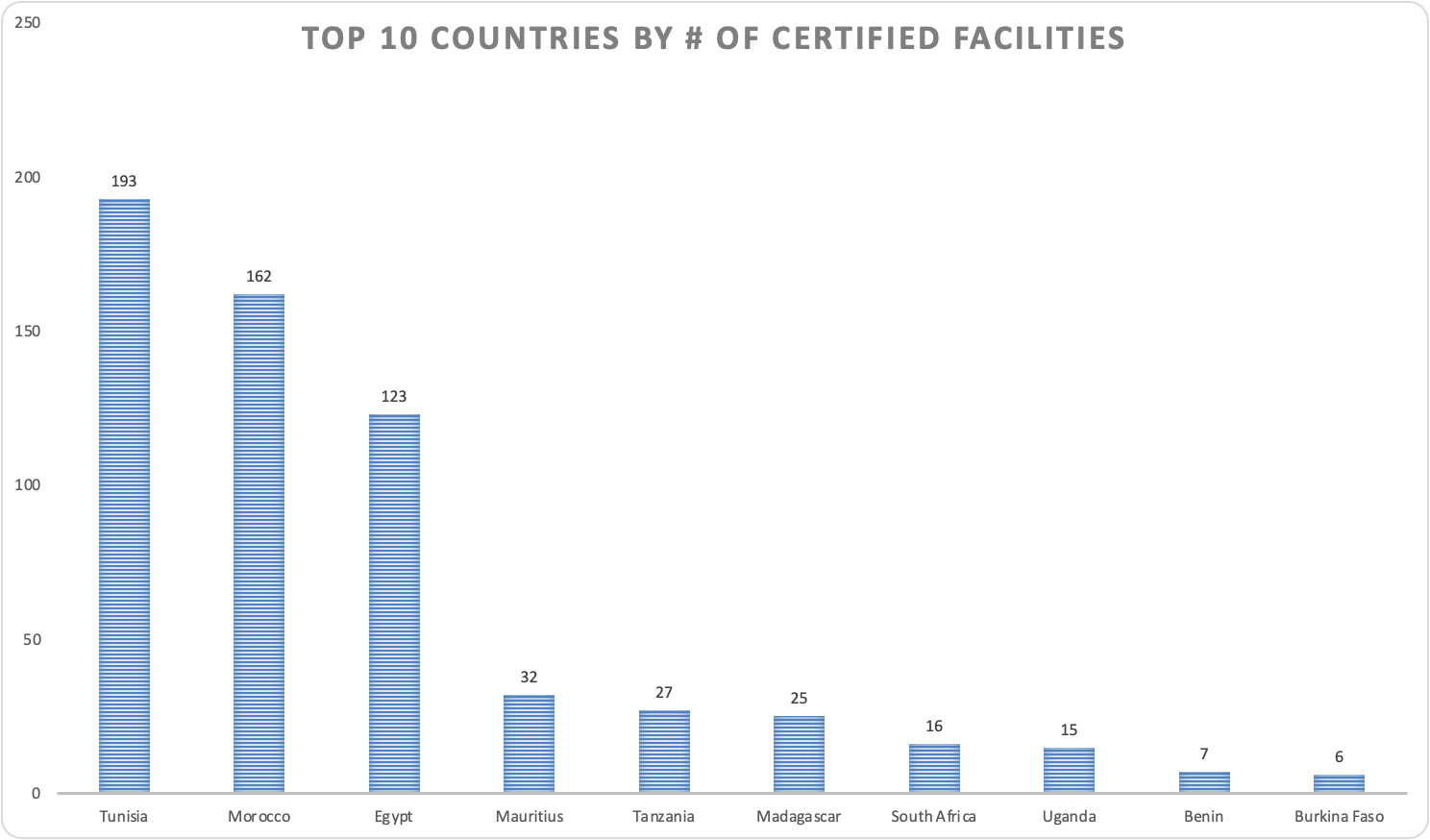
GOTS-Certified Entity Data in Africa
There are currently 627 Certified Facilities in Africa with active certification. Please see the list by country below:
| Country | Certified Facilities |
|---|---|
| Tunisia | 193 |
| Morocco | 162 |
| Egypt | 123 |
| Mauritius | 32 |
| Tanzania | 27 |
| Madagascar | 25 |
| South Africa | 16 |
| Uganda | 15 |
| Benin | 7 |
| Burkina Faso | 6 |
| Ethiopia | 5 |
| Senegal | 4 |
| Zambia | 3 |
| Botswana | 2 |
| Kenya | 2 |
| DR Congo | 1 |
| Cameroon | 1 |
| Seychelles | 1 |
| Algeria | 1 |
| Mali | 1 |
Tunisia, Morocco and Egypt account for 76.2% of the total number of facilities on the continent.