




For years, when international buyers spoke about Morocco’s textile manufacturers, one city dominated the conversation: Casablanca.
Casablanca was the sourcing hub.
The commercial center.
The meeting point between European brands and Moroccan manufacturers.
But that map is changing — and it is changing from the north.
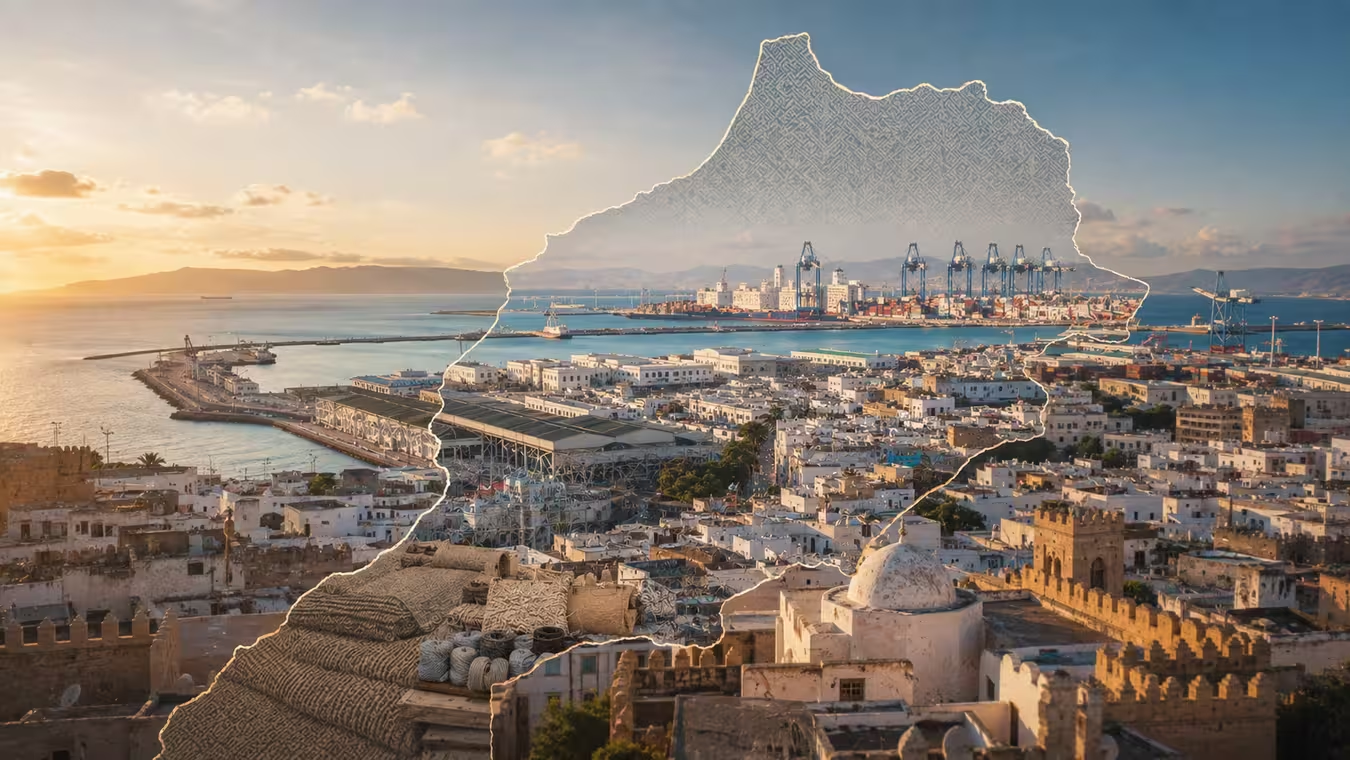
Tangier is no longer just a port city on the edge of Africa. It is rapidly becoming a strategic textile production base that is reshaping how Morocco positions itself in the global apparel supply chain.
This shift is not accidental. It is structural.
The Logistics Revolution That Changed Everything
The turning point was the rise of Tanger Med Port.
Today, Tanger Med is Africa’s largest container port and ranks among the world’s top 20, having handled 11.1 million TEUs in 2025 — up 8.4% year-on-year, according to the Tanger Med Port Authority.* For textile exporters, this is not a symbolic statistic — it is operational power.
*Source: Tanger Port Authority
From Tangier to southern Spain, shipping times can be measured in hours, not weeks.
In an industry where speed-to-market determines survival, this proximity has altered the competitive equation. European brands no longer need to wait for containers crossing the Indian Ocean. Production in northern Morocco means replenishment cycles that align with fast fashion timelines.
Nearshoring Is No Longer a Buzzword
Over the past few years, supply chain shocks have forced European buyers to rethink geography.
Rising costs in Asia, geopolitical uncertainties, and long transit times have accelerated what many executives now openly call the “regionalization phase” of textile sourcing.
Morocco has always been part of that conversation. But Tangier is now at the center of it. With direct access to EU markets, trade agreements, and competitive labor costs compared to Southern Europe, Tangier offers a middle ground:
Not the cheapest option — But one of the fastest and most strategically positioned.
For brands prioritizing flexibility, smaller batch production, and shorter lead times, this matters more than pure labor cost.
Industrial Planning vs Organic Growth
Unlike older textile clusters that evolved gradually, Tangier’s industrial ecosystem was strategically engineered.
The Tangier Free Zone and surrounding industrial parks were developed with export-oriented manufacturing in mind. Infrastructure, customs efficiency, and factory layouts reflect a long-term vision.
This is a key distinction. Casablanca grew as Morocco’s commercial capital. Tangier was built to compete internationally. That difference is increasingly visible in how investment flows are shifting north.
A Quiet Diversification of Morocco’s Textile Geography
Let’s be clear: Casablanca remains important. Headquarters, trading houses, and industry networks are still deeply rooted there.
But production geography is diversifying.
Northern Morocco — including Tangier and the broader regional corridor — is gradually absorbing more export-oriented textile activities.
The numbers back this up. According to Yassine Arroud, president of the Moroccan Association of Textile and Clothing Industries (AMITH), the Tangier-Tetouan-Al Hoceima region alone accounts for nearly 46.5% of the country’s textile and apparel workforce. Arroud has also noted that in Tangier specifically, an estimated 90–95% of local textile production is absorbed by a single customer group: Inditex, owner of Zara.
This is not rivalry between two cities; it is a structural rebalancing driven by where export-oriented manufacturers are choosing to invest — closer to the ports and free zones that serve European buyers directly.
For a broader overview of Morocco’s textile sector, including manufacturing, trade, investment and supply chain developments, explore the Morocco textile industry landscape.
What International Manufacturers Should Understand
For Turkish textile companies, European converters, and regional apparel producers considering expansion — as Hop Lun’s recent Morocco acquisition and Vita Couture-Diprints’ MAD 220 million Tangier investment demonstrate — Tangier represents something specific:
- Immediate access to Europe
- A logistics-driven industrial model
- Political stability within a structured export framework
- A growing ecosystem of skilled labor
However, entry requires more than optimism.
Understanding regulatory frameworks, industrial zones, partner selection, and operational realities on the ground is essential. Tangier is competitive — but it is not a shortcut market.
Strategic positioning is everything.
Why Tangier Stands Out for Export-Oriented Manufacturing
For investors evaluating manufacturing locations in Morocco, Tangier’s advantage becomes particularly clear when the business model depends heavily on exports.
Tanger Med handled more than 11.1 million TEUs in 2025, strengthening Tangier’s position as one of Morocco’s most strategically connected industrial locations. For textile and apparel manufacturers, however, the importance of this infrastructure goes beyond container volumes. It directly affects how quickly raw materials can enter the production chain and how efficiently finished goods can reach international customers.
This makes Tangier particularly relevant for export-oriented textile manufacturers supplying European markets, where shorter lead times, flexible production and rapid replenishment are becoming increasingly important.
The location decision therefore extends beyond factory costs. Logistics, access to suppliers, availability of skilled labour, proximity to customers and speed to market all influence the real competitiveness of an investment.
For Tangier, the combination of industrial infrastructure, port connectivity and proximity to Europe creates a particularly compelling proposition for textile companies whose growth strategy is built around international markets.
The Bigger Picture: Tangier as a Gateway, Not Just a City
The rise of Tangier reflects a broader shift in the global textile industry.
- Production is becoming more regional.
- Supply chains are becoming shorter.
- Speed is becoming currency.
In that context, Tangier is not simply emerging as another Moroccan city with factories.
It is positioning itself as a logistical and industrial bridge between Africa and Europe.
And in the coming years, that bridge may carry far more weight than many expect.
For a wider view of factory capabilities, production regions and sourcing models across the country, see Kohan Textile Journal’s Morocco Textile Manufacturing Hub. For the capital projects and FDI driving this regional growth, see the Morocco Textile Investment Hub.
Considering Expansion into Tangier’s Textile Sector?
Entering a new production geography requires informed strategy — not assumptions.
Kohan Textile Journal provides professional consulting services for textile companies exploring expansion, relocation, or investment in northern Morocco.
Our services include:
- Market entry analysis
- Industrial zone advisory
- Local partner identification
- Strategic positioning for EU supply chains
- On-site coordination and business matchmaking
If your company is evaluating Morocco — and particularly Tangier — as a potential production base, our advisory team is ready to assist.











