Bernard Samaraweera explains why low labour costs alone cannot make Africa competitive — and why people, processes, technology and regional integration will determine the continent’s future in global apparel sourcing.
Interview by Behnam Ghasemi, Editor-in-Chief, Kohan Textile Journal
Africa has long been discussed as one of the next major frontiers for global textile and apparel manufacturing. Competitive labour costs, a young workforce, expanding industrial infrastructure and growing interest from international investors have strengthened that argument.
But building a successful apparel manufacturing industry requires much more than inexpensive labour.
Productivity, technical expertise, quality consistency, access to materials, logistics, working capital, compliance and management capabilities can ultimately determine whether a factory is globally competitive.


Few professionals have observed these challenges from as many different manufacturing environments as Bernard Samaraweera.
With more than 23 years of international apparel manufacturing experience across Sri Lanka, Ethiopia, Madagascar and Ghana, Samaraweera has worked extensively in factory setup and transformation, operational excellence and apparel manufacturing management.
In this exclusive interview with Behnam Ghasemi, Editor-in-Chief of Kohan Textile Journal, he discusses what investors often misunderstand about apparel manufacturing in Africa, how African factories can close the productivity gap with Asia, where technology and AI fit into the equation, and why Morocco, Egypt and Ethiopia stand out as three particularly interesting investment destinations.
Building Successful Apparel Factories in Emerging Markets
Behnam Ghasemi: Having worked across Sri Lanka, Ethiopia, Madagascar and Ghana, what have you learned about building successful apparel factories in emerging markets?
Bernard Samaraweera: One of the most important lessons I have learned is that every country has a different starting point. There is no single formula that can simply be transferred from one country to another.
Sri Lanka, for example, has developed a mature apparel manufacturing ecosystem, with strong capabilities in productivity, quality, compliance, product development and serving demanding international customers.
Many African countries offer a different proposition. Labour can be comparatively competitive, and there is enormous potential for industrial development. However, factories can face challenges in productivity, technical skills, quality consistency, logistics, access to foreign currency and working capital.
Therefore, I believe the first requirement is not simply to build a factory. It is to build the right operating system around the factory.
That means having the right people, the right manufacturing methods, the right machines for the product, effective quality and compliance systems, reliable supply-chain planning and disciplined financial management.
My experience across Africa has taught me that investors should not look at labour cost alone. A factory with low labour costs but poor productivity, high rework, inconsistent quality and unreliable delivery can ultimately be much more expensive than a factory with a higher nominal labour cost.
The real objective should be competitive cost per good garment delivered on time, not simply low wages.


Morocco, Egypt and Ethiopia Stand Out
Behnam Ghasemi: Which African countries do you believe have the strongest potential to become major apparel manufacturing hubs over the next decade — and why?
Bernard Samaraweera: If I were advising an international investor today, my shortlist would be Morocco, Egypt and Ethiopia, but for different reasons.
Morocco would be particularly attractive for investors targeting European customers. Its geographic proximity to Europe, established textile and apparel ecosystem and strong connection with European markets provide an important nearshoring advantage.
I also see Morocco moving toward greater vertical integration. Recent investment in Fès, for example, includes a major integrated textile project covering yarn and fabrics, knitting, dyeing, printing and garment manufacturing — see Kohan Textile Journal’s Morocco Textile Manufacturing Hub for more on this shift toward vertical integration. This type of integration can reduce lead times, logistics costs and dependence on imported inputs.
Egypt is attractive because of its scale, textile heritage and potential for greater vertical integration. There is also clear evidence of new international investment, including plans for new ready-made garment factories and integrated textile production aimed at international export markets.
Ethiopia is a different proposition. I see it as a high-potential, long-term manufacturing location, particularly because of its labour availability, industrial-park infrastructure and ambition to develop an integrated textile and apparel value chain.
However, Ethiopia also demonstrates an important lesson: potential alone is not enough. Infrastructure, logistics, foreign exchange, technical skills, market access and economic stability must all be carefully considered before committing significant capital.
So I would describe the three countries differently:
Morocco — European nearshoring and market access.
Egypt — scale and textile integration.
Ethiopia — long-term manufacturing and industrial-development potential.
Ultimately, the right country depends on the investor’s target market, product, sourcing model and risk appetite.
Explore More: Morocco Textile Investment, FDI and Manufacturing Opportunities
Productivity Is Not About Making People Work Faster
Behnam Ghasemi: Africa offers competitive labour costs, but productivity remains a challenge in many markets. How can African factories close the productivity gap with Asian manufacturers?
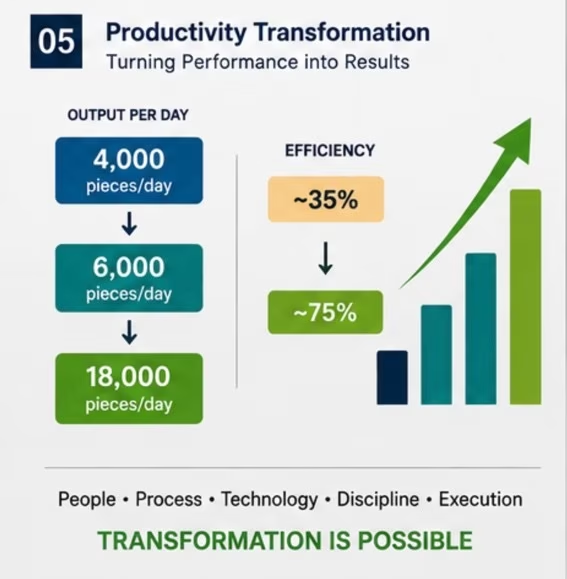
Bernard Samaraweera: The first step is to stop thinking that productivity comes simply from asking workers to work faster.
Productivity is the result of people + process + technology + management discipline.
In my experience, African factories can close a significant part of the productivity gap by transferring proven manufacturing knowledge from mature Asian apparel-producing countries and adapting it to local conditions.
Sri Lanka is a particularly good example because its apparel industry has developed strong capabilities in productivity, quality, compliance, product development and international customer requirements.
But technical knowledge transfer should not mean bringing expatriates into a factory permanently.
The objective should be:
Bring the right technical expertise → establish the system → train local managers → develop local supervisors → transfer knowledge → gradually localise leadership.
The critical areas include industrial engineering, line balancing, work study, quality management, production planning, maintenance, lean manufacturing, operator training and management information systems.
Technology can support this process, but technology must follow the manufacturing problem.
A factory cannot automate its way out of poor management.
The Five M’s: Where Apparel Investments Go Wrong
Behnam Ghasemi: From your experience setting up and transforming factories, what are the most common mistakes investors make when establishing apparel production in Africa?
Bernard Samaraweera: I normally describe the major risks as the Five M’s: Man, Machine, Method, Material and Money.
- First — Man.Investors sometimes underestimate the importance of experienced technical leadership.
A factory can have an excellent building and expensive machinery, but without the right people to establish and operate the system, the results will suffer.
The first technical team is particularly important because they establish the culture, standards and operating discipline that the factory will eventually inherit. - Second — Machine.A common mistake is selecting machines mainly on purchase price.
The correct machine must be selected according to the product, construction, quality requirement, production volume, durability, maintenance requirements and expected efficiency.The cheapest machine is not necessarily the lowest-cost machine over its lifetime. - Third — Method.This is one of the most important areas.Manufacturing methods, line layout, industrial engineering systems, quality systems, production planning and supervisory routines must be designed before the factory reaches full-scale production.I have seen situations where companies recruited technical personnel without the right experience for greenfield development. The result can be expensive delays, low productivity and repeated restructuring.
- Fourth — Material.For export-oriented apparel manufacturing, many African factories still need to import significant portions of their fabrics, trims and accessories.Therefore, material planning, supplier development, lead times, quality and foreign-exchange availability become critical.Over time, the objective should be to strengthen domestic and regional supply chains.
- Fifth — Money.This is often underestimated.It is not enough to have investment capital for buildings and machinery. A factory also needs sufficient working capital, banking facilities, foreign-exchange access and a financing structure compatible with international purchasing and export cycles.A factory can have orders and production capacity and still struggle if the financial system around it cannot support the business.
Can Africa Capture More Global Apparel Sourcing?
Behnam Ghasemi: Global brands are increasingly looking at supply-chain diversification and nearshoring. Can Africa realistically capture a larger share of sourcing currently concentrated in Asia?
Bernard Samaraweera: Yes — but I would say not immediately and not simply because Africa has lower labour costs.
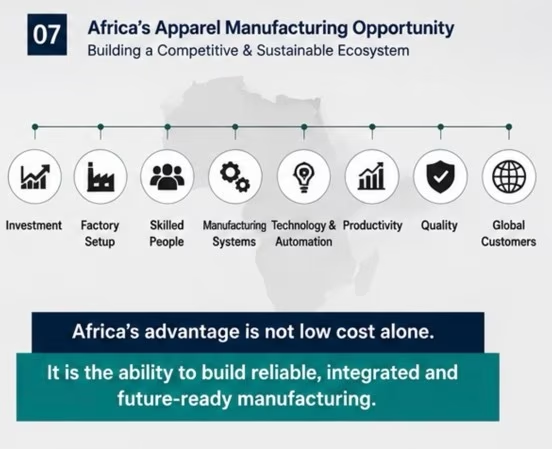
Africa has a major opportunity, but the industry needs to become competitive across the entire value chain.
Many African countries still have gaps in technical expertise, productivity, quality consistency, raw-material availability, logistics and industrial infrastructure.
The opportunity is therefore to move from:
“Low-cost production”
to
“Reliable, competitive and integrated manufacturing.”
Africa’s opportunity can also be regional rather than limited to individual countries.
The development of stronger cross-border supply chains could connect cotton, spinning, weaving, dyeing, garment manufacturing and regional markets.
That could create something much more powerful than individual factories competing independently.
I believe Africa can capture a larger share of global sourcing, but the winning factories will be those that combine cost, quality, speed, compliance and reliability.
Related Insight: Why Global Textile Investors Are Moving Toward Egypt
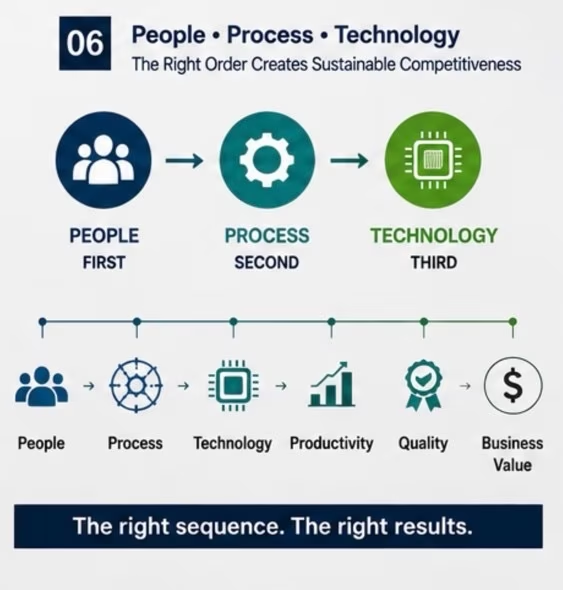
People First. Process Second. Technology Third
Behnam Ghasemi: Technology, automation and AI are transforming apparel manufacturing. Can these technologies help African factories leapfrog traditional stages of industrial development?
Bernard Samaraweera: Absolutely — but technology is not a substitute for people.
Apparel remains a highly human-oriented manufacturing industry. Sewing, quality judgement, problem-solving, production coordination, operator development and leadership still require capable people.
AI, automation, digital production monitoring, automated cutting, digital quality systems and data-driven planning can significantly improve manufacturing performance.
But if the underlying process is weak, technology can simply make a bad process faster.
My philosophy is:
People first. Process second. Technology third.
First establish competent people and stable processes. Then use technology to increase speed, accuracy, visibility and decision-making.
The biggest opportunity for Africa is therefore not to copy every technology used in Asia. It is to identify where technology can remove today’s biggest bottlenecks and allow African factories to move directly toward modern manufacturing systems.
What Does a Truly Competitive Apparel Factory Look Like?
Behnam Ghasemi: You often emphasize that operational excellence must ultimately create business value. What does a truly competitive apparel factory look like today?
Bernard Samaraweera: A truly competitive apparel factory is not simply a factory with high production numbers.
It must deliver the right product, at the right quality, at the right cost, on the right date, while protecting people, the environment and the reputation of the customer.
For me, the foundation is:
Compliance + Ethics + Quality + Productivity + Delivery + Cost + Customer Satisfaction.
These are interconnected.
You cannot call a factory competitive if it produces cheaply but repeatedly fails customer audits.
You cannot call it successful if productivity is high but quality is unstable.
And you cannot call it sustainable if financial performance is achieved at the expense of workers, ethics or the environment.
Operational excellence must ultimately create business value.
That means stronger customer relationships, repeat orders, better margins, lower waste, higher productivity, stronger people and a more resilient business.
If Investing in Africa Today, Where Would He Go?
Behnam Ghasemi: If you were advising an international investor today, which three African countries would you shortlist for a new apparel manufacturing investment — and what would make each attractive?
Bernard Samaraweera: My shortlist would be Morocco, Egypt and Ethiopia, but the final decision would depend on the investor’s target market and product strategy.
Morocco would be my first choice for a European-focused nearshoring operation. Its geographic position, established textile ecosystem and connection to European markets create a compelling proposition. The country’s recent textile investments also show a move toward greater integration and shorter supply-chain lead times.
Egypt would be particularly interesting for investors looking for scale and greater vertical integration. Its textile heritage, cotton base and growing international investment provide a strong foundation for developing a broader textile and apparel value chain.
Ethiopia is the high-potential option. It offers competitive labour, a large workforce, industrial-park infrastructure and significant ambition to develop an integrated textile and apparel industry.
However, I would advise investors entering Ethiopia to have a very strong operational team and a carefully designed risk-management structure. Ultimately, I would not select a country simply because its labour cost is low.
I would ask:
Where can we build a factory that can consistently deliver quality, productivity, compliance, speed and profitability?
That is the real investment question.
Editor’s Insight
By Behnam Ghasemi, Editor-in-Chief, Kohan Textile Journal
Perhaps the strongest message emerging from this interview is that Africa’s apparel opportunity should not be reduced to cheap labour.
For years, discussions around manufacturing investment in Africa have frequently started with wages. But as Samaraweera points out, the real calculation is considerably more complex.
A low hourly wage means little if productivity is poor, quality is inconsistent, materials arrive late, factories depend heavily on imported inputs, working capital is unavailable or orders cannot be delivered reliably.
This also explains why Africa should not necessarily try to replicate Asia’s manufacturing development model country by country.
A potentially stronger model is regional specialisation and integration.
Morocco can leverage its extraordinary proximity to Europe and nearshoring potential. Egypt offers scale, an established textile base and opportunities for vertical integration. Ethiopia offers long-term industrial potential. Other African countries can contribute fibres, manufacturing capacity, energy, logistics or regional demand.
Connecting these strengths could eventually matter more than attempting to build every stage of the textile value chain inside every country.
Technology will undoubtedly accelerate this transformation, but another important lesson from this interview should not be overlooked:
People first. Process second. Technology third.
For investors considering Africa, that may ultimately be more valuable advice than any calculation based purely on labour costs.
Africa does not need simply to become a cheaper alternative to Asia.
The bigger opportunity is to become a reliable, integrated and increasingly sophisticated manufacturing partner for the global apparel industry.