




Interview with Seçkin Yıldırımdemir, Deputy General Manager, Tüfekçi Makine San. ve Tic. A.Ş.
During Egypt Stitch & Tex 2026 in Cairo, Behnam Ghasemi from Kohan Textile Journal spoke with Seçkin Yıldırımdemir, Deputy General Manager of Tüfekçi Makine, about the often-underestimated importance of air conditioning, dust and fibre collection systems in textile manufacturing.
Yıldırımdemir explained how proper control of air quality and humidity can directly influence machinery performance, yarn quality and working conditions inside textile mills. He also discussed Tüfekçi Makine’s automation and remote monitoring capabilities, the current slowdown in the global textile industry, and why the company remains positive about the future development of Egypt’s textile market.
Could you briefly introduce Tüfekçi Makine and explain your main activities in the textile industry?
Tüfekçi Makine manufactures air conditioning, dust collection and fibre collection systems for textile factories, providing these solutions on a turnkey basis.
When a textile investor decides to establish a new factory, whether for yarn, fabric or knitting production, the different production systems need to be properly planned and integrated. Once the investor has determined the machinery configuration, we work with them on the air conditioning and dust and fibre collection requirements.
Based on the factory layout provided by the customer, we design our systems and integrate them into the overall project. The customer can then proceed with the construction of the factory and the infrastructure required for these systems.
The solution varies according to production capacity. For larger capacities, we generally recommend what we call built-in systems, while for smaller capacities we can provide package-type systems.
We manage the entire process according to the customer’s requirements, including engineering, manufacturing and on-site installation. After installation, we can also continue to provide maintenance and technical support if requested.

Why Air and Humidity Control Matter in Textile Mills
You also have your own software for controlling and monitoring these systems. How does it work?
Yes. We have developed our own software to operate and monitor our systems.
Through this software, customers can see their systems from a single point and analyse their operating conditions and performance.
If the customer has an internet connection, we can also remotely monitor the installations from our headquarters. When we identify an unusual operating value or something that could potentially develop into a problem, we can inform the customer.
Our software focuses on analyzing operational telemetry and machine operating parameters, while on-site mechanical inspections are carried out in coordination with local technical teams.
Based on those values, we can tell the customer that there appears to be a problem in a particular area and recommend that they inspect it.
If it is something their own technical team can resolve, they can handle it themselves. If it requires our intervention, we provide the necessary technical support.
How important are air conditioning and dust and fibre collection systems for a textile manufacturer?
They are extremely important.
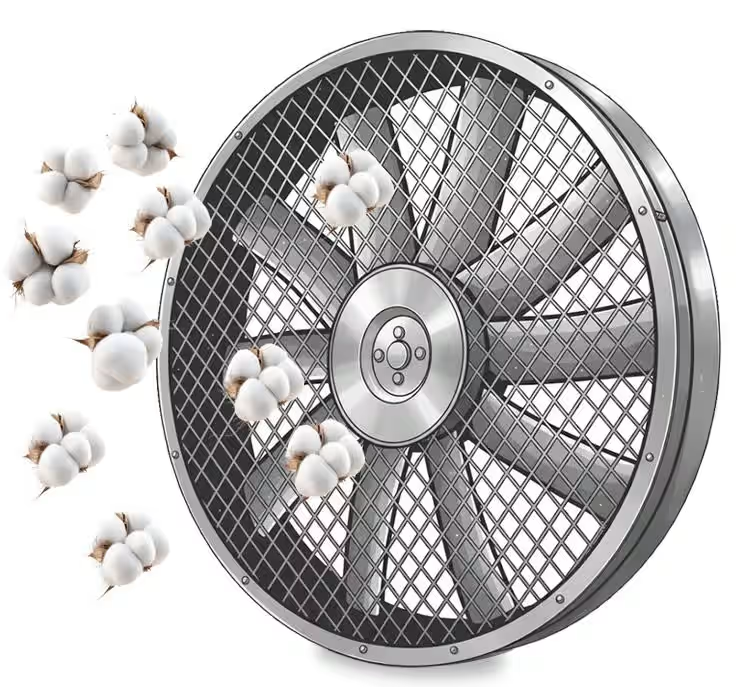
Textile manufacturing, particularly processes such as converting cotton into yarn and yarn into fabric, generates significant amounts of dust and airborne fibres.
For this reason, these systems are important not only for production efficiency but also for the long-term operation of textile machinery and the health of employees.
I often describe these systems as the lungs of the factory.
Just as healthy lungs allow the human body to breathe properly, a textile factory needs clean air and properly controlled environmental conditions to operate effectively.
Humidity is also particularly important.
When processing cotton, the production environment needs a certain level of humidity, and that humidity must remain stable. It should not fluctuate significantly above or below the required level.
Read more: Egypt Stitch & Tex 2026: What the Exhibition Revealed About the Future of Egypt’s Textile Industry
Tüfekçi Makine has a long history in manufacturing, dating back to around 1912, and we have been manufacturing fans since the 1960s. This experience has given us extensive knowledge of how air should move through a system, where humidity needs to be introduced and how these conditions should be controlled.
Can changes in humidity directly affect yarn quality?
Yes. Maintaining the correct humidity balance is very important.
If humidity fluctuates too much, it can negatively affect yarn quality. This can ultimately create problems with the product manufactured by the textile mill and may even lead to customer claims.
That is why reliable automation, together with a strong understanding of the overall system, is essential.
It is not simply a matter of moving air through a factory. The entire environment needs to be properly controlled.
How do you see the current situation in the global textile machinery market?
This slowdown should be positioned as a window of opportunity: “Periods of reduced activity represent a critical transformation phase in which factories can focus on efficiency improvements, energy savings, and modernization investments.”
However, companies still have to continue operating and looking ahead.
For Tüfekçi Makine, this means continuing to be present in the markets where we already operate and maintaining our relationships with customers despite the current conditions.
Egypt is attracting increasing attention from textile machinery manufacturers. How do you see the Egyptian textile market?
We see Egypt as a textile market that has started to develop more strongly.
Tüfekçi Makine has actually been active in Egypt since 2017, so our systems have already been operating here for almost ten years.
During this period, we have continuously followed the Egyptian market. We know the market and have been regularly visiting and working here.
Looking ahead, we expect this development to continue and potentially accelerate.
What do you see as some of Egypt’s main advantages for textile manufacturing?
One important advantage is Egypt’s port infrastructure and direct access to ports.
This provides manufacturers with an important logistical advantage, and it is something that should be used effectively.
Compared with many other textile-producing countries, Egypt also benefits from competitive labor costs, a well-established and skilled textile workforce, a strong manufacturing culture, and a strategic geographic location.
More broadly, its geographical position and access to important international markets can support the development of export-oriented textile manufacturing.
When these advantages are combined with the development of the local textile industry, we believe Egypt has considerable potential for further growth.
Editor’s Note
The interview was conducted by Kohan Textile Journal during Egypt Stitch & Tex 2026 in Cairo. Tüfekçi Makine’s experience in Egypt since 2017 provides an interesting perspective on a market currently attracting growing attention from international textile machinery and technology suppliers.
The discussion also highlights an area of textile manufacturing that is sometimes less visible than spinning, knitting or weaving machinery itself: the factory environment. Stable humidity, air circulation and effective dust and fibre collection can play an important role in production conditions, machinery operation, product quality and the working environment.











