




Africa’s ambitions to expand its textile and apparel manufacturing industry are becoming increasingly linked to a challenge that begins far before the spinning mill or garment factory: the ability of the continent’s cotton farmers to adapt to climate change.
Cotton remains one of Africa’s most strategically important agricultural commodities and provides income for millions of smallholder farmers while supplying a potential raw-material base for the continent’s growing textile value chain.
Across West, East and Southern Africa, governments and investors are increasingly looking beyond raw cotton exports toward domestic value addition through ginning, spinning, weaving, textile processing and garment manufacturing.
However, changing rainfall patterns, drought, declining soil health and extreme weather are creating new risks for cotton production—particularly because African cotton cultivation is overwhelmingly dependent on rainfall rather than artificial irrigation.
Cotton made in Africa (CmiA) notes that artificial irrigation is practically unknown among African smallholder cotton farmers, making natural rainfall fundamental to crop performance.
Rain-Fed Cotton Faces a Changing Climate
Africa’s rain-fed production model has traditionally provided important environmental advantages.
Cotton produced without artificial irrigation requires little or no so-called blue water from rivers, reservoirs or groundwater and eliminates much of the energy consumption associated with irrigation pumps.
A 2026 life-cycle assessment of CmiA Organic cotton produced in Tanzania found that the system’s environmental footprint benefits from the absence of artificial irrigation, mineral fertilisers and synthetic pesticides. At the same time, the study stressed that climate change itself is increasingly threatening the livelihoods of the smallholder farmers operating these low-input systems.
This creates a difficult equation for Africa.
The production system responsible for some of African cotton’s environmental advantages can also leave farmers particularly exposed when rainfall becomes unreliable.
Climate adaptation is therefore becoming essential not only for agriculture but also for the future competitiveness of Africa’s textile industry.
Healthy Soil Becomes a Climate Strategy
One increasingly important approach is to improve the ability of agricultural soil to withstand periods of drought and irregular rainfall. Regenerative practices including crop rotation, composting, cover crops, reduced tillage and biochar can improve soil health and help cotton farmers build greater resilience.
The Aid by Trade Foundation says approximately one million small-scale farmers have been reached through CmiA training programmes, while around 40% of cotton produced in Africa is now CmiA-verified. Its current programmes increasingly emphasize soil health and regenerative agriculture as responses to climate-related challenges.
Biochar is attracting particular attention.
Produced through the controlled conversion of plant material into a charcoal-like material, biochar can be incorporated into agricultural soils as part of efforts to improve soil conditions.
Aid by Trade Foundation reported that biochar use on demonstration fields under its Regenerative Cotton Standard increased yields by 15%, while other soil-improvement measures generated harvest increases of up to 37% on demonstration fields.
Such results could be significant for Africa because improving productivity on existing cotton farms may provide a more sustainable route to increasing fibre supply than simply expanding cultivated land.
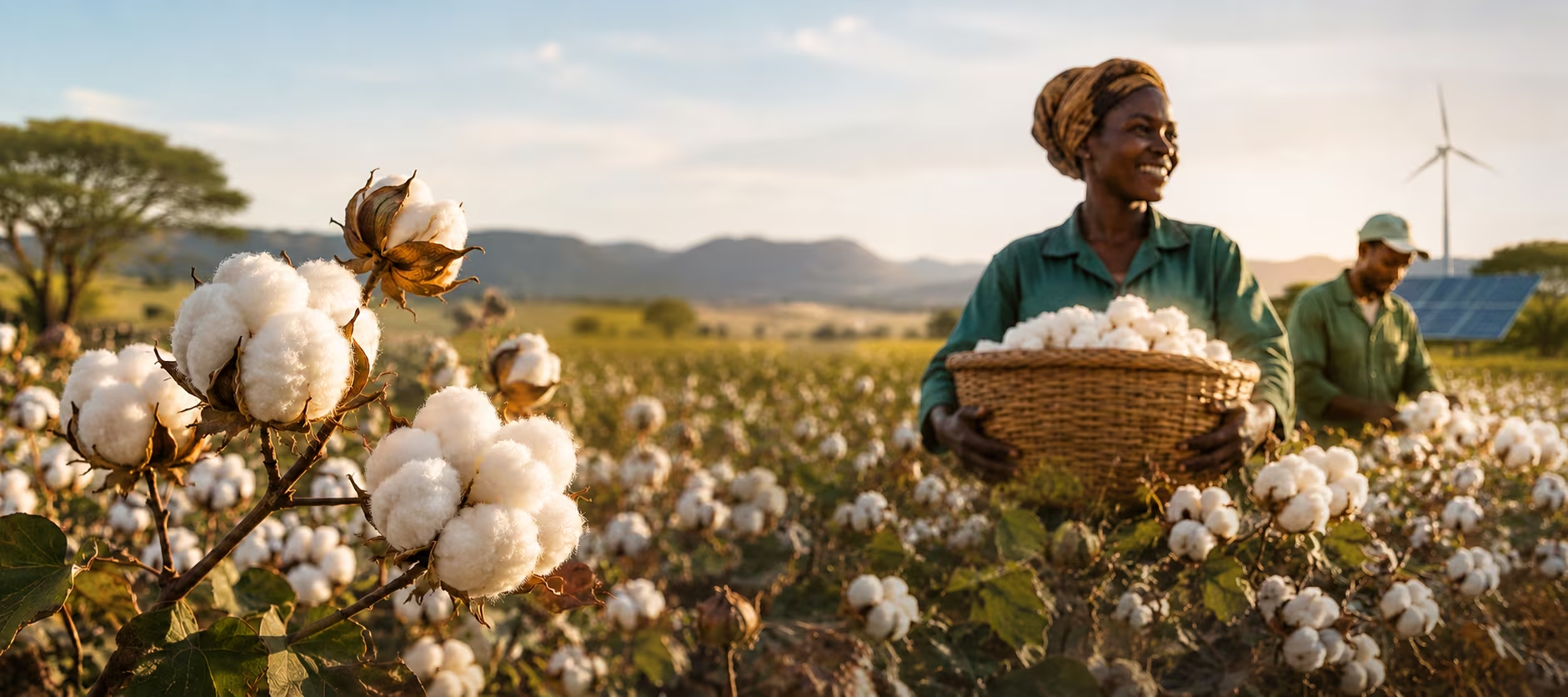
118,000 Farmers Reached Through Climate Programme
Climate adaptation projects are also beginning to operate at greater scale.
The Climate Adaptation and Resilience through improved Soil Management (CAR-iSMa) initiative worked with cotton-growing communities in Côte d’Ivoire, Mozambique and Zambia.
The €2.8 million project focused on helping smallholders improve soil management and adopt more sustainable cotton cultivation methods.
According to the Aid by Trade Foundation, approximately 118,400 smallholder farmers directly benefited from training through the programme—more than originally planned.
Measures being explored across climate-smart cotton programmes include biochar, composting, crop rotation and integrated pest management.
The objective is increasingly clear: climate resilience must become part of cotton productivity rather than a separate environmental initiative.
Irrigation Remains Part of Africa’s Agricultural Debate
Irrigation nevertheless remains an important component of wider agricultural investment across drought-prone parts of Africa.
In March 2026, the World Bank approved a $215.9 million Burkina Faso Agricultural Transformation Project, aimed at improving agricultural productivity, processing infrastructure and market access across priority value chains.
For cotton, however, the question is more complex.
Large-scale irrigation infrastructure can reduce dependence on rainfall but requires capital, energy and careful management of water resources. In areas facing groundwater stress, expanding irrigation without effective water management can create additional environmental pressures.
Rain-fed systems, meanwhile, offer environmental advantages but require farmers to improve soil resilience and agricultural management to cope with increasingly unpredictable weather.
The future of African cotton is therefore unlikely to depend on a single solution.
Read more: Cotton made in Africa Receives Top “Excellent” Rating from Germany’s Siegelklarheit Platform
Technology Could Transform African Cotton Farming
Digital agriculture could become another important part of the response.
Satellite monitoring, weather information, improved seed varieties, precision agriculture and better farm data can help farmers and cotton companies make more informed decisions about planting, crop health and resource use.
Meanwhile, the latest OECD-FAO Agricultural Outlook 2026–2035 points to continuing technological and productivity improvements as important factors shaping agricultural markets over the coming decade.
For African cotton-producing countries, increasing productivity could have consequences far beyond farming.
A stronger and more reliable domestic cotton supply can improve the investment case for ginning facilities, spinning mills, weaving and knitting plants, dyeing and finishing operations and eventually garment manufacturing.
From African Cotton to African Textiles
This is where climate adaptation and industrial policy increasingly intersect.
Africa has historically exported substantial quantities of agricultural commodities while capturing a smaller share of the value generated when those raw materials are transformed into finished products.
Cotton provides an opportunity to change that model.
Instead of ending the value chain at raw or ginned cotton, producing countries can seek to build an industrial ecosystem connecting:
Cotton → Ginning → Spinning → Fabric Production → Dyeing & Finishing → Garment Manufacturing → Export
Such development could create significantly more industrial employment while reducing dependence on imported yarn, fabric and finished garments.
West and Central African cotton economies already have decades of experience with the crop. FAO-backed research describes cotton as an important driver of agricultural transformation and local economies across the region, while also highlighting climate change, soil degradation and environmental sustainability among the major challenges facing the sector.

Sustainability Could Become Africa’s Competitive Advantage
Interestingly, the same production characteristics that make African cotton vulnerable to rainfall variability could become commercially valuable in an increasingly sustainability-focused textile market.
Low irrigation requirements, smallholder farming systems and the growing adoption of regenerative agricultural practices can provide African cotton with a distinctive sustainability proposition.
CmiA’s environmental assessments have found that its rain-fed cotton systems have near-zero blue-water consumption and can perform favourably on greenhouse-gas emissions compared with global benchmarks.
At the same time, new initiatives are exploring whether regenerative cotton farming could create additional income opportunities.
A cooperation launched in 2025 between the Aid by Trade Foundation, International Cotton Advisory Committee and bizpando is examining carbon-credit opportunities for African smallholder cotton farmers using practices such as biochar, minimum tillage and cover cropping. The initiative estimates that these approaches could potentially sequester up to 5.75 tonnes of CO₂ per hectare annually under suitable conditions.
Read more: Africa’s Cotton Industry Holds Key to Millions of Textile Jobs, Experts Say
Africa’s Textile Future Starts on the Farm
Climate change represents a serious challenge to Africa’s cotton sector, but it does not necessarily undermine the continent’s textile ambitions.
Instead, it is changing the conditions under which those ambitions must be pursued.
Building a competitive African textile industry will require investment not only in modern spinning mills, weaving machinery, dyehouses and garment factories but also in the agricultural systems supplying those facilities.
Improved soil management, regenerative agriculture, farmer training, better seeds, digital technologies and carefully designed water-management strategies will increasingly determine whether African cotton can provide a reliable foundation for industrial growth.
For Africa, the opportunity is ultimately larger than producing more cotton.
The strategic goal is to produce cotton more efficiently, make farming more resilient to climate change and transform a greater share of that fibre into yarn, fabric and garments within Africa.
If the continent can connect climate-resilient agriculture with investment in textile manufacturing, cotton could become not only one of Africa’s traditional agricultural commodities but also an important building block for its next generation of industrial development.











