
By: Farhat Ali / Senior Textile Operations & Technical Consultant
Independent Textile Advisory Services
Industry Insight & Strategic Analysis
Executive Summary & Key Takeaways
- Shift to Value Addition: Africa is transitioning from a raw cotton exporter to an integrated regional manufacturing ecosystem.
- Upstream Modernization: Massive investments in automated compact ring spinning and rotor technologies are addressing Africa’s historic yarn-deficit bottleneck.
- Trade Corridors: The combination of AfCFTA rules of origin and proximity to European markets gives the continent a strong nearshoring advantage over East Asia.
- Flagship Projects: Egypt’s multi-billion-dollar modernization, anchored by Misr El-Mahalla, and West Africa’s GDIZ park are redefining high-capacity production on the continent.
1. Insights into Textiles in Africa: Macro Dynamics
Overview & Market Footprint
The African textile and apparel market is experiencing rapid growth, driven by supply chain diversification out of Asia and strong domestic consumer demand. The sector is reorganizing into specialized regional manufacturing hubs:
- North Africa: High-end nearshoring, fast-fashion sourcing, and ELS cotton processing.
- West Africa: High-yield seed cotton production transitioning into raw processing SEZs.
- East & South Africa: Garment assembly hubs, duty-free trade corridors, and circular recycling initiatives.
African Textile Regional Hub Model
| Region | Countries | Strategic Focus |
|---|---|---|
| North Africa | Egypt, Morocco, Tunisia | Fast-fashion nearshoring, ELS cotton, vertical hubs |
| West Africa | Benin, Côte d’Ivoire, Togo – “Cotton-4” | High-yield lint, integrated industrial parks (GDIZ) |
| East & South Africa | Ethiopia, Kenya, Tanzania, South Africa | Garment assembly, circular recycling, export corridors |
Catalyzing Economic Growth
The economic importance of vertical integration in Africa rests on two key pillars:
- Value Retention: Converting raw seed cotton into finished yarn and greige fabric retains 400% to 600% more economic value domestically compared with exporting unprocessed bales.
- Workforce Absorption: As a labor-intensive industry, apparel assembly and textile processing absorb large urban youth and female populations into formal employment.

2. Cotton Agriculture & Growth Trends
Historical Yield Trends vs. Market Potential
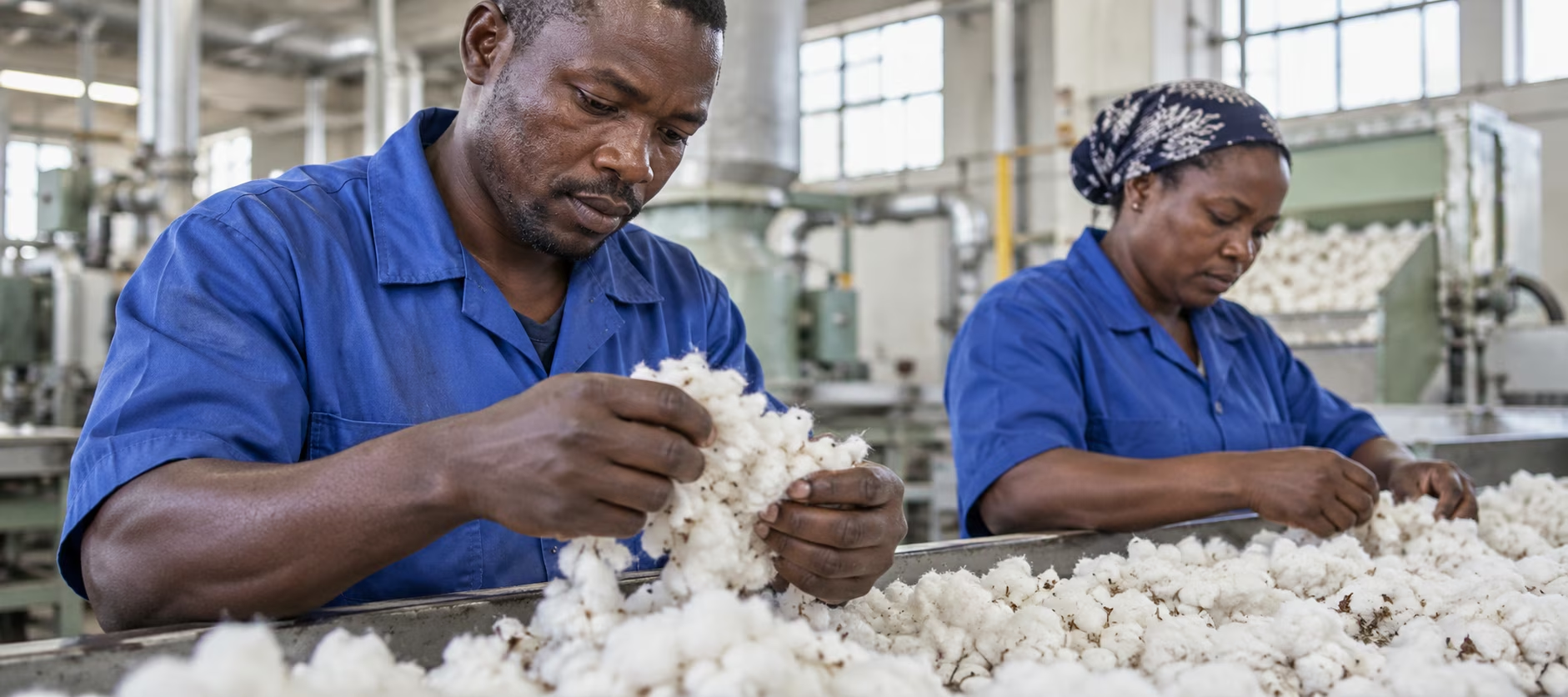
Africa produces nearly 10% of global raw cotton, anchored by West Africa’s “Cotton-4” (Benin, Burkina Faso, Chad, Mali), alongside Egypt and Sudan. While historical production has suffered from climate volatility and input price inflation, African hand-picked cotton retains a distinct competitive edge in fiber quality:
Global Cotton Competitive Advantages
| African Hand-Picked Cotton | Advantage to Spinning Mills |
|---|---|
| Low Mechanical Fiber Damage | Higher yarn tenacity & structural strength |
| High Length-to-Uniformity Ratio | Reduced yarn hairiness |
| Superior ELS Varieties (Egypt) | Premium luxury shirting and fine fabric |
Projections & Key Production Drivers
- Yield Enhancement: Adoption of climate-resilient seeds and regenerative agriculture (e.g., Better Cotton Initiative / BCI).
- Local Offtake Guarantees: Direct contracts between regional industrial parks and farmer cooperatives to stabilize farm-gate prices and secure domestic fiber supply.
Read More: Can Africa Turn Its Cotton Strength Into a Global Textile Industry?
3. Spinning Sector Dynamics: Overcoming the Yarn Deficit
The Historic Bottleneck
Spinning has long been the weakest link in Africa’s value chain. Historically, over 70% of sub-Saharan cotton was exported raw, while garment manufacturers imported yarn back from Asia.
Traditional Linear Flow
Modern Integrated Flow
Technology Adoption & Modernization
Modern African mills are scaling capacity through targeted technology investments:
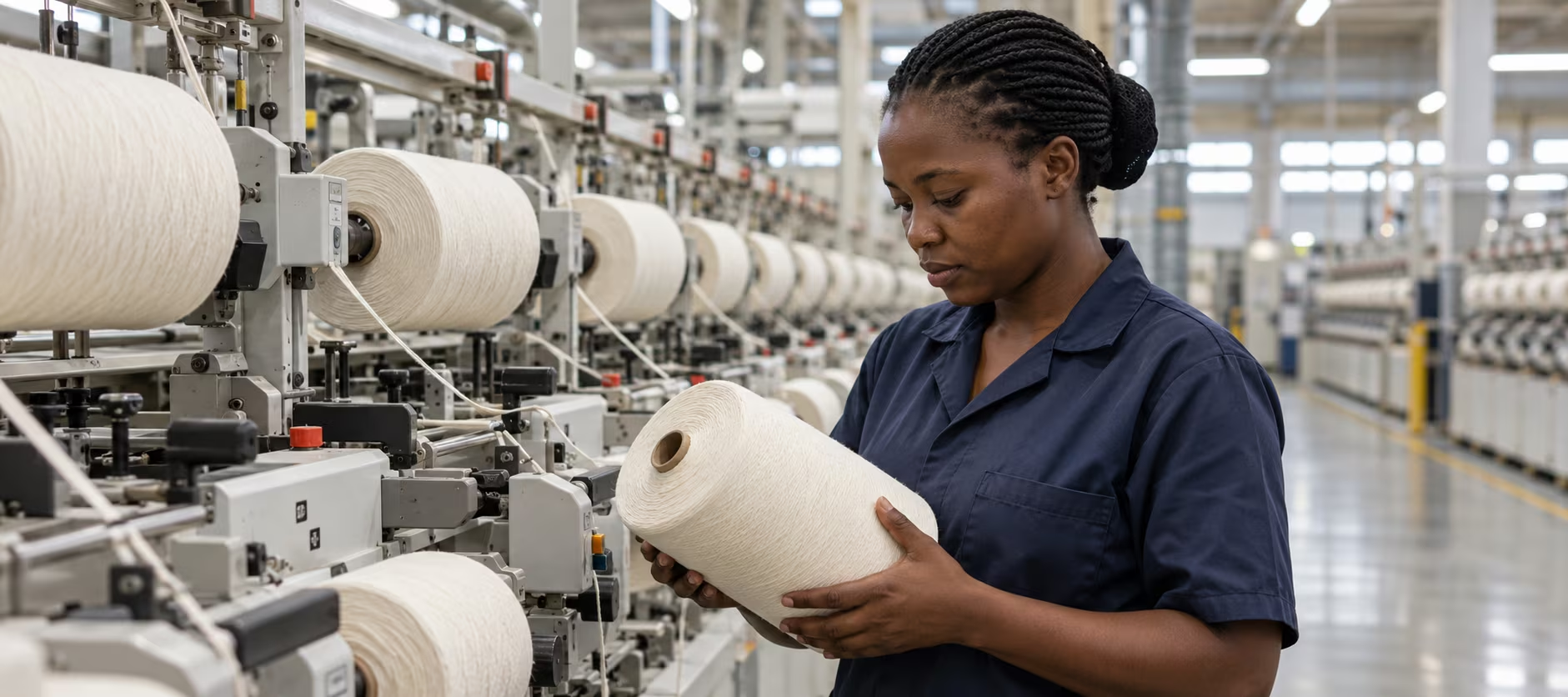
- Compact Ring Spinning: Widespread adoption of high-speed compact systems (Rieter, a few successful Chinese manufacturers & Saurer) to process medium- to extra-long-staple cotton into low-hairiness yarn.
- Open-End Rotor Automation: Increased installation of high-efficiency rotor machinery (Rieter, Saurer and new entries from Chinese manufacturers) for processing coarse yarns, denim, and recycled fiber blends.
- Digital Quality Assurance: Full integration of online fiber and yarn testing systems (e.g., Uster standards) to meet international compliance thresholds.
4. Fabric Production Quantity & Technology Trends
Greige & Finished Fabric Dynamics
| Processing Stage | Current Market Reality | Emerging Technological Trend |
|---|---|---|
| Greige Weaving | Dominated by basic woven constructions; sub-Saharan weaving lags garment capacity. | Transition to high-speed air-jet and rapier shuttleless looms in integrated SEZs |
| Knitted Fabric | Growing rapidly, driven by casualwear and activewear demand | Expansion of circular knitting lines with automated tension controls |
| Dyeing & Finishing | Constrained by energy costs and water effluent compliance | Adoption of low-liquor-ratio dyeing (Thies, Fong’s) and digital textile printing |
Read More: VDMA Sees Significant Growth Potential for Africa’s Textile Industry
5. Government Support & New Market Strategies
Policy & Trade Levers for Expansion
| Initiative | Impact on Value Chain |
|---|---|
| Special Economic Zones (SEZs) | Plug-and-play mills with ETPs & zero tax |
| AfCFTA Rules of Origin | Duty-free intra-African yarn sourcing |
| European Nearshoring | 10–14 days shipping vs. 35+ days from Asia |
Industrial Park Acceleration
African governments are moving away from piecemeal subsidies in favor of comprehensive Special Economic Zones (e.g., Benin’s Glo-Djigbé Industrial Zone and Ethiopia’s Hawassa Park). These zones provide dedicated power grids, central Effluent Treatment Plants (ETPs), and duty-free import status for textile machinery.
Trade Policy & Market Access
- AfCFTA Integration: Eliminates tariffs on intra-African trade, encouraging West African yarn to be processed in North African weaving units and assembled into garments in East Africa.
- Nearshoring Advantage: Proximity to European shipping lanes gives North and West African suppliers a significant lead-time advantage over Asian competitors.
6. Egyptian Government Insight: Industrial Transformation
State-Led Modernization & Mega Installations
Egypt stands at the pinnacle of Africa’s textile ecosystem, backed by its world-famous extra-long-staple (ELS) Giza cotton. Under the state-backed Cotton & Textile Industries Holding Company strategy, Egypt is completing a comprehensive sector overhaul:
Key Milestone: Misr El-Mahalla (Factory 1)
| Misr El-Mahalla – Factory 1 | Located in El-Mahalla El-Kubra, Factory 1 features over 180,000 spindles, positioning it among the world’s largest single-site compact spinning facilities. |
Egypt’s Strategic Textile Overhaul Pillars
| Pillar | Strategic Direction |
|---|---|
| 1. Traceability | Digital seed-to-bale tracking for Giza ELS varieties |
| 2. Scale | World-scale spinning mills (Misr El-Mahalla) |
| 3. Foreign FDI | Joint ventures in the Suez Canal Economic Zone (SCZONE) |
| 4. Export Hubs | Integrated logistics corridors into Sub-Saharan Africa |
Strategic Support & Private Sector FDI
- Purity Protections: Implementation of strict national ginning protocols to preserve the genetic purity and length of Giza cotton strains.
- SCZONE FDI Growth: Attracting foreign direct investment from Turkish, Chinese, and European mills into the Suez Canal Economic Zone for downstream finishing and garmenting.
Read More: Benin Turns Cotton Wealth Into an Emerging Textile Industrial Economy
Conclusion
Africa’s textile value chain is executing a structural transition. By bridging the historic gap between raw cotton production and finished fabric processing through modern spinning technology, special economic zones, and regional trade framework alignment, the African continent is solidifying its position as a major, vertically integrated hub for global textile manufacturing.