Thika Cloth Mills says Kenya’s renewed cotton production could support a wider industrial value chain encompassing ginning, spinning, fabric production, garments and exports—but reliable supply, financing and modern technology remain essential.
Kenya’s cotton recovery is creating opportunities beyond agriculture as textile manufacturers seek to retain more processing and manufacturing value within the country.
According to Hesborn Olweny, Cotton Development Lead at Thika Cloth Mills (TCM), the success of the revival should not be measured solely by the volume of seed cotton harvested. Its wider economic impact will depend on how much of that cotton is ginned, spun, woven, finished and converted into products within Kenya.
“Cotton is not just an agricultural commodity,” Olweny said. “The strategy is what happens after the farm.”
The textile sector has the potential to connect agriculture with industrial production, supporting employment in processing, engineering, logistics, design, garment manufacturing and retail. However, establishing that value chain will require predictable cotton volumes, consistent quality and sustained investment.
Lamu Emerges as a Cotton Production Centre
Kenya’s renewed interest in cotton cultivation has gained momentum in Lamu, where farmers are increasingly adopting Bt cotton.
Last season, Thika Cloth Mills purchased slightly more than two million kilograms of seed cotton from Lamu. Total production in the county reached approximately 3.5 million kilograms, with other ginners purchasing the remaining crop.
TCM expects production to increase as more farmers return to cotton cultivation and yields improve. The company is working directly with farmers and cooperatives to strengthen its access to locally produced raw materials.
Its longer-term objective is to support Lamu’s development as an important cotton production and processing centre, particularly for ginning. A successful model could subsequently be introduced in other cotton-producing counties.
For textile manufacturers, increasing production alone is not sufficient. Factories require a dependable supply of cotton of consistent quality throughout the year.
“We need predictable volumes and consistent quality,” Olweny said.
Processing Cotton Closer to Farmers
Locating ginning capacity near cotton-producing communities could improve both logistics and crop quality.
Seed cotton is bulky, making its transportation over long distances expensive. Delays between harvesting and processing can also affect quality. Establishing ginneries closer to farms can reduce transport requirements, accelerate processing and provide farmers with more direct access to buyers.
The economic benefits extend beyond the production of cotton lint. Ginning also generates cottonseed, which can be processed into animal feed and cottonseed oil. The oil may be used for soap manufacturing and other industrial applications.
Additional activities develop around these operations, including transport, packaging, machinery maintenance and technical services.
“The more stages we keep in Kenya, the more employment we create,” Olweny said.

From ‘Made in Kenya’ to ‘Made From Kenyan Cotton’
Kenya already has an established apparel manufacturing industry, particularly for export. However, many local manufacturers depend on imported yarn and fabric.
Consequently, a garment can be labelled “Made in Kenya” even though the cotton, yarn or fabric used in its production originated abroad.
Olweny believes Kenya should move towards producing garments that are both manufactured locally and made from domestically grown cotton.
“What we need is not simply ‘Made in Kenya’,” he said. “We need to move towards ‘Made in Kenya, from Kenyan cotton’.”
A fully connected domestic value chain would allow cotton grown in Lamu or other counties to be ginned, spun, woven or knitted and converted into garments within Kenya.
Keeping these production stages in the country would increase the value generated by each kilogram of cotton while supporting the government’s “Buy Kenya, Build Kenya” policy.
Reliable Supply Remains a Challenge
Kenyan textile manufacturers previously depended heavily on cotton imported from neighbouring Tanzania and Uganda. At certain times, domestic production could meet local industrial demand for only two or three months.
According to Olweny, the local supply situation has improved during the past two years. Nevertheless, fragmented production and uneven quality continue to present challenges.
Farmers require quality seed, agronomic assistance, agricultural inputs, extension services and dependable buyers. Manufacturers, meanwhile, require cotton to be delivered in commercially viable quantities and to consistent specifications.
Direct cooperation between textile companies, cooperatives and farmers could benefit both sides. Farmers gain greater market certainty, while manufacturers secure improved visibility over the availability and quality of their raw materials.
Cotton Farmers Need Access to Finance
The sustainability of Kenya’s cotton revival will also depend on whether farmers can access adequate financing.
Cotton producers need capital to purchase seeds and other inputs before planting. They also require timely payments following the harvest.
Olweny suggested that Kenya could consider systems used in neighbouring countries, including warehouse receipt mechanisms that allow farmers to access financing while awaiting the sale of their crops.
He also proposed establishing a dedicated cotton fund, potentially operating as a revolving facility, to improve access to production inputs.
Seed availability is particularly important for farmers cultivating Bt cotton. Although the variety provides protection against certain damaging pests, its seed is expensive, imported from India and not always available when required.
Delays in receiving seed can cause farmers to miss the appropriate planting window, directly affecting productivity and final yields.
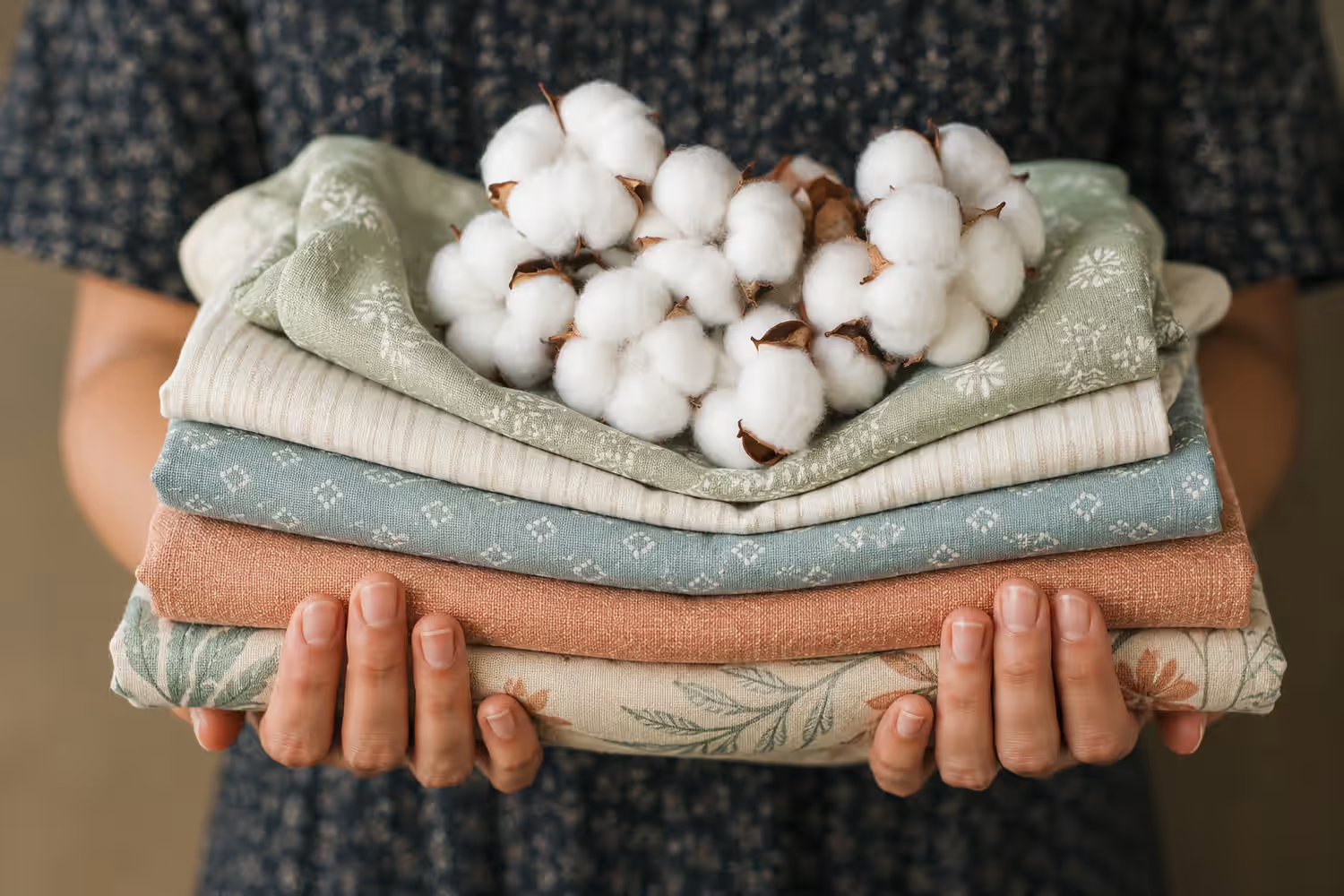
Textile Factories Require Modernisation
Building a competitive cotton-to-garment industry will require investment in modern textile machinery and manufacturing infrastructure.
Kenyan manufacturers compete with large producers in countries such as China and India, which benefit from significant scale, advanced technology and integrated supply chains.
Modernisation therefore involves more than replacing ageing production equipment. It also includes energy-efficient machinery, renewable-energy systems, wastewater treatment, digital production management and quality-control laboratories.
These investments require access to affordable, long-term capital. For an industry recovering from years of decline, financing conditions can determine whether manufacturers expand or remain unable to compete.
Investors also require predictable policies, reliable raw-material supplies, skilled employees and confidence that a market exists for locally manufactured products.
Skills Development Must Match Industrial Needs
An integrated textile sector can create demand for agronomists, ginnery workers, machine operators, mechanics, engineers, laboratory specialists, designers, packaging professionals and marketing teams.
Olweny called for closer cooperation between manufacturers, universities and Technical and Vocational Education and Training institutions. This would help ensure that training programmes reflect the practical requirements of modern textile factories.
Without appropriately trained employees, investment in new equipment may not achieve its full productivity or quality potential.
Imports Continue to Pressure Local Manufacturers
Kenyan textile producers also face competition from imported fabrics, garments and second-hand clothing, widely known as mitumba.
Concerns over counterfeit goods, low-quality imports and weaknesses in border enforcement add to the pressure on local manufacturers. The challenge is particularly difficult for companies seeking to invest in new machinery while competing with low-priced imported products.
Olweny called for stronger implementation of policies supporting local procurement and manufacturing, alongside proper taxation and regulation of imported goods.
The objective, he said, should not necessarily be to eliminate the second-hand clothing market, but to create sufficient commercial space for domestic manufacturers to invest, expand and compete.
Read more: Kenya’s Apparel Industry Gains Trade Certainty as US Senate Backs AGOA Extension to 2028
Kenya Could Become a Regional Textile Hub
Kenya’s opportunity extends beyond its domestic market. Africa possesses cotton resources, a growing workforce and expanding consumer demand, but many countries lack sufficient industrial capacity to connect raw-material production with finished textile manufacturing.
Developing an integrated cotton, textile and apparel industry could position Kenya as a regional manufacturing and sourcing centre.
“No investor will put money where they do not believe there is a good future,” Olweny said. “We are saying we are seeing the future.”
For Kenya, the ultimate measure of the cotton revival will not be the number of farmers returning to cultivation or the total kilograms harvested. It will be the amount of economic value created from that cotton before it reaches the market.
Taking cotton from the farm through ginning, spinning, fabric production and garment manufacturing could transform an agricultural recovery into a broader industrial development strategy—creating employment, businesses, technology investment and export revenue across the country.