




Why Long-Term Value Matters More Than the Initial Investment
When investing in a digital textile printing machine, the first question many manufacturers ask is simple:
“How much does it cost?”
However, according to Ali Erdem Erner of ERA Mümessillik, the official representative of Zimmer Austria in Türkiye, that may be the wrong question.
The real question should be:
How much will this machine cost throughout its entire lifetime?
As competition from lower-cost machinery manufacturers—particularly from China—continues to intensify, textile producers face increasing pressure to balance investment costs with production performance. While purchase price remains an important consideration, industry experts argue that focusing solely on the initial investment can become an expensive mistake.
Price Is Only One Part of the Equation
Chinese machinery manufacturers have become highly competitive by offering significantly lower purchase prices across many industrial sectors, including textile machinery.
But, according to Erner, textile production is not driven by price alone.
“It is impossible to replace more than 150 years of engineering knowledge simply by offering a lower price,” he explains.
Zimmer Austria has been manufacturing textile machinery for over a century and a half while maintaining production in Europe. During that time, the company has accumulated decades of engineering expertise, process knowledge and application experience that cannot easily be replicated.
Experience Becomes a Competitive Advantage
Digital textile printing is a highly technical production process where machine performance depends on much more than hardware.
Every production environment presents different challenges involving:
- Ink behavior
- Fabric characteristics
- Temperature control
- Process optimization
- Color consistency
- Machine calibration
Years of accumulated know-how allow experienced manufacturers to solve these challenges faster and more efficiently than companies with limited industrial experience.
According to Erner, this technical expertise is often the biggest difference between premium machinery suppliers and low-cost alternatives.
What Happens After the Machine Is Installed?
For many textile manufacturers, purchasing a machine is only the beginning of the investment.
The real value is determined by everything that follows, including:
- Technical support
- Spare parts availability
- Preventive maintenance
- Process optimization
- Software updates
- Operator training
- Fast service response
“When customers compare prices, we always remind them that they are not only buying a machine—they are investing in long-term support and expertise,” says Erner.
A production stoppage lasting only a few days can easily cost far more than the price difference between two competing machines.
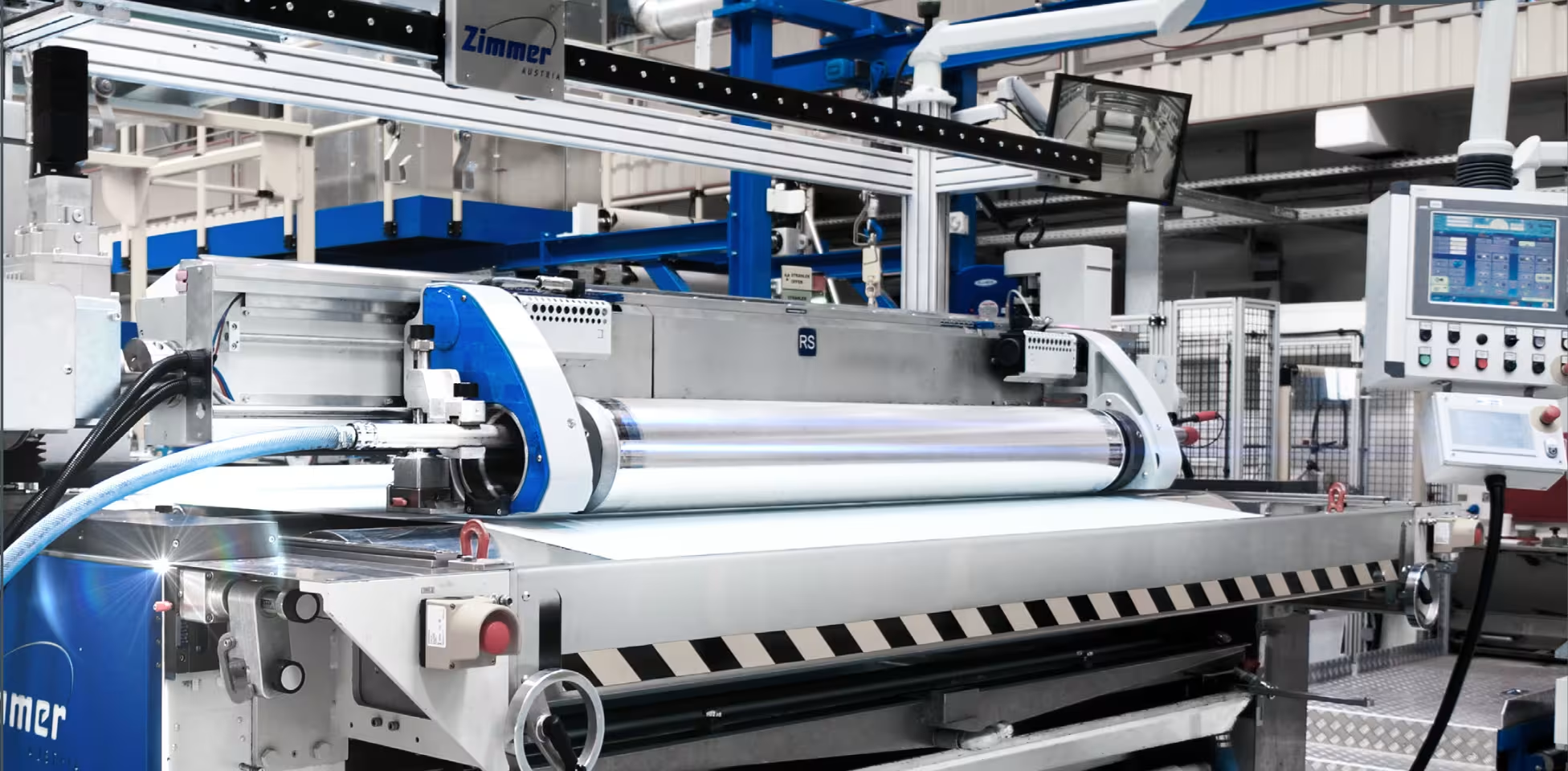
Total Cost of Ownership Matters More Than Purchase Price
The textile industry increasingly evaluates machinery based on Total Cost of Ownership (TCO) rather than purchase price alone.
A lower-priced machine may initially appear attractive, but hidden costs can quickly emerge through:
- Higher maintenance expenses
- Longer downtime
- Lower production efficiency
- Reduced print quality
- Shorter machine lifespan
- Limited technical support
Conversely, premium machinery often delivers greater profitability through higher productivity, improved reliability and lower operating costs over many years.
Built to Last for Decades
Perhaps the strongest argument for long-term value is durability.
According to Erner, Zimmer Austria still has machines installed during the 1960s that remain in production today.
When investment costs are spread over several decades of operation, the initial price difference becomes significantly less important.
For manufacturers operating around the clock, machine reliability often generates far greater financial value than a lower purchase price.
Cheap Can Become Expensive
Today’s textile manufacturers face enormous pressure to reduce production costs.
However, Erner believes purchasing machinery based solely on price can introduce significant business risks.
Production errors, inconsistent quality, unexpected downtime and insufficient technical support may ultimately cost companies far more than they initially saved.
Rather than asking which machine is cheaper, manufacturers should evaluate which supplier offers the strongest combination of:
- Engineering expertise
- Product quality
- Long-term reliability
- Service capability
- Technical know-how
- Customer support
These factors directly influence production efficiency, profitability and competitiveness.
Read more: Zimmer Austria Sees Rising Demand for Technical Textiles and Coating Technologies in Türkiye
Investing Beyond the Machine
The digital textile printing industry continues to evolve rapidly, with higher customer expectations for quality, flexibility and sustainability.
In this environment, machinery is no longer simply equipment—it becomes a long-term production partner.
While low-cost alternatives may reduce initial capital expenditure, many manufacturers increasingly recognize that the greatest return comes from investing in technology backed by decades of engineering knowledge, dependable service and continuous technical support.
As Ali Erdem Erner concludes, the highest-priced machine is not necessarily the most expensive investment—and the lowest-priced machine is not always the most economical choice.
Sometimes, paying more at the beginning is the smartest way to spend less over the lifetime of the machine.











