






AI-generated designs and virtual prototypes are transforming textile product development—but physical validation remains essential for colour, touch, performance and production accuracy
Generative artificial intelligence is rapidly changing how textile prints, fabrics, garments and home furnishing collections are conceived. A designer can now enter a written prompt and produce dozens of patterns, colourways, garment concepts or interior applications in minutes.
Combined with 3D garment simulation, digital fabric libraries, virtual showrooms and AI-generated models, these technologies are significantly reducing the time and material required to develop new textile products.
This raises an increasingly important question for textile manufacturers, fashion brands and sourcing professionals:
Are physical samples becoming obsolete?
The short answer is no—but their role is changing dramatically.
Generative AI can replace many early-stage visual samples, while accurate 3D simulation can eliminate a substantial proportion of development prototypes. However, neither technology can yet fully replace physical samples when buyers must
evaluate touch, colour, construction, durability, comfort or compliance.
The future is therefore unlikely to be completely sample-free. Instead, the industry is moving towards a digital-first, physical-final development model.
How Generative AI Is Changing Textile Sampling
A critical distinction is often overlooked in discussions about digital fashion.
Generative AI tools create new images, patterns, textures or design concepts by learning relationships within large datasets. They are particularly effective in ideation, visual experimentation and rapid presentation.
For example, AI can generate:
- Textile prints and repeat patterns
- Alternative colourways
- Garment silhouettes
- Embroidery and surface design concepts
- Home textile applications
- Virtual models and campaign images
- Trend boards and collection themes
Adobe Illustrator’s AI-powered Text to Pattern feature can generate editable vector patterns from written prompts, allowing designers to create, recolour and scale textile graphics more rapidly. Adobe also combines its Substance 3D tools with Firefly to generate and visualise customised digital materials. Adobe Illustrator, Adobe Substance 3D
Academic research similarly identifies pattern, colour and surface generation as the most visible applications of AI in fabric design. However, generating a convincing textile image is not the same as engineering a manufacturable fabric. Humanities and Social Sciences Communications
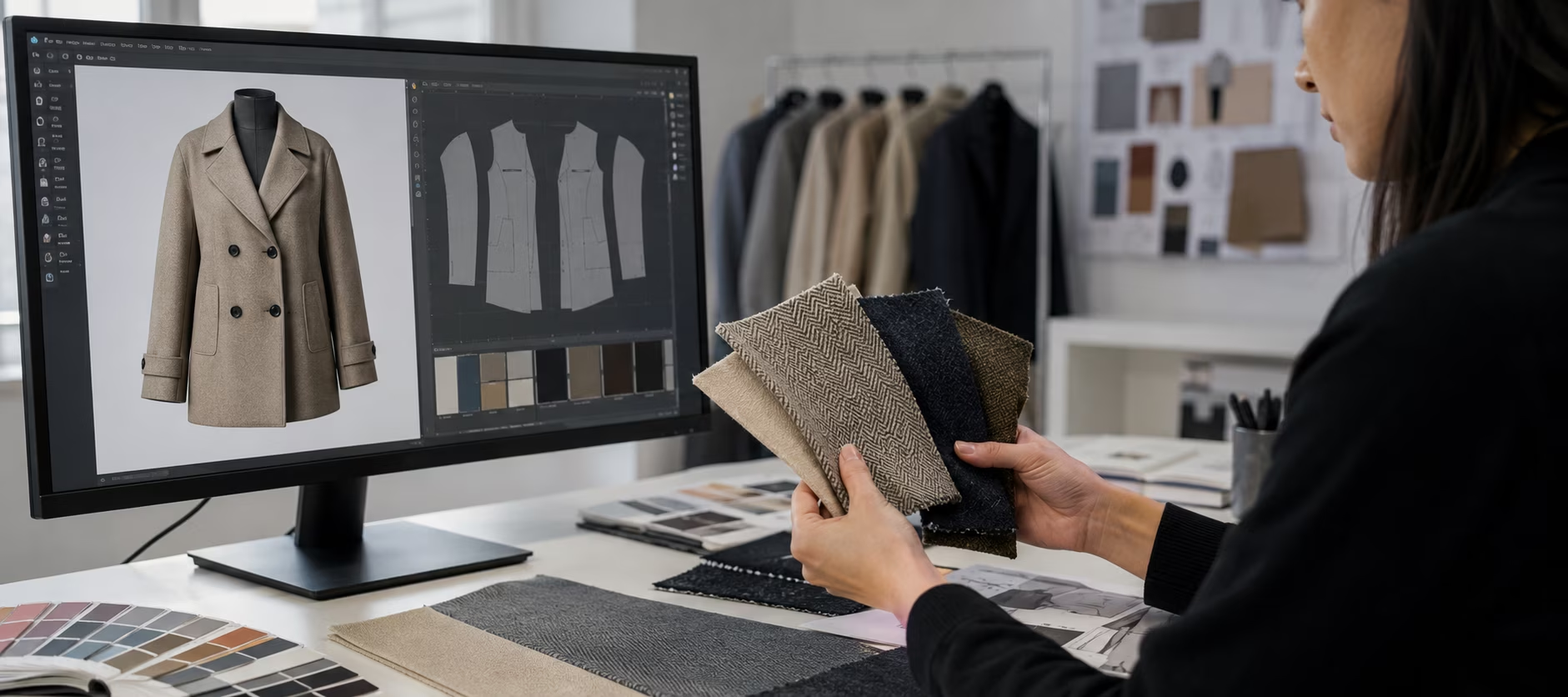
A 3D virtual sample, by contrast, normally combines:
- A production-ready pattern
- Garment measurements
- Sewing and construction information
- Avatar or body measurements
- Fabric weight and thickness
- Stretch and recovery data
- Bending and drape properties
- Surface appearance and texture
Generative AI is therefore primarily an ideation and visualisation tool, while physics-based 3D simulation is a product-development and validation tool.
AI may generate an attractive jacket, carpet or upholstery concept, but unless that image is connected to verified material data, patterns and manufacturing specifications, it remains a visual proposal rather than a digital twin.
What can already be replaced?
Concept samples and mood boards
Generative AI can largely replace manually produced concept mock-ups during the earliest stages of development.
Design teams can explore different aesthetics, colour combinations, textures and product applications without printing fabric, sewing prototypes or organising photography.
This is particularly valuable when developing seasonal collections. Instead of manufacturing multiple speculative options, companies can evaluate a broader range of concepts digitally and select only the strongest designs for further development.
Print and pattern variations
AI-generated vector patterns can accelerate the creation of repeat prints, geometric motifs, florals and decorative graphics. Designers can generate multiple options, edit individual elements and apply approved colour palettes before conducting strike-offs.
This does not eliminate the eventual need to test printing behaviour, colour fastness or fabric interaction, but it can substantially reduce the number of initial print trials.
Early garment prototypes
Virtual prototyping platforms can simulate garment appearance, fit, drape and proportion before fabric is cut.
Browzwear states that companies using its digital apparel platform can achieve between 50% and 80% fewer physical samples.
The company also reports that some less complex product categories can progress to production without a physical development sample. These are vendor-reported results and will vary according to product complexity, material data and the digital maturity of the supply chain.
Lectra similarly states that virtual prototyping can reduce physical sampling by up to 50%, while enabling patterns and fabric behaviour to be evaluated earlier in product development.
Read more: AI in Textile Industry Transforming Fashion Savings Sustainability
Sales and merchandising samples
Many brands produce samples not only for technical development but also for buyer meetings, internal collection reviews, catalogues, wholesale presentations and e-commerce preparation.
High-quality digital assets can replace many of these samples. Buyers can review complete virtual collections, compare colourways and approve assortments before final products exist.
The same approved digital asset can subsequently be used in:
- Wholesale presentations
- Virtual showrooms
- Online catalogues
- E-commerce testing
- Social media campaigns
- Market research
- Pre-order programmes
This creates an important commercial advantage: brands can measure market interest before committing to large quantities of fabric and finished inventory.
The environmental case for virtual sampling
Physical sample development consumes fabric, trims, thread, dyeing and finishing chemicals, electricity, packaging and international freight. Multiple correction rounds amplify these environmental impacts.
A factory-based life-cycle assessment published in the Journal of Cleaner Production compared conventional and virtual sampling for four garment models. The study found that replacing physical samples with virtual alternatives reduced global warming potential, human toxicity and primary energy demand by approximately 85% to 90%.
Water consumption fell by approximately 86% to 91%, depending on the garment, while sample preparation time was reduced by as much as 73%.
These results demonstrate that virtual sampling can deliver measurable benefits beyond attractive presentations. It can reduce the environmental burden associated with material preparation, sewing, finishing, packaging and sample transportation.
However, digital sampling is not impact-free. Rendering, cloud computing, data storage and generative AI require electricity. The environmental value of digitalisation therefore depends partly on energy sources, computing efficiency and whether digital tools genuinely replace physical activity instead of simply adding another layer to the process.
Why physical samples are not yet obsolete
Touch cannot be fully communicated through a screen
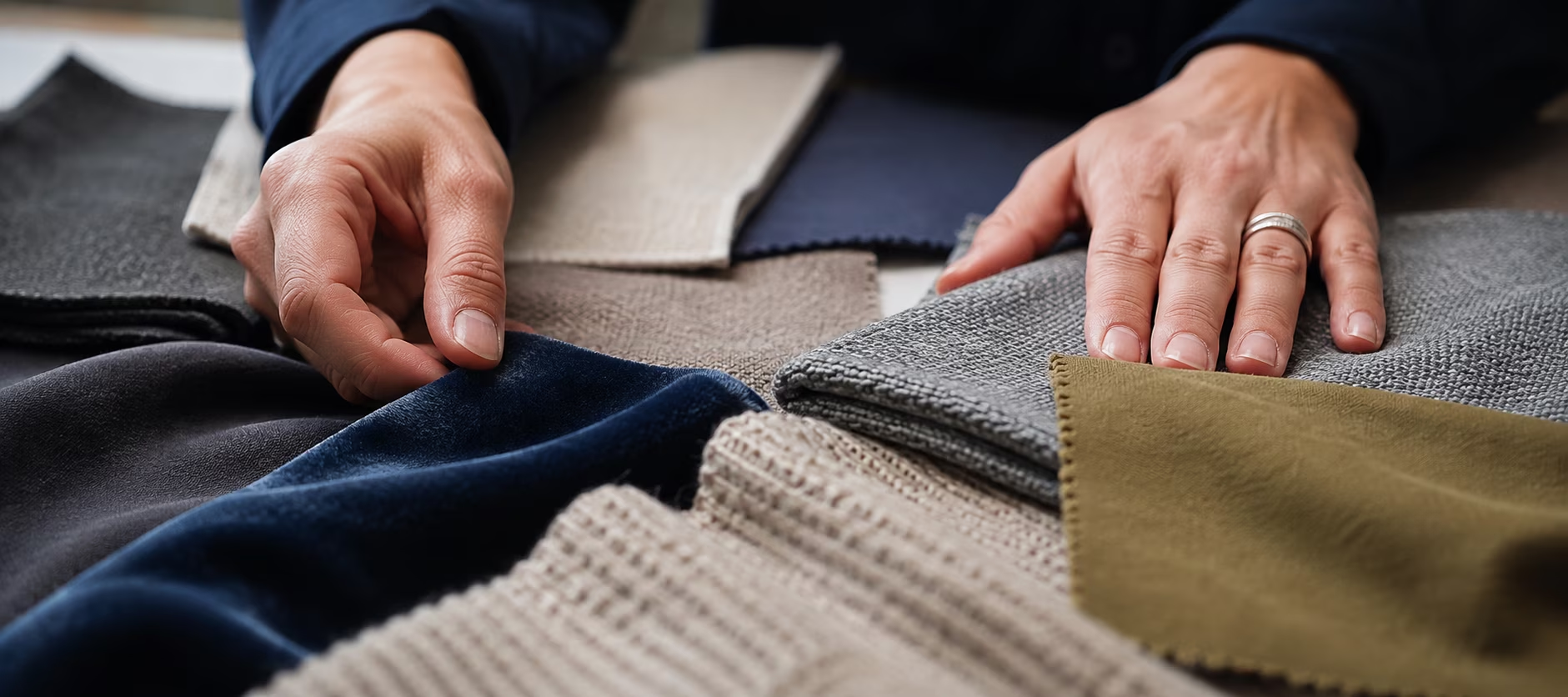
Textiles are sensory materials. Buyers evaluate softness, warmth, smoothness, dryness, bulk, compression, elasticity and surface character by touching the fabric.
A digital image can make velvet appear soft or a chenille fabric look voluminous, but it cannot allow the buyer to feel pile density, recovery, friction or skin comfort.
Research into tactile simulation is progressing, including systems designed to reproduce fabric sensations using haptic signals. Nevertheless, realistic virtual reproduction of textile touch remains a developing field rather than a standard commercial sourcing tool.
This limitation is especially significant for:
- Luxury fabrics
- Velvet and chenille
- Towels and bath textiles
- Bedding
- Carpets and rugs
- Performance sportswear
- Lingerie
- Upholstery
- Coated and laminated textiles
In these categories, hand feel can be as important as appearance.
Digital colour still requires controlled measurement
A fabric colour displayed on a laptop may look different on another screen. Ambient lighting, monitor calibration, fabric structure, yarn lustre and finishing processes all influence colour perception.
Digital colour management can significantly reduce the exchange of physical lab dips and colour swatches. AATCC notes that digital tools can improve colour communication and reduce the need to transport samples between supply-chain partners.
However, accurate digital colour approval requires a controlled workflow involving calibrated instruments, standard illumination, spectrophotometric data and agreed tolerances. A generic AI-generated image cannot provide this level of accuracy.
Fluorescent materials, metallic yarns, pile fabrics, mélange effects and fabrics that change appearance under different light sources remain particularly difficult to evaluate remotely.
A visual simulation cannot certify performance
AI can predict what a fabric or garment might look like, but it cannot prove how the product will perform after repeated use.
Physical testing remains necessary for properties such as:
- Colour fastness
- Abrasion resistance
- Pilling
- Tensile and tear strength
- Dimensional stability
- Seam strength
- Water repellency
- Air permeability
- Moisture management
- Flammability
- Antimicrobial performance
- Resistance to perspiration and washing
AATCC maintains extensive physical test methods covering colour fastness, water resistance, appearance, abrasion, fibre analysis and other textile properties. These tests require representative material specimens rather than visual simulations.
For technical textiles, protective clothing, automotive fabrics and medical products, physical testing is not merely preferable—it is essential for compliance and risk management.
Fabric simulation depends on reliable physical data
A realistic 3D garment requires verified fabric properties. If a designer applies a visually similar fabric preset without measuring the actual material, the virtual result may look convincing while behaving differently from the final garment.
Critical inputs include:
- Weight
- Thickness
- Bending stiffness
- Stretch
- Recovery
- Shear behaviour
- Friction
- Shrinkage
- Surface texture
This creates an important paradox: a digital sample may replace a complete sewn prototype, but companies often still need a physical fabric swatch to measure and digitise its properties.
CLO’s guidance on comparing 3D and real-life samples also reflects the continuing need to calibrate digital simulations against physical outcomes.
Complex construction still requires validation
Simple T-shirts, sweatshirts and basic garments are strong candidates for low-sample or sample-free development, particularly when brands use established patterns and familiar fabrics.
The risk increases with:
- Tailored garments
- Lingerie and shapewear
- Highly elastic sportswear
- Seam-sealed outerwear
- Multi-layer protective clothing
- Engineered knitwear
- Wash-effect denim
- Products combining several materials
- Complex embroidery or embellishment
- Performance garments requiring precise pressure or support
In these products, fabric behaviour interacts with seams, linings, interlinings, elastics, adhesives, trims and finishing treatments. A digital material model alone may not capture the behaviour of the complete assembly.
Where generative AI can be misleading
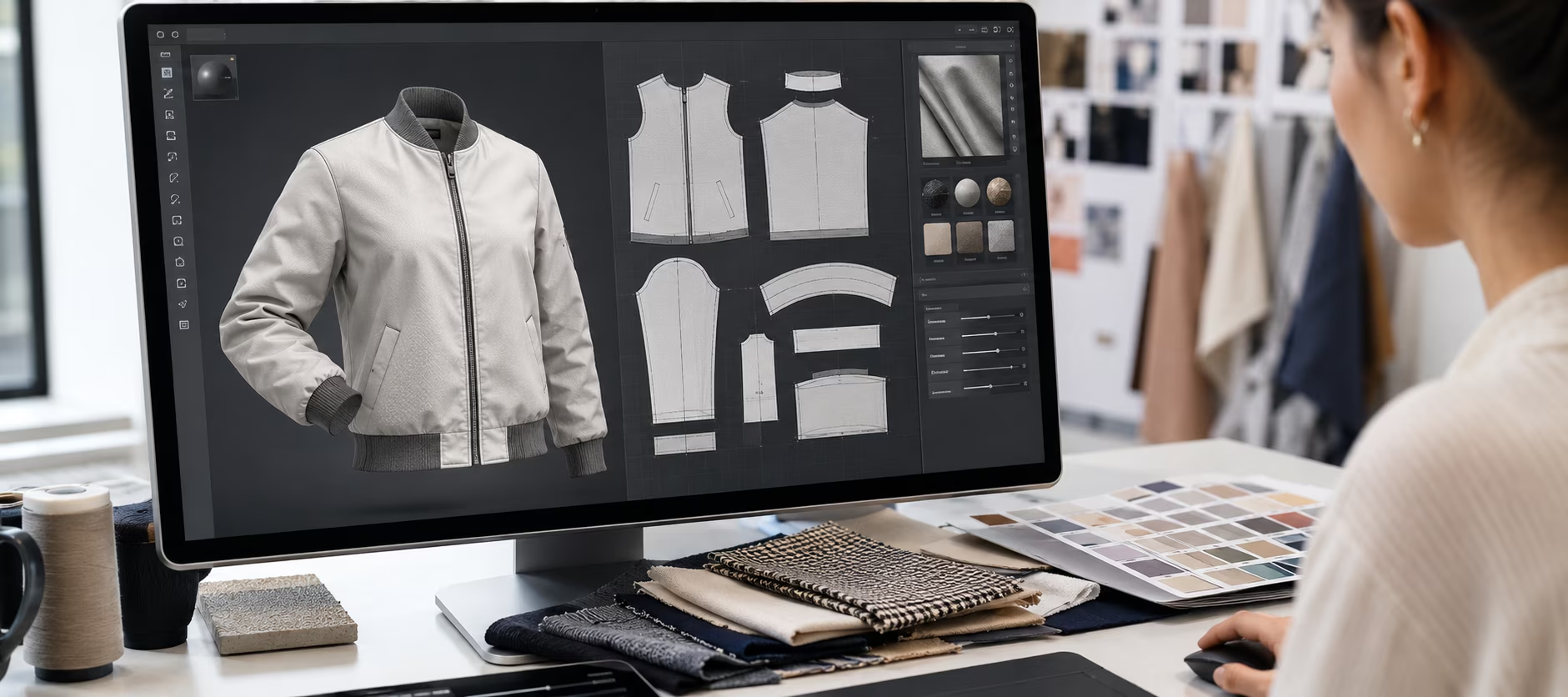
Generative AI produces statistically plausible results. It does not automatically understand textile engineering or factory constraints.
An AI-generated garment may include:
- Seams that cannot be constructed
- Unsupported shapes
- Inconsistent patterns between front and back
- Unrealistic drape
- Impossible jacquard structures
- Excessive colour counts for a printing process
- Details requiring unavailable machinery
- Textures that do not correspond to a real yarn or weave
- Attractive effects that cannot be reproduced economically
Research into generative design has identified manufacturability as a broader challenge: complex AI-generated concepts often require manual modification before they can enter mass production.
In textiles, this gap makes human expertise more important, not less. Designers, textile technologists, pattern makers, colourists and production engineers must translate AI output into achievable specifications.
Generative AI should therefore be treated as a creative collaborator—not as proof that a product can be manufactured.
A new hierarchy of textile samples
The industry is gradually moving from repeated physical sampling towards a more selective model.
| Development stage | Best-suited format | Is a physical sample necessary? |
|---|---|---|
| Trend research and ideation | Generative AI | Usually no |
| Pattern and colour exploration | AI and digital design | Usually no |
| Initial collection review | 2D or 3D visualisation | Often no |
| Fit and proportion review | Physics-based 3D sample | Depends on complexity |
| Buyer presentation | Digital twin or virtual showroom | Often no |
| Fabric hand-feel approval | Physical swatch | Yes |
| Precise colour approval | Digital colour data plus controlled sample when required | Sometimes |
| Construction validation | Physical prototype | Frequently |
| Performance and compliance testing | Physical material or garment | Yes |
| Final pre-production approval | Digital and physical verification | Usually yes |
This model can be described as a sample pyramid: hundreds of ideas are generated digitally, a smaller number are converted into accurate 3D prototypes, and only the most promising designs proceed to physical validation.
The most realistic future: fewer, smarter samples
Physical samples will not disappear simultaneously across the textile industry. Their decline will vary by product type, company and supply chain.
Basic garments made from previously tested fabrics may reach production with very few prototypes. Fashion prints and home textile patterns can be evaluated digitally before strike-offs are prepared. Virtual collections may replace showroom samples and early sales sets.
By contrast, tactile, technical and performance-driven products will continue to require physical verification.
The decisive factor will not be whether a company has access to generative AI. It will be whether its digital workflow is connected to reliable product data.
A credible digital development system requires:
- Standardised digital fabric data
- Accurate patterns and construction specifications
- Calibrated colour-management systems
- Integration between 3D, PLM and factory workflows
- Libraries validated against real production
- Clear rules determining when physical approval remains mandatory
Without this infrastructure, generative AI may produce faster images but not necessarily better products.
Read more: Digital Clones and Virtual Influencers: How AI Is Reshaping Fast-Fashion Marketing
Conclusion: physical samples are evolving, not disappearing
Generative AI is making many traditional concept samples obsolete. Physics-based 3D technology is also reducing the number of fit, development, sales and merchandising samples required by apparel companies.
But a photorealistic image is not a fabric, and a visually convincing virtual garment is not automatically production-ready.
Physical samples remain critical wherever decisions depend on touch, exact colour, construction, comfort, durability, safety or regulatory compliance. The strongest development model is therefore neither entirely physical nor completely virtual.
The future of textile product development will be AI-assisted, data-driven and digital-first—but physically verified where material reality matters.
For textile manufacturers, the strategic question is no longer, “Can we eliminate every sample?” It is:
Which samples create real technical value, and which can now be replaced by trusted digital information?











