An interview with Fateme Kojouri, Sustainability at Milano Unica
For international textile buyers, sustainability increasingly requires clear evidence about materials, production processes and supply-chain practices. Milano Unica is responding through its MU Tendenze & Sostenibilità project, which presents specific sustainability information alongside selected textile samples to support more informed sourcing decisions.
In this interview with Kohan Textile Journal, Fateme Kojouri, Sustainability at Milano Unica, discusses the exhibition’s approach to transparency, emerging developments in circularity and chemical safety, and the importance of combining environmental responsibility with quality, creativity and performance. She also explores opportunities in the Middle East and Africa and how digital services can strengthen connections between exhibitors and buyers beyond the exhibition.
Milano Unica’s Role in High-End Textile Sourcing
Q: Milano Unica has established itself as one of the key international events for high-end textiles and accessories. What makes the exhibition particularly important for the global textile and fashion industry today?
Milano Unica occupies a distinctive position because it brings together, in one place, the excellence of Italian and European textile manufacturing with a strong focus on creativity, quality and innovation.
Its identity is not simply that of a trade fair, but of a platform where the textile industry can present its most advanced proposals and where brands, designers and international buyers can discover the materials that will contribute to shaping future fashion collections.
The increasingly international profile of the exhibition is particularly significant. At the latest edition, international buyers represented almost 50% of total attendance, confirming the growing global relevance of Milano Unica. At the same time, the increase in European exhibitors reinforces its role as a leading showcase for Made-in-Europe textile excellence.
What makes Milano Unica particularly relevant today is therefore the combination of selection and openness: a highly qualified offer, strong manufacturing know-how and a constant dialogue with international markets. In a rapidly changing industry, professionals are looking not only for products, but for reliability, innovation, traceability and long-term partnerships.
Read More: Milano Unica: The Leading Italian Textiles
Moving Sustainability Beyond Generic Claims
Q: Sustainability has become an increasingly important part of Milano Unica. How is the exhibition helping textile companies present and communicate their sustainable innovations in a credible and transparent way?
For Milano Unica, sustainability is not simply a trend or a communication theme. It is increasingly integrated into the way products and companies are selected and presented.
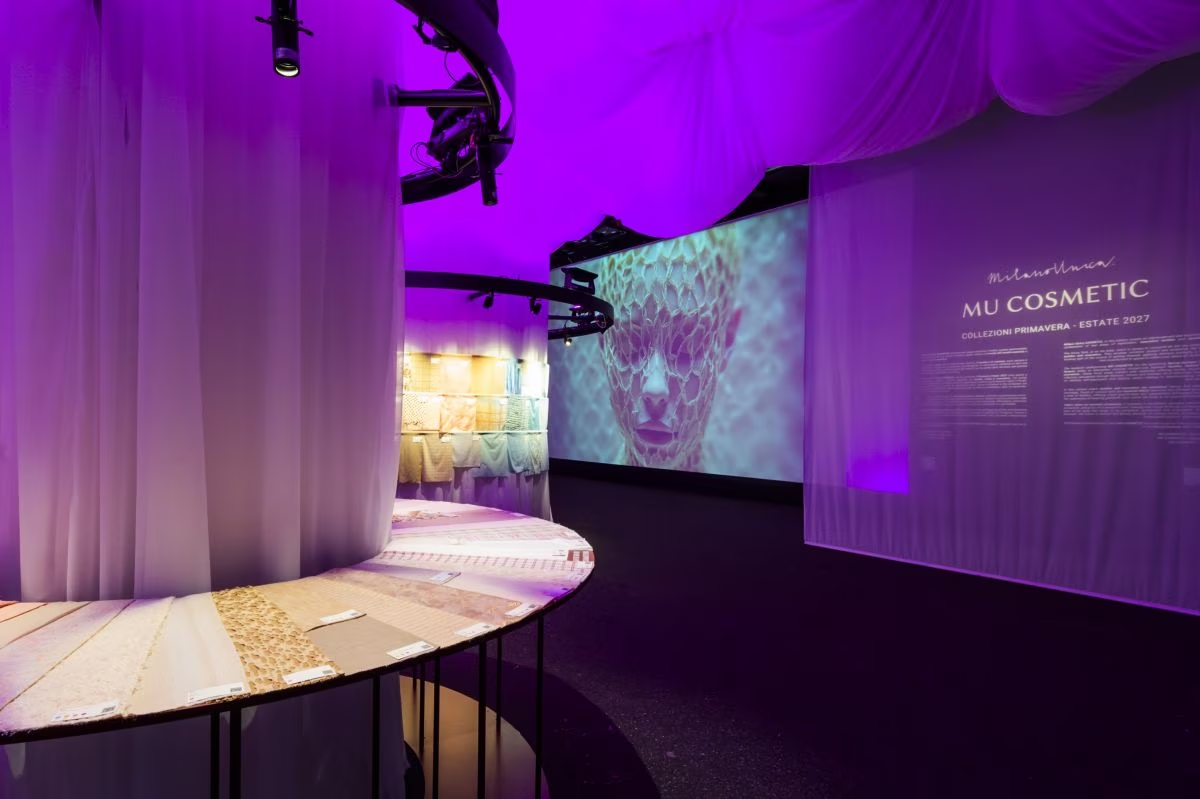
The MU Tendenze & Sostenibilità project is a concrete example. The samples presented are accompanied by information that identifies specific sustainability characteristics, rather than relying on generic claims. The framework considers five main areas: Climate Action, Chemical Safety, Biodiversity Preservation, Circular Economy and Social Justice. It also provides information on aspects such as sustainable management systems, Product Environmental Footprint declarations and supply-chain traceability.
This approach is important because credibility depends on the ability to distinguish between a product that simply communicates a sustainable message and one for which specific processes, standards, certifications or management systems can be identified.
The objective is therefore to give buyers and designers useful information with which to evaluate materials, while encouraging companies to make their sustainability journey increasingly measurable and transparent.


Circularity and Chemical Safety Move Into the Product
Q: From your perspective, what are the most important sustainability trends currently emerging among the fabrics, materials and technologies presented at Milano Unica?
One of the clearest developments is that sustainability is becoming much more integrated into the product itself and into the entire production process.
We are seeing a strong focus on circularity, resource efficiency and chemical safety, together with increasing attention to traceability and the environmental impact of products. The research is also moving towards materials with a lower environmental impact, the use of recycled or more responsibly sourced raw materials, renewable energy and production processes designed to reduce emissions and resource consumption.
The most interesting aspect, however, is that sustainability is no longer necessarily presented as something separate from aesthetics and performance. The challenge for textile companies is to combine environmental responsibility with quality, functionality, beauty and creativity.
This is precisely the direction of the MU Tendenze & Sostenibilità project. For the latest edition, more than 3,100 samples from over 360 exhibitors were selected, and 81% of the accepted samples were produced using processes complying with recognised certifications, standards or protocols concerning the elimination of harmful chemicals.
Middle East and Africa Offer New Opportunities
Q: Milano Unica attracts international buyers and manufacturers. How important are markets outside Europe — particularly the Middle East, Türkiye and Africa — for the exhibitors and the future international development of the show?
International markets are increasingly important for Milano Unica and for its exhibitors. Beyond the traditional European markets, we are paying growing attention to the new markets such as the Middle East and Africa, which present interesting opportunities and evolving demand for high-quality textiles.
Our approach is to strengthen Milano Unica’s international reach progressively, focusing on qualified professionals and on markets where there is a genuine interest in the quality, creativity and manufacturing excellence represented by our exhibitors.
The objective is not simply to increase the number of international visitors, but to create new, valuable business connections while maintaining the highly selective positioning of the exhibition.
Digital Services Extend the Buyer–Exhibitor Relationship
Q: Looking ahead, how do you see Milano Unica evolving over the next few editions, and what should international textile professionals expect from the exhibition in terms of sustainability, innovation and new business opportunities?
Milano Unica is evolving as an increasingly integrated platform where business, research, sustainability, creativity and digital services work together.
The physical exhibition will remain essential because textiles are materials that need to be seen, touched and experienced. At the same time, digital tools such as e-MilanoUnica Connect and the Milano Unica app can extend the relationship between exhibitors and buyers before and after the three days of the exhibition, making the business experience more continuous and effective.
In terms of sustainability, we expect the focus to move progressively from declarations towards measurable information, traceability and greater transparency. Innovation will continue to be central, not only through new fibres and materials but also through production technologies, processing techniques and solutions capable of combining performance with a lower environmental impact.
Finally, we believe that one of Milano Unica’s most important roles will be to help companies respond to a rapidly changing international market. The latest edition demonstrated that the exhibition is becoming increasingly international, with nearly half of visitors coming from outside Italy.
The Milano Unica of the future should therefore remain faithful to its fundamental values — quality, creativity, manufacturing excellence and Italian and European know-how — while becoming increasingly open to new markets, new technologies and new forms of collaboration. The ultimate objective is to create the conditions for exhibitors and international buyers to discover not only new products, but also new ideas and new business opportunities.