




At ITM 2026, ERA Mümessillik’s Alican Alkım Şar explained how changing order patterns, growing tufting capacity and digital printing could push Turkish carpet producers toward more flexible manufacturing.
Türkiye’s carpet manufacturing industry is entering a period in which production flexibility may become increasingly important alongside scale and capacity.
Speaking with Kohan Textile Journal during ITM 2026 in Istanbul, Alican Alkım Şar of ERA Mümessillik ve Makina discussed how investment trends, changing customer requirements and new production technologies are reshaping different segments of the Turkish carpet industry.
From growing polyester-based raschel production to expanding tufting capacity and new applications for digital carpet printing, Şar believes manufacturers are increasingly looking for production models that can respond to more designs, smaller quantities and shorter product cycles.
Polyester Investment Supports Growth in Raschel Carpets
One of the developments highlighted during the interview is the expansion of polyester-based carpet manufacturing in Türkiye.
According to Şar, increased investment in polyester has contributed to stronger activity in the raschel carpet segment, particularly for products targeting more price-sensitive international markets.
Raschel production provides manufacturers with an opportunity to address lower-cost product categories while diversifying beyond conventional machine-made woven carpet structures.
For Turkish manufacturers competing in international markets where affordability remains an important purchasing factor, continued development of this segment could create additional export opportunities.
Tufted Carpet Manufacturing Is Attracting New Investment
Tufting is another area where production capacity is expanding.
Türkiye already has significant experience in tufted carpets, particularly in wall-to-wall applications, and Şar noted that existing manufacturers are increasing capacity while new investment interest continues to emerge.
The development is important because tufting offers manufacturers different possibilities in terms of construction, design and production flexibility compared with traditional woven carpet manufacturing.
Some producers that have historically worked with pre-dyed yarn are also beginning to evaluate printing technologies as another method for creating colour and design variation.
Customers Want More Designs in Smaller Quantities
Behind these technology investments is an important change in how carpets are being purchased.
Traditional carpet production was often built around long runs of a relatively small number of designs and colours. Large volumes helped manufacturers maximise machine efficiency and reduce unit production costs.
Today, buyers increasingly want broader collections, faster design changes and smaller quantities of individual products.
“Today, there may be 100 or 150 different designs within the same truck.”
This change creates new challenges for manufacturers whose production systems were originally optimised for large quantities of identical or similar products.
More designs can require additional coloured-yarn inventories, more production changes and more complicated planning. As order quantities become increasingly fragmented, flexibility can therefore become an important part of manufacturing efficiency.
Digital Carpet Printing Reduces Dependence on Coloured Yarn
This is where digital carpet printing could become strategically important.
Instead of producing every colour and design through different coloured yarn combinations, manufacturers can potentially produce a suitable base carpet and introduce part of the final design through digital printing.
This approach can reduce the need to maintain large inventories of yarn in many different colours while making smaller production quantities more commercially practical.
For manufacturers serving fashion-driven home furnishing markets, this could also shorten the time required to introduce new designs.
ERA Mümessillik has been expanding its activities in textile printing and finishing technologies, combining machinery representation with technical service, spare parts and engineering support for Turkish textile manufacturers.
Digital Printing Could Also Open New Possibilities for Woven Carpets
Perhaps one of the most significant parts of the discussion concerns conventional woven carpets.
Gaziantep is one of the world’s largest centres for machine-made woven carpet production, where manufacturers have built extensive capacity around high-volume weaving.
Şar explained that trials have been carried out on different carpet constructions to evaluate whether digital printing could be applied successfully to woven carpets as an additional manufacturing process.
According to the interview, tests in Türkiye and Iran have produced encouraging results across different materials, including polyester, acrylic and BCF-based carpet constructions.
One of the technical challenges is achieving sufficient colour penetration into the pile rather than printing only the surface. Şar said trials have achieved penetration through pile heights of approximately 20–25 mm.
If commercialised more widely, the approach could allow woven carpet manufacturers to combine their existing weaving capacity with a more flexible design process.
Existing Weaving Capacity Could Be Used More Efficiently
The concept could become especially relevant at a time when some woven carpet producers are operating below their maximum production capacity. Şar estimated that some manufacturers in Gaziantep are currently operating at approximately 50–60% capacity.
Under these conditions, manufacturers may not always need additional conventional weaving capacity. Instead, part of the existing machinery could potentially produce base carpet constructions that are subsequently customised through printing.
This represents a different approach to textile machinery investment. Rather than simply increasing output by installing more machines, manufacturers can focus on extracting more commercial flexibility from existing production assets.
Inventory Could Become an Important Part of the Digital Printing Equation
Another potential advantage involves working capital and inventory management.
Traditional carpet manufacturers may need to maintain substantial stocks of coloured yarn to support large design collections. As the number of colours and designs increases, the financial and logistical burden of these inventories also grows.
Some yarn may remain unused for extended periods, while changing design trends can reduce the commercial value of colours already held in stock.
Digital printing potentially changes this model by allowing manufacturers to maintain more standardised base materials while introducing colour and pattern closer to the final customer order.
For producers working with hundreds of designs, the impact could extend beyond production flexibility to inventory costs and working-capital efficiency.
ERA and Zimmer Austria Target Türkiye’s Changing Printing Market
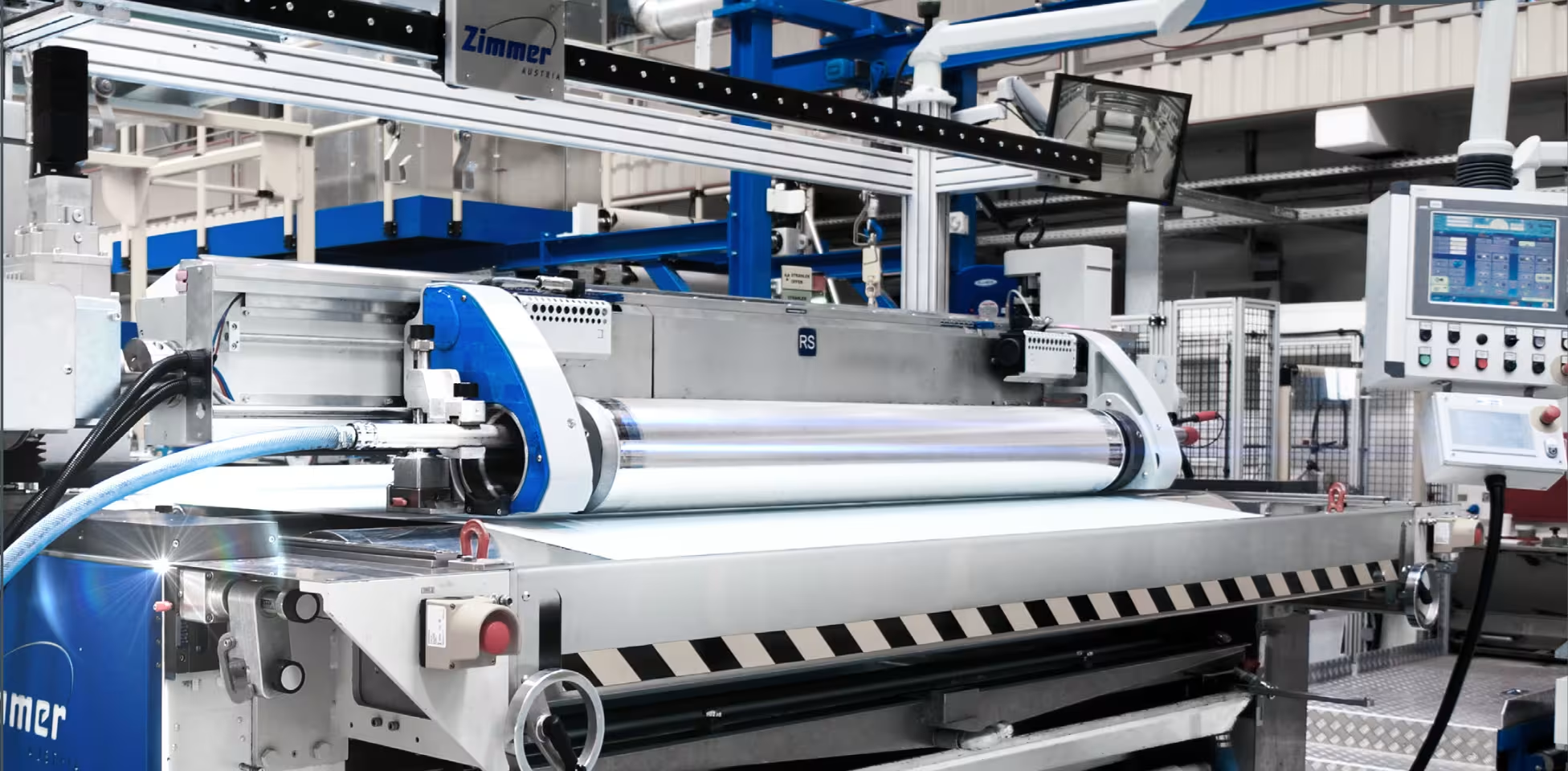
ERA Mümessillik currently represents ZIMMER AUSTRIA in Türkiye across Digital Printing Systems and Screen Printing & Coating Systems.
The cooperation gives ERA a direct role in introducing industrial digital printing technologies to Turkish textile and carpet manufacturers while providing local market knowledge and technical support.
Gaziantep has become particularly important in this development as manufacturers increasingly gain practical experience with industrial carpet printing systems.
Read more: Zimmer Austria Sees Rising Demand for Technical Textiles and Coating Technologies in Türkiye
From Mass Production to Flexible Carpet Manufacturing
Türkiye’s carpet industry is unlikely to move away from large-scale production. Manufacturing capacity, technical knowledge and an established export infrastructure remain some of the country’s strongest competitive advantages.
What may change is how manufacturers define efficiency.
Producing the highest possible volume at the lowest possible cost will remain important, but future competitiveness may increasingly depend on the ability to offer more designs, smaller quantities and faster product development without creating excessive inventory.
Raschel production is expanding Türkiye’s presence in more price-sensitive markets. Tufting investment is creating new manufacturing possibilities. Woven carpet producers are examining ways to improve utilisation of their existing machinery.
Digital carpet printing could connect these developments by giving manufacturers a more flexible route to colour, design and product differentiation.
For Gaziantep and the wider Turkish carpet industry, the next competitive advantage may therefore come not simply from producing more carpets, but from producing a greater variety of products more efficiently.











