




By: T. A. Motasim Billah
Head of Processing, Osiyo Home Textile (Namangan, Uzbekistan)
B. Sc in Textile Engineering, DIU (Bangladesh)
M. Sc in Textile Engineering, NamDTU (Uzbekistan)
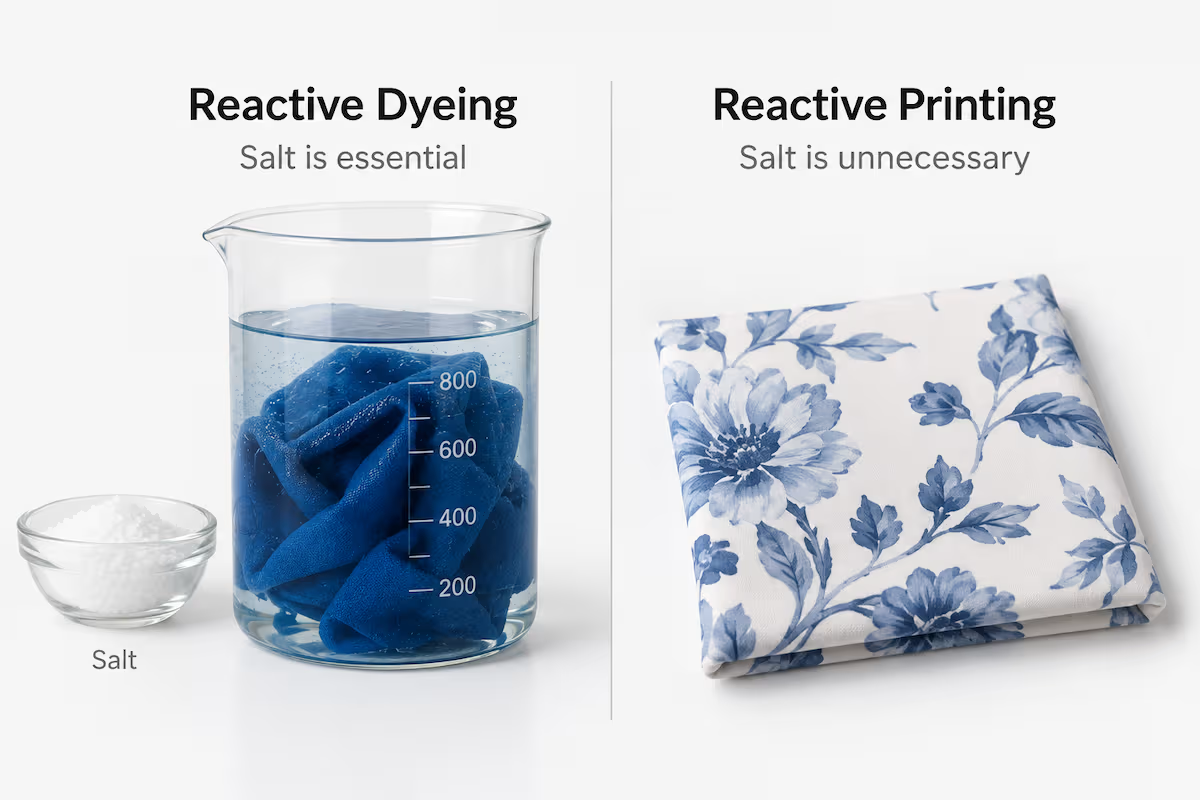
Why Is Salt Essential in Reactive Dyeing but Unnecessary in Reactive Printing?
Reactive dyes are widely used in the textile industry due to their brilliant shades, excellent wash fastness and versatile application on cellulosic fibers. However, the role of salt in reactive coloration differs significantly between dyeing and printing. In reactive dyeing, salt typically sodium chloride or sodium sulfate is essential to overcome electrostatic repulsion between negatively charged dye molecules and the cotton fiber surface.
It promotes dye exhaustion, improves fixation and ensures uniform shade development. Conversely, in reactive printing, salt is unnecessary and even undesirable, as the dye is directly applied to the fabric surface through a thickened paste. The addition of salt in printing paste destabilizes viscosity, causes dye migration and reduces design sharpness. Instead, a specialized auxiliary known as resist salt (an oxidizing sulfonic acid derivative) is used in printing to prevent background staining and achieve clear resist effects.
This article explores the chemical basis of salt application in reactive dyeing and printing, with a focus on the properties, advantages, and limitations of common salt, Glauber’s salt and resist salt. It also discusses environmental challenges caused by high salt discharge in effluents and highlights eco-friendly alternatives such as low-salt dyeing systems, cationization of cotton and effluent recycling. By clarifying the distinct roles of salt in dyeing and printing, this study bridges theory with industrial practice and emphasizes the importance of sustainable salt management in textile processing.
Introduction
The textile industry is one of the most chemically intensive sectors, relying heavily on dyes, auxiliaries, and finishing agents. Among all dye classes, reactive dyes hold a unique position because of their bright shades, wide color gamut and superior wash fastness.
Reactive dyes form permanent covalent bonds with cellulose fibers, resulting in long-lasting coloration. This strong chemical bonding ensures that garments retain their brilliance even after repeated washing.
However, there are clear differences between reactive dyeing and reactive printing. In dyeing, large volumes of aqueous dye solution are used and fiber-dye interaction requires careful management of electrolytes. In printing, the process is localized that the dye is already positioned in paste form directly on fabric, so the chemistry of fixation is different. This difference explains why salt is considered essential in reactive dyeing but unnecessary in reactive printing.
This article will explore the detailed technical explanation of the phenomenon, with emphasis on three key salts used in textile processing- Glauber’s salt (sodium sulfate), common salt (sodium chloride) and resist salt (oxidizing sulfonic acid derivatives). Their chemical behavior, roles, advantages, limitations and environmental impacts will also be covered in detail.
Comparison of Common Salt, Glauber’s Salt and Resist Salt in Textile Processing
| Salt Type | Chemical Name | Main Application | Chemical Role | Stage of Use | Key Limitations |
|---|---|---|---|---|---|
| Common Salt | Sodium Chloride (NaCl) | Reactive dyeing | Promotes dye exhaustion by reducing electrostatic repulsion between negatively charged reactive dyes and cellulose fibers. | Added to the dye bath before fixation with alkali. | Rapid exhaustion may cause uneven shades, especially in dark colors; high effluent salt load; can contribute to equipment corrosion. |
| Glauber’s Salt | Sodium Sulfate Decahydrate (Na₂SO₄·10H₂O) | Reactive dyeing | Promotes controlled dye exhaustion and helps move reactive dye from the solution toward the fiber. | Added during the dyeing and exhaustion stage before alkali fixation. | More expensive than common salt and requires heavier handling. |
| Resist Salt | Sodium m-Nitrobenzene Sulfonate | Reactive printing | Acts as a mild oxidizing agent and helps stabilize the printing system, preventing premature reactions during drying. | Added to reactive printing paste before printing and steaming. | Requires careful dosage and process control; excessive or incorrect use may reduce dye fixation. |
Key distinction: Common Salt and Glauber’s Salt are used mainly in reactive dyeing to promote dye exhaustion, while Resist Salt serves a different chemical role in reactive printing.
Chemistry of Reactive Dyes
Reactive dyes consist of:
- Chromophore: The color-giving part.
- Reactive group: Such as monochlorotriazine or vinyl sulfone, which can form a covalent
bond with cellulose. - Solubilizing group: Often sulfonic acid (–SO₃Na), which makes the dye water soluble.
In an aqueous bath:
- Cotton fiber has hydroxyl (–OH) groups, which ionize slightly, giving the surface a
negative charge. - Reactive dye molecules also carry negative charges due to sulfonate groups.
- Electrostatic repulsion prevents dye from approaching the fiber.
This is where salt becomes essential in reactive dyeing.
Types of Salts Used in Reactive Processing
Common Salt (Sodium Chloride, NaCl)
- Provides rapid exhaustion in dyeing.
- Cheap and widely available.
- Limitation- Harsh exhaustion → uneven shades in dark colors, high effluent load,
corrosion.
Glauber’s Salt (Sodium Sulfate Decahydrate, Na₂SO₄·10H₂O)
- Provides slower, smoother exhaustion compared to NaCl.
- Preferred for deeper shades and sensitive fabrics.
- Less corrosive than NaCl.
- Limitation- More expensive, heavier handling.
Resist Salt (Oxidizing Agent – Sodium Meta-Nitrobenzene Sulfonate)
- Used in reactive printing only.
- Acts as a mild oxidizing agent.
- Prevents fixation of dye in unprinted areas (background).
- Produces sharp outlines, white grounds, and resist effects.
- Limitation- Must be carefully controlled, otherwise reduces fixation.
Eco-friendly approaches:
- Use of low-salt or salt-free reactive dyes.
- Fiber cationization to eliminate the need for salt.
- Effluent treatment with membranes and ion exchange.
- Recycling of dye-house water.
Role of Salt in Reactive Dyeing
In dyeing, the fabric is immersed in a large volume of dye liquor. Because both the dye molecules. and the fiber carry negative charges, there is strong electrostatic repulsion, leading to poor dye uptake.
Salt works as an exhaustion promoter in reactive dyeing.
Functions:
- Neutralization of fiber charge: Sodium ions (Na⁺) neutralize the negative charges on
the fiber surface, reducing repulsion. - Driving dye out of solution: Salt decreases solubility of dye in water (salting-out effect),
forcing dye molecules toward the fiber. - Improved exhaustion and fixation: This ensures brighter, deeper and more uniform
shades.
Without salt, reactive dye uptake would be extremely low, resulting in pale and uneven colors.
Role of Soda Ash in Dyeing
Once the dye is exhausted onto the fiber, fixation must take place. Soda ash (Na₂CO₃) is used to raise the pH (around 10–11). In this alkaline medium-
- Cellulose –OH groups are activated.
- Reactive dye groups (such as monochlorotriazine or vinyl sulfone) react with –OH,
forming covalent bonds.
Thus, soda ash is responsible for fixation in dyeing, while salt is mainly for exhaustion.
Why Salt is Not Required in Reactive Printing
Reactive printing differs fundamentally from dyeing.
- The dye is already in a thick paste (not in a bulk solution).
- The paste contains dye, thickener (sodium alginate), urea, alkali and resist salt.
- The paste is printed directly onto the fabric, placing dye molecules in intimate contact
with the fiber surface. - During steaming, heat and moisture allow dye to react directly with cellulose.
Since the dye is already positioned on the fabric, there is no need for salt to drive exhaustion. In fact, adding salt would-
- Destabilize the thickener system.
- Reduce viscosity of the paste.
- Cause dye migration and blurred outlines.
Therefore, salt is avoided in printing paste.

Special Case: Resist Salt in Reactive Printing
It is important to note that in reactive printing paste, a special chemical known as resist salt is commonly used. This is not the same as the common salt or Glauber’s salt (NaCl or Na₂SO₄) which is used in dyeing. As name is same like salt sometimes it is confusing that may be we are using resist salt instead of Glauber’s salt. But chemically it totally different chemical. Salt (NaCl, Na₂SO₄), used in dyeing to promote exhaustion.
Resist salt (sodium m-nitrobenzene sulfonate), a mild oxidizing agent used in printing pastes. It prevents premature reaction of the dye with cellulose during drying and stabilizes the printing paste. Only during steaming, when heat and moisture are applied, proper fixation occur. This stabilizing function ensures sharp designs, better reproducibility and brighter shades in reactive printing.
Industrial Practices and Challenges
In large-scale dye houses, the choice of salt depends on cost, fabric type and shade depth. Many Asian mills prefer NaCl for its low price, despite effluent issues. European operations often adopt Na₂SO₄ for better quality control. Printing houses worldwide avoid NaCl/Na₂SO₄ and rely on resist salts for precision.
The main challenge remains wastewater salinity. Dyeing effluents may contain 60–100 g/L salt, which increases total dissolved solids (TDS), harms agriculture and pollutes rivers. This has pushed global brands and governments to demand low-salt or salt-free alternatives.
Environmental and Economic Impact of Salt in Reactive Dyeing
Salt discharge remains one of the major environmental challenges associated with reactive dyeing. Large quantities of electrolytes are often required to promote dye exhaustion, and the resulting wastewater can contain 60–100 g/L of salts. This significantly increases the total dissolved solids (TDS) of textile effluent and can contribute to higher water salinity, environmental pollution and negative impacts on agricultural land and freshwater ecosystems.
The issue is not only environmental but also economic. High-salinity wastewater requires more complex and costly treatment, while extensive salt use can increase chemical handling requirements, contribute to equipment corrosion and create additional pressure on effluent treatment plants (ETPs).
For textile mills, reducing salt consumption can therefore provide both environmental and operational benefits. Several approaches are being explored to make reactive dyeing more sustainable, including:
Low-salt reactive dyeing systems that achieve acceptable exhaustion with reduced electrolyte consumption.
Pretreated or cationized cotton, which improves the attraction between reactive dyes and cellulose and can significantly reduce or even eliminate the need for salt.
Advanced effluent treatment technologies, including membrane filtration, ion exchange and reverse osmosis, to manage high-TDS wastewater.
Dye-bath and process-water recycling, helping mills reduce both freshwater consumption and wastewater discharge.
As environmental regulations become stricter and global brands place greater emphasis on cleaner production, reducing salt consumption is becoming an increasingly important part of sustainable reactive dyeing. For dye houses, the challenge is to achieve the required shade depth, reproducibility and fixation efficiency while using less salt and generating lower-TDS effluent.
Future Outlook
The future of reactive coloration lies in eco-friendly and digital approaches. Salt-free reactive dyes and pre-cationized fibers are gaining adoption in Asia and Europe. Digital printing, which uses precise ink-jet deposition, also eliminates the need for large quantities of salt. However, adoption requires investment in machinery, operator training and reliable supply chains.
Mills that adopt sustainable strategies will not only reduce environmental impact but also improve brand competitiveness, as global buyers increasingly demand eco-compliant production.
Conclusion
The use of auxiliaries in reactive coloration depends on the method. In dyeing, salt is essential to drive dye molecules onto the fiber, while soda ash ensures fixation. In printing, since dyes are already positioned on the fabric surface, salt is unnecessary. Instead, resist salt acts as a mild oxidizing agent that prevents premature fixation, ensuring paste stability and sharp prints. This distinction highlights that how the same group of dyes require completely different auxiliary strategies depending on the application process.
The future of the industry lies in low-salt technologies that maintain performance while reducing environmental impact. Sustainable reactive dyeing means achieving brilliant colors with less salt and less pollution.
Understanding these differences not only improves technical knowledge but also helps textile professionals optimize cost, quality and environmental impact in their processes.
References
1. Shore, J. (1995). Cellulosic Dyeing. Society of Dyers and Colorists.
2. Hunger, K. (2003). Industrial Dyes: Chemistry, Properties, Applications. Wiley-VCH.
3. Burkinshaw, S. M. (2016). Textile Dyeing: Principles and Processes. Elsevier.
4. Broadbent, A. D. (2001). Basic Principles of Textile Coloration. Society of Dyers and Colorists.
5. Christie, R. M. (2007). Environmental Aspects of Textile Dyeing. Woodhead Publishing.
6. Patel, B. H. (2018). Advances in Low-Salt Reactive Dyeing. Indian Journal of Fiber & Textile Research.
7. Burkinshaw, S. M. (2017). Reactive Dyes and Effluent Treatment. Coloration Technology.
8. Haji, A. (2020). Cationization of Cotton for Salt-Free Dyeing. Journal of Cleaner Production.
9. Choudhury, A. K. R. (2006). Textile Preparation and Dyeing. Science Publishers.
10. Khattab, T. (2019). Advances in Reactive Printing. Textile Review Journal.
11. Sakthivel, M. (2018). Sustainable Reactive Dyeing Practices. International Dyer Journal.
12. Saxena, S. & Raja, A. S. M. (2014). Impact of Salt on Textile Effluents. Journal of Textile Science.
13. Ramaswamy, G. N. (2010). Textile Dyeing Industry Trends. Textile Asia.











