




In the modern spinning industry, the efficiency of sliver handling can make or break yarn quality. At the prestigious ITM 2026 Exhibition in Istanbul, Behnam Ghasemi, Editor-in-Chief of Kohan Textile Journal, spoke exclusively with Mr. Himanshu Fogla, Director of JUMAC (Sliver Handling System).
Celebrating over five decades of engineering excellence, JUMAC has grown from a specialized family business into a global supply chain titan. In this interview, Mr. Fogla outlines their end-to-end manufacturing capabilities, their strategic navigation of the Turkish market, and the rising manufacturing landscapes across Africa and the Middle East.
Over 50 Years of In-House Engineering and Global Supply
Established in 1972 by Mr. Fogla’s uncle in Kolkata, India, JUMAC has marked 53 years of continuous innovation in material handling systems for spinning and jute mills. Today, the family-owned enterprise serves spinning operators across more than 54 countries globally.
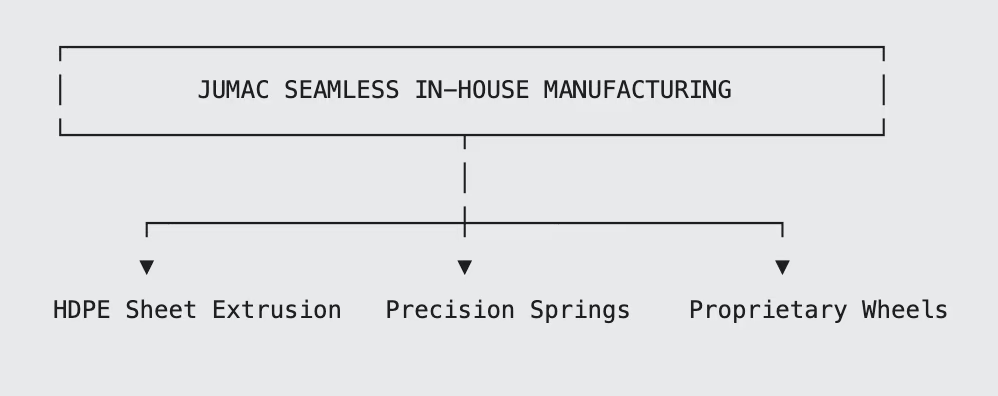
“We manage a highly integrated, state-of-the-art manufacturing facility in India,” Mr. Fogla explained. “Unlike companies that simply assemble components, every single part of a JUMAC sliver can—from the extrusion of the plastic sheets to the internal springs and the spinning wheels—is designed and fabricated completely in-house. This strict quality control allows us to cater directly to both the standard textile spinning and the specialized jute industries.”
JUMAC’s product portfolio showcases a comprehensive scale of dimensional choices, manufacturing customized sliver cans starting from a narrow 300 mm diameter all the way up to a heavy-duty 1200 mm diameter.
Read More: The Countdown to ITM 2026 Has Begun: Global Textile Investors Will Meet in Istanbul
Navigating Turkey’s Quality-Conscious Textile Market via Alfafort
Turkey has consistently remained an elite, high-volume market for international machinery components, making ITM 2026 the perfect platform for JUMAC to strengthen its regional presence.
“We officially entered the Turkish textile market in 2017 through our earlier alliance with Muteks,” Mr. Fogla noted. “Turkey is an incredibly unique region; it is exceptionally quality-conscious yet simultaneously highly price-sensitive. Because our in-house production allows us to balance competitive pricing with flawless mechanical durability, our cans have been very well accepted by Turkish spinning mills.”
To accelerate their regional market share, JUMAC has recently shifted to a new corporate alliance.
“Currently, we are collaborating with our new localized partners, Alfafort,” said Mr. Fogla. “We are entering a new phase of market optimization, and we strongly expect our commercial footprint in Turkey to improve further over the coming months.”
The Current Global Slowdown
“Right now, the global spinning sector is navigating a challenging period,” Mr. Fogla admitted. “Capital expansions are slow, and many corporate project pipelines are temporarily on hold. However, this is cyclical. As consumer demand stabilizes and clothes consumption picks up speed again, we expect mill operations to step back onto the right track.”
The African Potential: From Blueprint to Reality
For JUMAC, the African continent remains a highly watched area with massive structural possibilities that have yet to be fully realized.
- Sub-Saharan Development: JUMAC is executing new project lines in rising apparel zones like Benin and tracking strategic factory installations in Kenya.
- Established Hubs: Egypt and South Africa continue to anchor the continent’s advanced spinning demands.
- The Next Big Leap: Mr. Fogla pointed out that the CIS countries and Turkey are demonstrating the most resilient and rapid spinning growth. “Africa holds massive potential, but it has not fully converted that potential into reality yet. However, with regional infrastructure rising, we see a very strong future ahead.”
Editor’s Insight: Sliver Integrity and the True Cost of Down-Time
In the spinning mill ecosystem, material handling is frequently overlooked in favor of high-profile blowroom or ring frame hardware. However, as JUMAC demonstrated at ITM 2026 in Istanbul, the humble sliver can is where yarn quality is either preserved or ruined. If a can’t internal springs tilt or its plastic walls accumulate static electricity, the sliver stretches, creating imperfections that flow directly into the final yarn package.
JUMAC’s core competitive advantage lies in its total rejection of third-party part sourcing. By maintaining vertical integration over sheet extrusion, wheel molding, and spring calibration, they eliminate the tolerances that cause material fatigue. For quality-focused spinning regions like Turkey and expanding clusters across Africa, investing in vertically engineered components isn’t an added expense—it is a mandatory insurance policy against costly machine downtime and material waste.











