



Morocco Textile Industry
A practical guide to textile machinery, production equipment, automation, technology suppliers and factory modernization in Morocco.
Last Reviewed: September 2026
Knitting & Weaving
Dyeing & Finishing
Garment Technology
Automation
Testing
Recycling
Demand Drivers
Why Textile Machinery Matters in Morocco
Machinery demand in Morocco is closely connected to the changing role of the country within regional and international textile supply chains. Morocco has developed a strong position in apparel manufacturing, particularly for European markets. Its geographic proximity to the European Union can support shorter lead times and more responsive sourcing, but the value of that proximity depends on what Moroccan factories are technically capable of producing.
A nearshore factory must do more than manufacture garments quickly. It must manage frequent style changes, smaller production runs, quality consistency, production planning and delivery reliability — requirements that increase the importance of flexible machinery and digital production systems.
The correct machinery strategy begins with the production constraint or capability the factory needs to solve — not with the machine itself. This connects directly to decisions covered in the Morocco Textile Manufacturing Hub and the Morocco Textile Investment Hub.
Machinery Ecosystem
Morocco Textile Machinery at a Glance
CompaniesCasablanca Symposium · 2025
Context: These figures indicate exhibition and international technology engagement in Morocco. They do not represent national machinery market size, installed capacity or machinery orders.
Technology Landscape
Explore Machinery by Technology
Explore the main machinery and technology categories supporting Morocco’s textile and apparel production chain.
Spinning
Fibre Preparation and Yarn Production
Technologies supporting fibre preparation and yarn production for textile manufacturing.
- Fibre preparation
- Spinning systems
- Yarn monitoring
Weaving
Preparation and Fabric Formation
Machinery for weaving preparation and woven-fabric production.
- Preparation
- Weaving systems
- Fabric monitoring
Knitting
Knitted Fabric Production
Technologies supporting circular, flat and warp-knitted fabric production.
- Circular knitting
- Flat knitting
- Warp knitting
Dyeing & Finishing
Wet Processing and Finishing
Technologies supporting controlled coloration, finishing and fabric performance.
- Dyeing
- Finishing
- Process control
Garment Technology
Cutting, Sewing and Production
Technologies supporting efficient and flexible garment manufacturing.
- Cutting
- Sewing
- Production systems
Automation
Digital Production and Factory Systems
Technologies connecting production processes, equipment and factory data.
- Automation
- Monitoring & data
- Digital factory systems
Testing & Inspection
Quality Control Technology
Technologies supporting consistent quality, measurement and production control.
- Testing
- Measurement
- Inspection
Recycling
Textile Waste and Fibre Recovery
Technologies supporting textile-waste processing and recycled-material production.
- Waste preparation
- Fibre recovery
- Material separation
Equipment by Stage
Textile Machinery Across the Production Chain
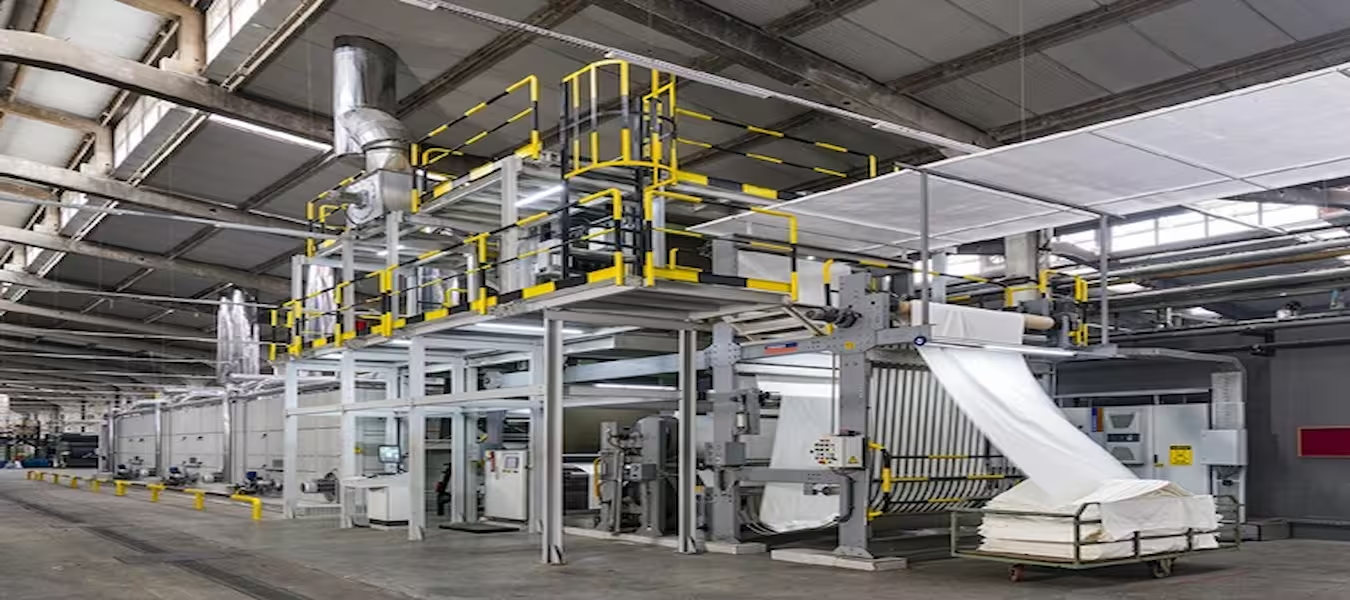
Textile machinery should be understood as a production system rather than a collection of individual machines. Each stage of the value chain creates requirements for different equipment, controls and technical skills, and the importance of each category in Morocco depends on the type of factory and its level of vertical integration.
01Fibre Preparation, Recycling & Spinning — Opening · Carding · Drawing · Spinning
Upstream machinery determines how fibres are prepared and converted into yarn, including fibre opening, cleaning, blending, carding, drawing, combing, roving and spinning systems. Recycled textile processing may also require sorting, cutting, shredding, opening and blending technologies before material can re-enter yarn production. For Morocco, deeper local processing can increase domestic value creation and reduce dependence on imported intermediate materials, but upstream investment is technically and financially demanding — selection must consider fibre type, yarn specifications, production scale, energy consumption, quality-control requirements and access to specialised maintenance.
02Fabric Formation — Knitting & Weaving — Knitting · Weaving · Preparation
Fabric formation connects yarn production with apparel, home textile, technical textile and other downstream applications. Knitting machinery can support flexible production across different fabric structures, while weaving systems are relevant to woven apparel fabrics, technical applications and other constructions. Machine speed alone is not the main competitive factor — fabric consistency, changeover time, defect control, energy consumption, operator capability and compatibility with downstream finishing all influence commercial performance, which is particularly important for manufacturers serving short-lead-time markets.
03Wet Processing — Dyeing, Finishing & Printing — Dyeing · Finishing · Printing · Drying
Dyeing and finishing are among the most technically important and resource-intensive stages of textile production, determining colour, handle, dimensional stability, appearance and many functional properties of the final material. Modern equipment can improve chemical dosing, temperature control, recipe repeatability, drying efficiency and production documentation, while digital textile printing can add flexibility for shorter runs and faster product development. Expanding technically capable wet-processing operations can support greater value-chain integration in Morocco, but investment decisions must consider water availability, wastewater treatment, energy requirements, chemical management and laboratory control.
04Garment Manufacturing Technology — CAD · Cutting · Sewing · Monitoring
Garment production remains one of the most important areas for machinery and digitalisation in Morocco, supporting the process from product development and pattern preparation to spreading, cutting, sewing, finishing, inspection and production planning. CAD systems and automated nesting can improve material utilisation, automated spreading and cutting can increase repeatability, and production-monitoring systems can give managers better visibility into line performance and bottlenecks. Automation does not remove the need for skilled workers — it changes the type of skills required, increasing the importance of machine setup, programming, maintenance and data interpretation.
05Testing, Inspection & Quality-Control Technology — Lab testing · Inspection · Data
Testing and inspection technologies support quality decisions throughout textile production. Laboratory equipment can measure properties such as yarn consistency, fabric construction, colour, strength, dimensional stability and final-product performance, while automated inspection systems can identify defects earlier and digital quality records can improve production control. Testing equipment does not replace accredited third-party testing where regulations or buyer programmes require independent conformity assessment — its primary value inside the factory is process control and early problem detection. Review Morocco’s textile-testing context →
Digitalisation
Automation and Digital Textile Production
Automation in textile manufacturing is not limited to replacing manual operations with machines. Increasingly, it involves connecting planning, production, quality and maintenance information across the factory — which matters most for Moroccan manufacturers serving fast-moving markets, since nearshore competitiveness depends on responsiveness.
Digital Factory Operations
Select an area to see what it does and what it enables.
01Production PlanningOrders, capacity and scheduling
Transforms orders, demand forecasts and available capacity into production schedules, machine allocation and material requirements.
What it enables
02Machine DataStatus, downtime and performance
Operational data from production equipment provides visibility into machine status, speed, downtime and process performance.
What it enables
03Quality DataInspection, testing and variation
Captures inspection, testing and process-quality information to identify defects, variation and recurring quality issues.
What it enables
04TraceabilityBatches, materials and process records
Links materials, batches, production stages and process records so products can be traced through the manufacturing workflow.
What it enables
05AnalyticsPatterns, bottlenecks and performance
Combines production, machine, quality and resource data to identify patterns, bottlenecks and opportunities for improvement.
What it enables
06Decisions & ControlAdjustments, actions and improvement
Turns operational insights into production adjustments, maintenance actions and process-control decisions.
What it enables
Related insight: Enmos on Smart Textile Manufacturing and Digital Production →
Supplier Ecosystem
How Morocco’s Textile Machinery Supply Ecosystem Works
Morocco’s textile machinery ecosystem is strongly connected to international technology suppliers. Production equipment reaches Moroccan manufacturers through direct relationships, representatives, distributors, technical partnerships and specialist exhibitions — and the commercial relationship does not end when a machine is delivered.
Since most machinery enters Morocco as an import, customs classification, duties and logistics also shape total equipment cost. For import procedures and trade logistics context, see Kohan Textile Journal’s Morocco Textile Trade Hub.
After-sales & Technical Support Ongoing, not sequential
A technically advanced machine can become an operational problem if replacement parts are difficult to obtain, technicians are unavailable or production staff have not received sufficient training. For this reason, local and regional service capability can influence machinery selection alongside purchase price and technical specifications.
Supplier discovery can also take place through specialist textile machinery exhibitions. Explore Morocco Textile Exhibitions →
International Technology Partnerships
International Textile Machinery Partnerships in Morocco
Industry symposiums and technical missions provide evidence of international technology engagement with Moroccan textile manufacturers. Participation indicates cooperation and supplier interest, not necessarily a permanent office, installed machinery or active commercial project in Morocco.
Switzerland · Technology Engagement
Casablanca · 2025 · 11 Swiss Manufacturers
The Casablanca symposium connected Swiss technology companies with Morocco’s textile sector around production efficiency, sustainability, recycling and resource-efficient technology.
Read: Swiss Textile Machinery Symposium in Casablanca 2025 →
France · Equipment & Technical Cooperation
Fès · Technical Mission & Factory Visits
French industry cooperation brought equipment expertise in dyeing and finishing, yarn control, spinning preparation, spare parts and textile-management software into meetings and factory visits in Morocco.
Directory Preview
Featured Machinery & Technology Companies
An editorial preview of selected machinery manufacturers and technology providers. This is not a complete supplier directory or evidence of a Moroccan office, installation or commercial endorsement.
Monforts
Finishing Technology
Mayer & Cie.
Circular Knitting Machinery
Rabatex
Warping & Material Handling
Investment Planning
Where Moroccan Textile Factories Can Modernise
Factory modernisation should begin with a production constraint rather than a technology trend. Priorities may include material waste, colour repeatability, long changeovers, machine downtime, poor production visibility or missing production capabilities.
The right machinery investment is one that addresses a measurable operational or commercial requirement.
| Factory Challenge | Technology Response | Potential Benefit | Implementation Risk |
|---|---|---|---|
| High material waste | CAD, automated nesting, spreading and cutting | Better fabric utilisation and repeatability | Savings depend on accurate data, operator discipline and maintenance. |
| Unplanned downtime | Condition monitoring, preventive maintenance and spare-parts planning | Higher machine availability and more reliable delivery | Digital monitoring provides little value when maintenance responsibilities are unclear. |
| Variable quality | Online monitoring, laboratory instruments and automated inspection | Earlier defect detection and stronger production documentation | Data must lead to corrective action rather than simply being collected. |
| High water and energy use | Efficient dyeing, dosing control, heat recovery and optimised drying | Potentially lower resource use and operating costs | Results depend on product mix, production loading and operating conditions. |
| Long changeovers | Digital recipes, standardised settings and flexible machinery | Better economics for smaller and more frequent orders | Poor process discipline can reduce the expected benefit. |
Before Investing in Machinery
Purchase price is only one part of machinery investment. Total cost should also account for freight, installation, energy use, consumables, downtime, maintenance, spare parts, software and training.
Equipment that creates excessive dependence on proprietary systems or unavailable technical support can reduce long-term flexibility. See the Morocco Textile Investment Hub for the wider capital-project and investment environment.
Resource Efficiency
Machinery for Resource Efficiency and Circular Production
Textile machinery can influence environmental performance throughout the production chain. The largest improvements do not necessarily come from a single “sustainable machine” — they often result from better process control, lower material losses, efficient utilities and technologies designed around specific production requirements.
For broader environmental policy, circularity and sector strategy, this will be covered separately once Kohan Textile Journal’s Morocco Textile Sustainability Hub is published.
Industry Reference
Morocco Textile Industry
Explore Kohan Textile Journal’s broader guide to Morocco’s textile industry, connecting machinery and production technology with manufacturing, trade, investment, sustainability and the country’s wider textile ecosystem.
Machinery FAQ
Frequently Asked Questions
Answers to the most common questions about textile machinery, automation, suppliers and factory modernization in Morocco.
What types of textile machinery are most relevant to Morocco?
Relevant categories include garment CAD, spreading and cutting systems, sewing and production-monitoring technology, knitting and weaving machinery, dyeing and finishing equipment, textile printing, testing and inspection systems, recycling machinery and production software. The priority depends on the factory’s product range, production model and level of vertical integration.
Does Morocco manufacture textile machinery locally?
Morocco relies significantly on imported textile production machinery and international technology suppliers. Local value can be created through representation, engineering, installation, maintenance, training, spare parts and technical services. Claims about machinery manufactured locally should be verified company by company.
Which countries supply textile machinery to Morocco?
Morocco sources textile machinery and technology from multiple international markets. Documented industry engagement includes Swiss and French technology suppliers, alongside broader European and Asian machinery networks. Supplier activity and local representation should be verified individually rather than inferred from participation in exhibitions or technical missions.
What should a Moroccan textile factory consider before buying machinery?
Factories should define the required product and process, evaluate total cost of ownership, check utility and installation requirements, confirm spare-parts and service availability, assess training needs and determine whether the equipment can integrate with existing production and data systems.
Why is after-sales service important for textile machinery?
Machinery performance depends on maintenance, spare parts, technical support and operator capability throughout the equipment’s working life. Poor service availability can increase downtime and operating costs even when the original machine purchase price is attractive.
How is automation changing textile production in Morocco?
Automation can improve cutting accuracy, production planning, process control, inspection, monitoring and production visibility. It can also increase demand for technical skills in programming, maintenance, production engineering and data interpretation. The value of automation depends on how well the technology is integrated into the factory’s production system.
How can textile machinery reduce water, energy and textile waste?
Resource-efficient equipment can improve material utilisation, chemical dosing, process control, heat recovery, drying efficiency and early defect detection. Recycling machinery can also prepare textile waste for reuse in new production. Actual savings depend on product mix, machine utilisation, maintenance and operating practices.
Editorial note: Machinery categories, supplier activity, capabilities and technology claims can change. Verify current specifications, supplier relationships and service availability directly with the relevant company before making purchasing decisions.
