



Morocco Textile Trade Intelligence
Morocco Textile Trade: Exports, Markets and Logistics
Understand Morocco’s textile exports and imports, core destination markets, preferential market access, origin requirements and the logistics corridors connecting production with international buyers.
By Behnam Ghasemi · Last reviewed: October 2026
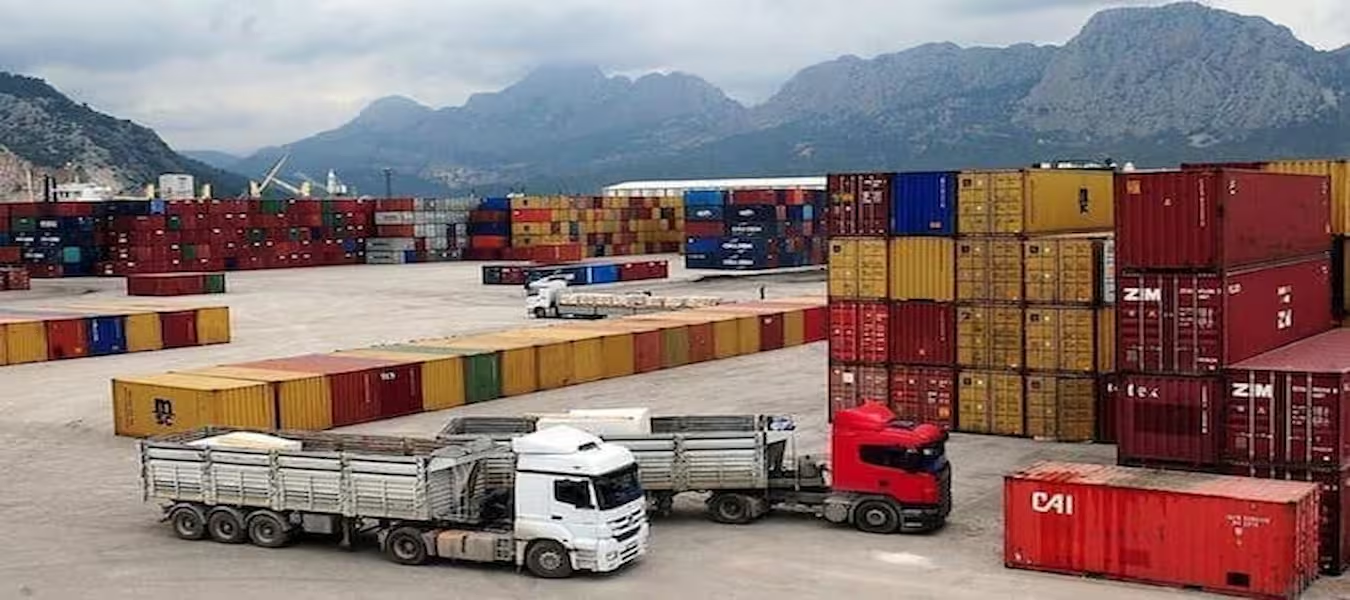
Morocco exported MAD 43.8 billion of textile and leather goods in 2025 (provisional, −4.5% on 2024), most of it garments and knitwear sold to Europe. Spain and France accounted for more than 70% of the sector’s export turnover in 2022, and Spain alone sourced 11.9% of its clothing imports from Morocco in 2025. Because exporters rely on imported yarns and fabrics, EU rules of origin and port logistics through Tanger Med shape competitiveness as much as labour costs.
Connected Trade System
How Morocco’s Textile Trade System Works
Imports and exports form one connected system. Imported materials support Moroccan production, while customs, freight and port operations connect finished or semi-finished products with international markets. Disruption at any stage can affect cost, origin eligibility and delivery.
International Position
Morocco’s Position in International Textile Trade
Morocco’s strongest trade role is nearshore and export-oriented rather than scale-led. European proximity, established buyer relationships and shorter transport routes can support responsiveness, smaller programmes and replenishment. The model also depends on imported fabrics, yarns, trims, dyes and technology, linking import efficiency directly to export performance. Export performance can also shift year to year: see how Morocco’s textile and leather exports performed in H1 2026 →
Export Product Mix
What Morocco Exports
Morocco’s textile export trade includes several product groups. These categories describe goods moving through Morocco’s export trade rather than manufacturing capabilities; production segments are covered separately in the Morocco Textile Manufacturing Hub.
In 2025, garments earned MAD 28.47 billion and knitwear MAD 8.45 billion — together MAD 36.9 billion, down 4.7% on 2024 (provisional figures, Office des Changes).
Woven Apparel & Fashion
Women’s and men’s garments, dresses, jackets, shirts, outerwear and seasonal fashion products.
Knitwear & Lingerie
T-shirts, sweaters, knitted garments, underwear, lingerie and related clothing categories.
Denim & Casualwear
Jeans and casualwear supported by Morocco’s established denim manufacturing ecosystem.
Textile Made-Ups & Specialist Products
Made-up textile articles and selected specialist textile products serving consumer, institutional and industrial markets.
Destination Markets
Where Morocco Exports
Spain
A major consumer market and supply-chain gateway supported by short maritime routes and European fashion networks. In 2025, Morocco supplied 11.9% of Spain’s clothing imports — third behind China and Bangladesh — worth €1.69 billion (+1.8%), according to Eurostat data reported by Médias24.
France
A long-standing European destination for Moroccan apparel, knitwear and specialist clothing exports.
Other European Markets
Moroccan textile exporters also serve and develop business across markets including Portugal, Germany, Italy, the Netherlands and Belgium.
Africa and Emerging Markets
Regional markets offer potential, but commercial growth depends on product fit, distribution, finance, logistics and implementation of trade frameworks. Explore Morocco’s textile export position in Africa →
Market concentration: Spain and France together accounted for more than 70% of the textile and leather export turnover of active Moroccan exporters in 2022 (Office des Changes). This concentration supports fast, repeat programmes but leaves exporters exposed to demand shifts in two markets.
Core Market Access
Morocco–EU Textile Trade & Market Access
The European Union is Morocco’s principal textile and apparel destination. European Commission data for 2025 valued EU textile imports from Morocco at €2.9 billion, or 11.4% of EU goods imports from Morocco. These figures cover EU imports under EU classifications, not Morocco’s whole textile economy (European Commission).
For clothing specifically, EU imports from Morocco were about €2.73 billion in 2025, flat on 2024, while Morocco’s share of EU clothing imports slipped from 3.10% to 3.03% (Eurostat, via Médias24). In January–May 2026, Moroccan textile and clothing exports to the EU exceeded €1.05 billion, keeping Morocco the EU’s eighth-largest supplier (Eurostat data compiled by the Istanbul Apparel Exporters’ Association, via Hespress).
Preferential Access and Rules of Origin
Preferential treatment is not automatic. Eligibility depends on tariff classification, the applicable origin rule, the production process and valid documentation. Imported yarn or fabric can affect whether a product qualifies.
PEM and Documentary Requirements
The Pan-Euro-Mediterranean framework can allow cumulation in defined circumstances, but the exact textile rule varies by product. EU–Morocco Decision 1/2025, amending Protocol 4 on originating products, entered into force on 2 October 2025, allowing transitional rules to operate alongside the PEM Convention framework. Exporters should verify the rule currently applicable to each shipment.
Regulatory Market Access
Fibre composition, restricted substances, labelling, buyer audits, traceability and environmental evidence can influence commercial access alongside customs formalities. See the EURATEX–AMITH partnership and AMITH–CBI export programme for examples of industry cooperation supporting Morocco’s access to European textile markets. For deeper environmental and circularity coverage, see Kohan Textile Journal’s Morocco Sustainability Hub →
Trade Agreements
Morocco’s Trade Agreements for Textiles at a Glance
Morocco’s textile exports rely on a small number of preferential agreements. The table lists those most relevant to textile and apparel trade; tariff treatment and origin rules must still be checked by HS code for each shipment.
| Agreement | Partners | In force | Textile relevance | Source |
|---|---|---|---|---|
| EU–Morocco Association Agreement | European Union | 1 March 2000 | Main export framework; origin rules in Protocol 4 (amended by Decision 1/2025) and PEM cumulation | trade.gov |
| EFTA–Morocco FTA | Switzerland, Norway, Iceland, Liechtenstein | 1 December 1999 | Preferential access for industrial goods under Pan-Euro-Mediterranean origin rules | EFTA |
| Morocco–Türkiye FTA | Türkiye | 1 January 2006 (amended 24 April 2022) | Major source of textile inputs; 2022 amendment restored duties on selected products | Türkiye Ministry of Trade |
| US–Morocco FTA | United States | 2006 | Textile-specific origin rules apply; verify by product | trade.gov |
| Agadir Agreement | Egypt, Jordan, Tunisia | 27 March 2007 (signed 25 February 2004) | Arab-Mediterranean free trade; can support cumulation with EU-linked origin rules | Agreement text (bilaterals.org) |
| AfCFTA | African Union members | Signed 2018; ratification pending as last reported | Regional diversification; depends on tariff schedules and rules of origin | trade.gov |
Bilateral Trade Timeline
Morocco–Türkiye Textile Trade
Türkiye is a significant regional supplier of textile inputs and products, while Moroccan industry and policymakers have raised concerns about import competition and the bilateral trade deficit. Proposals, negotiations, legal decisions and implemented customs measures must be treated as separate events.
2006 — FTA Enters into Force
The Morocco–Türkiye Free Trade Agreement, signed on 7 April 2004, entered into force on 1 January 2006, establishing a framework for progressive tariff liberalisation in trade in goods.
2015 — Industrial Tariff Liberalisation
The original tariff phase-out for most industrial products was completed by 1 January 2015, substantially expanding duty-free industrial trade under the agreement.
2020–2022 — FTA Amendment
Concerns over trade imbalances and competitive pressure contributed to a review of the agreement. An amendment was signed on 24 August 2020 and entered into force on 24 April 2022, changing preferential treatment for selected products.
Broader EU-Turkey trade tensions during this period also shaped Morocco’s export positioning. See how Morocco’s exports were affected →
2025 — Renewed Bilateral Review
Morocco and Türkiye continued reviewing implementation of the FTA in 2025, with discussions focused on improving the trade balance, expanding Moroccan exports and strengthening bilateral cooperation, including cooperation in textile supply chains.
Regional Diversification
African and Regional Textile Trade
Europe remains Morocco’s established textile export base. African markets represent a diversification pathway rather than proven or automatic growth.
AfCFTA
A developing framework for reducing regional barriers. Outcomes depend on tariff schedules, origin rules, customs implementation, logistics, payments and demand.
Agadir and Euro-Mediterranean Networks
Regional arrangements can support trade and cumulation, but exporters must verify participating countries, product rules and documentary evidence.
Input Dependency
What Morocco Imports
Morocco’s export-oriented textile sector also depends on international suppliers. Imported inputs broaden production options but can create exposure to cost, lead-time and origin-rule risks.
| Imported Input | Trade Function | Trade Exposure |
|---|---|---|
| Yarn | Feeds knitting and weaving | Price volatility and origin implications |
| Woven & Knitted Fabrics | Supports garment export programmes | Lead-time dependency and limited substitution |
| Denim Fabric | Supports jeans and casualwear | Foreign-mill and specification dependency |
| Dyes & Chemicals | Supports finishing and performance | Safety, compliance and transport controls |
| Accessories & Trims | Completes export orders | Small shortages can delay entire shipments |
For textile machinery, equipment and production technology, see the Morocco Textile Machinery Hub →
Trade Corridors
Ports, Trade Logistics and Lead Times
Geographic proximity becomes a trade advantage only when customs, consolidation, freight, warehousing, road transport and production planning convert distance into reliable delivery.
Key Logistics Gateway
Tanger Med is an integrated port, logistics and industrial platform with strong connections to Europe and international networks. It handled 11.1 million TEUs in 2025, up 8.4% year on year (Tanger Med Port Authority).
Casablanca Commercial Corridor
Commercial services, customs expertise, freight connections and buyer representation support trade operations.
Exporter Checklist
Export Compliance and Documentation
Requirements vary by product, destination and customer. Exporters commonly need to verify:
- HS classification and applicable tariff treatment
- Commercial invoice with parties, products, value and terms
- Packing list with quantities, weights and configuration
- Customs declaration and transport documentation
- Proof of origin when preference is claimed
- Fibre composition and labelling
- Testing and restricted substances
- Buyer-specific quality, social or environmental evidence
Trade Verification
Verify Current Trade Requirements
Tariffs, rules of origin, customs procedures and documentation requirements can change. Before making operational decisions, buyers and exporters should verify current requirements with the relevant customs authorities, trade ministries or recognised industry bodies.
Strategic Closing Analysis
Trade Challenges and Emerging Opportunities
Imported Input Dependency
Dependence on imported yarns, fabrics, trims and production chemicals can expose exporters to cost, lead-time and origin-rule risks.
European Market Concentration
Established EU demand supports trade while increasing exposure to regional demand and regulatory change.
Competitive Pressure
Moroccan exporters compete on cost, speed, quality, compliance and service against established regional and global suppliers.
Regulatory Complexity
Product-specific origin rules, documentation, labelling and buyer requirements can affect effective market access.
Export Diversification
Wider European, African and emerging markets may broaden demand, subject to product fit, logistics, finance and market development.
Higher-Value Trade
Specialised apparel, technical products and stronger product-development capabilities may help expand Morocco’s export proposition beyond basic assembly.
Industry Reference
Beyond Trade: The Wider Industry
Explore Kohan Textile Journal’s broader guide to Morocco’s textile industry, connecting manufacturing with trade, investment, machinery, sustainability and the country’s wider textile ecosystem.
Trade FAQ
Frequently Asked Questions
Answers to the most common questions about Morocco’s textile exports, market access, origin requirements and trade documentation.
How much textile does Morocco export?
Morocco’s textile and leather exports reached MAD 43.8 billion in 2025 (provisional), down 4.5% from 2024, according to Office des Changes. Garments and knitwear accounted for MAD 36.9 billion. On the EU side, European Commission data valued EU textile imports from Morocco at €2.9 billion in 2025.
What are Morocco’s main textile export products?
Morocco’s textile exports include woven apparel and fashion products, knitwear and lingerie, denim and casualwear, and textile made-ups and selected specialist products. The mix varies by year and customs classification.
Which countries are the main markets for Moroccan textiles and clothing?
Spain and France are the core markets, together accounting for more than 70% of textile and leather export turnover in 2022 (Office des Changes). In 2025 Morocco supplied 11.9% of Spain’s clothing imports. Portugal, Germany, Italy, the Netherlands and Belgium are also served, while African markets represent a diversification opportunity.
Why is the European Union important to Morocco’s textile trade?
The EU is Morocco’s principal textile and apparel export destination. Proximity, established buyer relationships and preferential arrangements support trade, subject to origin rules and documentation.
How do rules of origin affect Moroccan textile exports?
Rules of origin determine whether a product qualifies as Moroccan for preferential tariff purposes. Eligibility depends on tariff classification, imported inputs, processing stages and valid documentation.
Why does Morocco import yarn and fabric?
Domestic upstream capacity does not cover every fibre, yarn, fabric or specification required by exporters. Imports broaden sourcing options but create cost, timing and origin-rule dependencies.
What documents do Moroccan textile exporters generally need?
Common documents include a commercial invoice, packing list, customs declaration, transport documents and proof of origin when preference is claimed. Testing, fibre composition, labels and buyer evidence may also be required.
Editorial note: Statistics, tariffs, rules of origin, trade agreements and implementation can change. Figures should retain their reference years, and operational decisions should be checked against current official sources.
