




Morocco’s textile and clothing sector held on to its place as the EU’s 8th-largest supplier in early 2025, with exports to the bloc up 7% year on year in the first four months. The gains were modest, though, and the detail behind them points to a sector that still needs to move up the value chain to stay competitive.
According to Eurostat and Morocco’s Foreign Exchange Office, textile and apparel exports to the European Union reached €881.7 million in January–April 2025. That is a step forward, but it is small next to the main Asian suppliers:
- China: €7.88 billion (+24%)
- Bangladesh: €7.54 billion (+25%)
- Cambodia: +45% growth since 2023
Overdependence on Spain and Uneven Market Performance
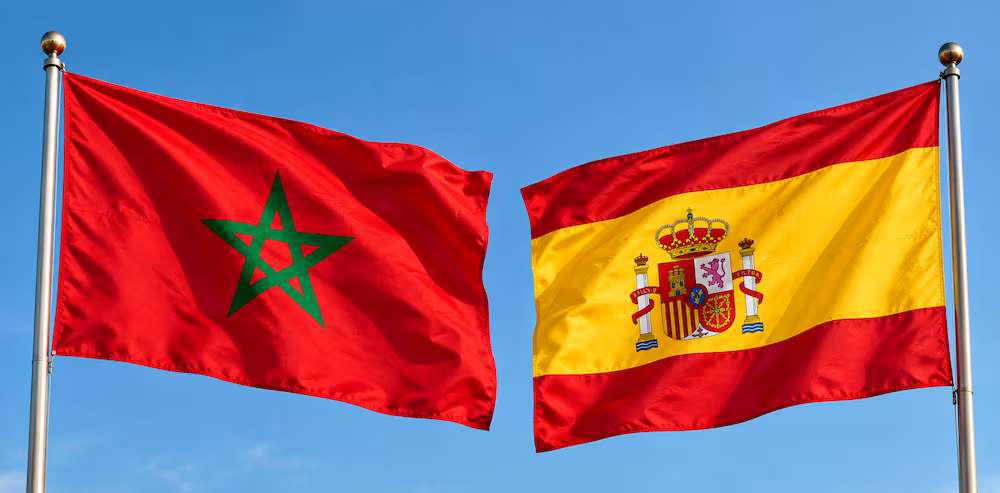
Morocco’s export dependency on Spain remains stark, with €526.1 million of exports going to Spain in January–April 2025, up 13%. That is almost 60% of everything Morocco shipped to the EU in the period. In contrast, several traditional European markets are in decline, including:
- France: -4%
- Benelux: -17%
- Italy: -14%
There was better news from Germany, where exports grew 24%, and Portugal, up 27%, both small but useful signs of diversification.
| Market | Jan–Apr 2025 | Change |
|---|---|---|
| European Union (total) | €881.7 million | +7% |
| Spain | €526.1 million | +13% |
| Portugal | — | +27% |
| Germany | — | +24% |
| France | — | −4% |
| Italy | — | −14% |
| Benelux | — | −17% |
Product-Level Disparities
Product-level data also reveal an uneven performance across Morocco’s apparel exports. Labor-intensive categories showed relatively stronger results, with T-shirt exports increasing by 2% and dresses by 3%. In contrast, trousers declined by 11%, while pullovers fell by 17%.
The divergence suggests that Morocco’s apparel sector is adapting unevenly to changing market demand, with growth in some product categories failing to offset weaker performance elsewhere.
Strategic Partnerships and Industrial Upgrading
On 18 June 2025, Morocco’s textile association AMITH met the chief executive of Hugo Boss in Metzingen, Germany. The luxury brand expressed interest in expanding its sourcing footprint in Morocco — contingent upon partners meeting “high standards of quality, traceability, and performance.”
This signals a broader opportunity for Morocco to reposition itself as a quality-driven, nearshore production hub for Europe, especially in premium and fast-fashion segments.
Trade Tensions with Turkey and Need for Policy Reform
Meanwhile, Morocco’s trade deficit with Turkey, driven largely by fabric imports, is close to $3 billion, and the government has responded. Under the 2022 amendment to the free trade agreement, duties set at 90% of the standard rate were reintroduced on around 1,200 Turkish products, including textiles and clothing. In mid-2025, Rabat was also reported to be seeking further changes to the 2006 agreement to rebalance trade flows, alongside a stated target of $5 billion in two-way trade.
Looking Ahead
Industry leaders stress that Morocco must evolve beyond cost-based competitiveness. The future lies in:
- High-value production
- Deeper integration into global supply chains
- Market diversification and innovation
- Sustainability and traceability compliance
Without strategic reforms and investment in capabilities, Morocco risks losing ground in an increasingly demanding global market.
For more on Morocco’s EU market access, export markets and trade logistics, see Kohan Textile Journal’s Morocco Textile Trade Hub.











