By: Behnam Ghasemi
For decades, trade fairs have played a central role in the global textile industry. Buyers travelled to exhibitions to discover new suppliers, manufacturers presented their latest collections, samples changed hands, negotiations started and, in many cases, orders were placed directly at the stand.
That model still exists, but the textile business around it has changed considerably. Digital communication has made international sourcing faster, buyers have access to a much larger supplier base, samples can travel between continents within days, and sales teams can reach potential customers directly without waiting for the next major exhibition.
At the same time, participation in international exhibitions has become increasingly expensive for both exhibitors and visitors.
This combination raises an important question for the textile industry:
Are trade fairs losing their traditional role, and if so, what will replace it?
The answer is probably more complicated than simply arguing that exhibitions are becoming less important. Trade fairs continue to provide something that digital communication cannot fully replace, particularly in an industry where touching a fabric, examining a finish, seeing machinery operating and building personal relationships remain important parts of business. What appears to be changing is the purpose of participating.
From Taking Orders to Building Relationships
Anyone who has spent many years attending textile exhibitions has probably heard stories about the days when manufacturers arrived at a fair with their new collections and returned home with substantial order books.
Today, the purchasing process is often much longer. A buyer may visit a stand, examine several products, request samples, return to the office and discuss the collection with colleagues before starting price negotiations or placing a trial order weeks later.
This means that evaluating an exhibition only by the orders received during three or four days can give an incomplete picture of its real commercial value.
A meeting at a trade fair may eventually develop into an important customer relationship, while another promising conversation may lead nowhere. For manufacturers investing significant amounts of money in international exhibitions, distinguishing between these two outcomes has become increasingly important. This is one reason companies are becoming much more selective about which events deserve their time and marketing budgets.

Has the Textile Industry Created Too Many Suppliers?
Another major change is the enormous expansion of global textile manufacturing.
Today, international buyers can source textiles from established manufacturing centres such as China, Türkiye, India, Pakistan and Bangladesh, while countries including Vietnam, Egypt and several emerging manufacturing markets are also competing for international orders.
In many textile categories, therefore, the buyer’s challenge is no longer finding a supplier. It is selecting the right supplier from an enormous number of available options.
This becomes even more significant when demand is weak. When global production capacity grows faster than consumption, more manufacturers compete for fewer orders, putting additional pressure on prices and supplier relationships.
Trade fairs naturally feel the effects of this imbalance. If purchasing departments are already contacted regularly by manufacturers from around the world, travelling thousands of kilometres simply to discover additional suppliers becomes more difficult to justify.
For exhibitors, this means that simply being present at a major exhibition is no longer enough. They need to give buyers a clear reason to begin a new business relationship.
Buyers Are Working With Fewer Suppliers
The sourcing strategies of major buyers are also changing. Many companies are attempting to simplify their supply chains by reducing the number of suppliers they work with and developing deeper relationships with reliable manufacturing partners.
A buyer that once sourced several product categories from different manufacturers may increasingly prefer a supplier capable of providing broader product ranges while meeting expectations for quality, price, compliance, flexibility and delivery.
This trend has important implications for exhibitions because supplier discovery has traditionally been one of the main reasons for attending international trade fairs.
If buyers are deliberately consolidating their supplier networks, exhibitions cannot rely entirely on presenting thousands of suppliers under one roof. The challenge becomes creating meaningful connections between exhibitors and buyers who actually have a reason to work together.
For manufacturers, differentiation becomes equally important. Offering another version of a product already available from dozens of competing factories is unlikely to generate much interest. Technical capabilities, innovative materials, sustainability, design, flexibility and specialized production are becoming stronger reasons for buyers to consider a new supplier.
Digital Communication Has Changed International Sourcing
Technology has also removed many of the practical reasons that once made trade fairs essential for international business.
A video meeting between a European buyer and an Asian manufacturer can now be arranged almost immediately. Digital catalogues, high-resolution product images, certificates and technical specifications can be exchanged within minutes, while international courier networks allow physical samples to reach customers surprisingly quickly.
Sales teams have also become more proactive. Instead of waiting for buyers to visit an exhibition, manufacturers can identify potential customers online and arrange direct meetings in their markets.
None of this means that digital communication can completely replace physical interaction. Textiles remain a highly tactile business, and evaluating the hand feel, colour, construction and finishing of a fabric through a computer screen has obvious limitations. The same applies to textile machinery, where seeing equipment operating and speaking directly with technical specialists can be extremely valuable.
However, technology has reduced the industry’s dependence on exhibitions. A trade fair is now one communication channel among several rather than the only realistic opportunity to meet international suppliers and buyers.
Can Companies Still Justify the Cost of Exhibiting?
This changing environment becomes particularly important when participation costs are considered.
An international exhibition involves much more than renting a stand. Companies must calculate stand construction, transportation of samples and machinery, flights, accommodation, local transportation, marketing materials, hospitality and the time of employees who may spend a week away from their normal responsibilities.
For visitors, international exhibitions also require considerable investment. Sending purchasing teams abroad means travel costs as well as several working days away from the office.
When markets are growing strongly, these expenses may be relatively easy to justify. During periods of weaker demand and tighter margins, management naturally examines every marketing investment more carefully.
The question is no longer simply whether an exhibition is important. Companies increasingly want to know whether that particular exhibition is important for their particular business.
This shift could ultimately be healthy for the exhibition industry because it encourages organizers to focus more closely on the quality of buyers and business opportunities rather than simply reporting large visitor numbers.
Trade Fairs Are Becoming Marketing Platforms
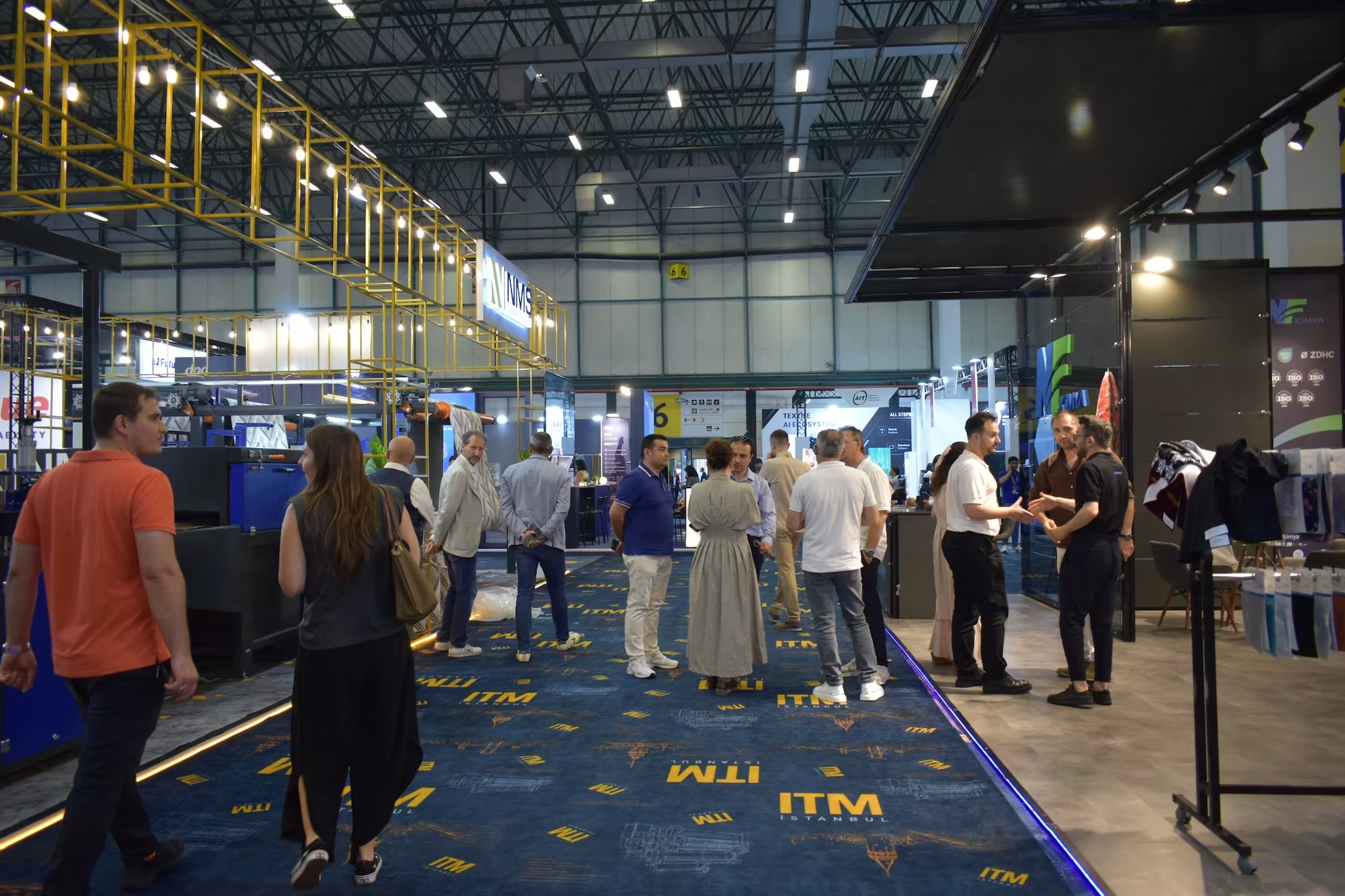
Perhaps the biggest transformation is that exhibitions are gradually becoming broader marketing and communication platforms rather than purely sales events.
For many textile companies, participation now serves several purposes at the same time. A fair can provide opportunities to meet existing customers, introduce new products, strengthen brand visibility, find distributors, observe competitors, understand market trends and create new relationships.
Immediate sales remain important, but they are increasingly only one element of the overall return on investment.
In this sense, a modern textile exhibition functions almost like a temporary physical media platform for an entire industry. Manufacturers communicate their positioning, machinery companies demonstrate technologies, designers search for inspiration, associations meet their members, journalists create content and executives exchange information about markets and investment.
This wider role can be extremely valuable, but companies need to recognize that it requires a different exhibition strategy. Renting a stand, displaying products and waiting for visitors is unlikely to generate the same results it did twenty years ago.
Why the Destination Matters More Than Before
There is another factor that exhibition organizers should probably take more seriously: the destination itself has become part of the decision to attend.
Buyers and executives have limited travel budgets and increasingly crowded calendars. If they must choose between several exhibitions offering similar business opportunities, the city, accessibility, hospitality and overall experience surrounding the event can influence that decision.
Business travel has always contained a social element, but this may become more important as exhibitions compete not only with each other but also with digital meetings and direct supplier visits.
A successful exhibition therefore needs to provide more than halls filled with booths. Networking events, industry discussions, design experiences, local hospitality and opportunities for meaningful interaction can all make travelling to an exhibition more worthwhile.
The future of exhibitions may depend partly on their ability to create an industry experience that cannot easily be replicated through an online meeting.
Read more: visitor quality is increasingly more important than visitor quantity
Does the Textile Industry Have Too Many Trade Fairs?
The number of textile exhibitions around the world is another issue worth discussing.
There are international and regional events covering home textiles, apparel, textile machinery, yarns, fibres, nonwovens, carpets, technical textiles, digital printing and almost every other segment of the textile value chain.
Neither manufacturers nor buyers can attend all of them.
As companies become more selective, some consolidation within the exhibition industry appears inevitable. Major events with strong international reputations and high-quality visitor profiles are likely to remain important, while smaller exhibitions without a clearly differentiated position may find it increasingly difficult to attract international participants.
This also means that traditional indicators such as total visitor numbers should be interpreted more carefully. A specialized manufacturer may gain considerably more value from meeting twenty serious decision-makers than from receiving hundreds of visitors who have little purchasing authority or genuine interest in its products.
Exhibitors Also Need to Change
It would be easy to blame exhibition organizers for declining results, but manufacturers themselves also need to reconsider how they approach trade fairs.
Showing products that buyers can already find from dozens of competitors provides little reason for visitors to stop at a stand. Exhibitors increasingly need a clear story, whether that comes from a new technology, an innovative material, sustainable production, technical performance, design capabilities or a solution to a specific customer problem.
Companies should also consider exhibitions as part of a much longer marketing process. Communication should begin before the event, important meetings should be arranged in advance, content should be produced during the fair, leads should be qualified properly and follow-up should continue after everyone has returned home.
The commercial impact of an exhibition may therefore need to be measured over several months rather than during the event itself.Simply exhibiting is no longer a strategy. Companies need to understand exactly why they are exhibiting and what they expect to achieve.
So, Are Trade Fairs Really Losing Their Traditional Role?
Probably yes, but that does not mean they are losing their relevance.
Face-to-face relationships remain important in the textile industry. Buyers still want to touch fabrics and evaluate products physically. Engineers want to see machinery running. Designers need inspiration, manufacturers need market intelligence, and personal conversations continue to build trust in ways that digital communication sometimes cannot.
What is disappearing is the assumption that bringing thousands of buyers and suppliers into the same building will automatically generate orders. The global textile industry has become too connected, too competitive and too efficient for that traditional model to function in exactly the same way it did twenty years ago.
Future trade fairs will need to provide more than exhibition space. They will need to create strong industry communities, attract qualified decision-makers, provide knowledge and networking opportunities and give professionals a genuine reason to travel.
Manufacturers will also need to change their expectations. Success may increasingly be measured through relationships created, markets opened, brand visibility achieved and business generated months after an exhibition rather than simply by the number of orders signed at the stand.
Trade fairs are not disappearing from the textile industry. They are evolving from traditional marketplaces into broader business, marketing and networking platforms — and both organizers and exhibitors will have to evolve with them.