




The textile industry is entering a decisive phase. On one side, the pressure to adopt sustainable practices is stronger than ever. On the other, manufacturers are still facing a fundamental challenge: how to transform innovation into scalable, industrial reality.
Recycling technologies, new fiber developments, and circular economy models are widely discussed across the industry. Yet, in practice, many of these innovations struggle to move beyond laboratory environments. The gap between research and real production remains one of the most critical bottlenecks in textile manufacturing today.
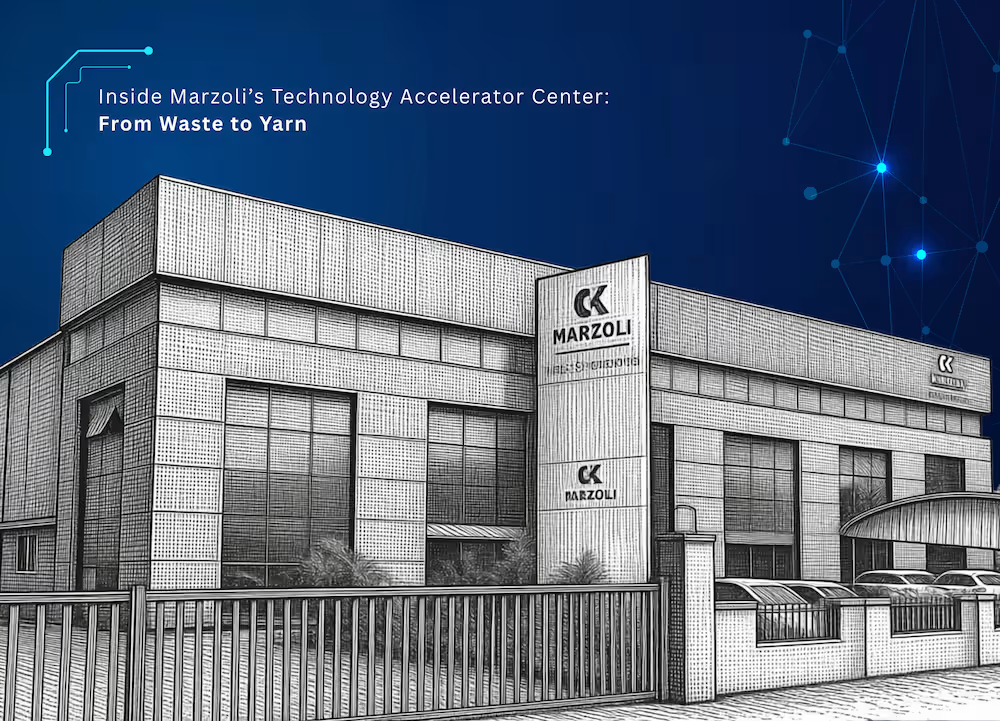
It is precisely within this context that innovation platforms such as the Technology Accelerator Center (TAC) are gaining strategic importance.
A new model for industrial innovation
Rather than functioning as a traditional research lab, the Technology Accelerator Center represents a different approach to innovation—one that is deeply rooted in industrial application.
The concept is simple but powerful: develop, test, and validate new textile processes under conditions that closely replicate real production environments. This allows manufacturers not only to observe new technologies, but to understand how they perform at scale.
In a sector where investment decisions are often capital-intensive and risk-sensitive, this approach significantly reduces uncertainty. Instead of relying on theoretical performance, companies can evaluate solutions based on measurable results.
From textile waste to high-quality fibers
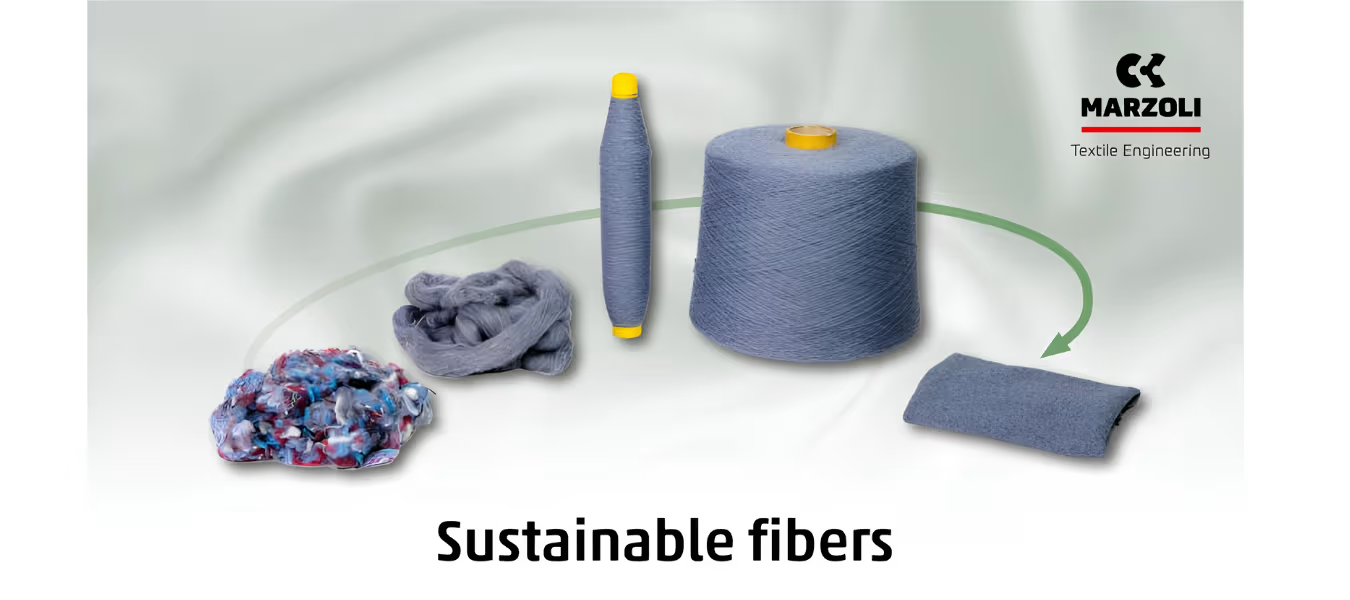
One of the most compelling applications developed within this framework is the regeneration of textile fibers from post-industrial and post-consumer waste.
Traditionally, recycling processes have been limited by fiber degradation. Recycled materials often lose length, strength, and consistency, making them less suitable for high-quality yarn production. This has restricted their use to lower-value applications.
At TAC, a different approach has been explored—one that focuses not only on recycling, but on preserving and enhancing fiber quality.
Through advanced processing techniques, textile waste can be transformed into regenerated fibers with improved characteristics compared to conventional recycled materials. This includes better fiber length, more consistent structure, and enhanced performance in spinning processes.
The result is a shift in perception: recycled fibers are no longer seen as a compromise, but as a viable alternative for high-performance applications.
A multi-material approach to recycling
One of the key strengths of this development lies in its versatility.
The process has been successfully applied to a wide range of materials, including natural fibers such as cotton, wool, and cashmere, as well as synthetic blends. This flexibility is critical in today’s textile landscape, where mixed-material garments represent a growing share of global production.
By enabling the regeneration of diverse fiber types, the approach moves closer to a truly circular model—where waste is not limited by composition, but becomes a resource for new production cycles.
Closing the loop: from fiber to finished product
Perhaps the most significant aspect of the work carried out at TAC is its ability to connect multiple stages of the textile value chain.
Instead of focusing solely on fiber recovery, the process extends to yarn production and even finished garments. This end-to-end perspective is essential for validating the real impact of recycling technologies.
It ensures that regenerated fibers are not only technically viable, but also commercially relevant. For manufacturers, this means the ability to integrate recycled materials into existing production lines without compromising efficiency or product quality.
Reducing risk, accelerating adoption
One of the main barriers to adopting new technologies in the textile industry is risk. Investments in new machinery, processes, or materials must be justified not only by potential benefits, but also by proven reliability.
By providing a controlled environment where technologies can be tested under realistic conditions, TAC helps reduce this risk. Manufacturers can assess performance, identify limitations, and adapt processes before committing to large-scale implementation.
This significantly accelerates the adoption of innovation, turning experimental concepts into practical solutions.
The broader impact on the textile industry
The emergence of centers like TAC reflects a broader transformation within the industry.
Textile manufacturing is no longer defined solely by production capacity. Increasingly, it is shaped by the ability to innovate, adapt, and respond to changing market demands. Sustainability, in particular, is becoming a central driver of this transformation.
However, achieving sustainability at scale requires more than intention. It requires systems, processes, and technologies that can operate efficiently in real-world conditions.
By bridging the gap between research and production, innovation platforms play a crucial role in enabling this transition.
Read more: Marzoli Hosts Uzbek Textile Delegation to Showcase Spinning and Sustainable Technologies
A step toward true circularity
The concept of a circular textile economy has long been discussed, but its implementation remains complex. Challenges related to material recovery, processing efficiency, and product performance have slowed progress.
What is emerging now is a more practical pathway—one that combines technological innovation with industrial validation.
Transforming textile waste into high-quality yarn is not just a technical achievement. It represents a shift in how the industry views resources, production, and sustainability.
Final Perspective
From an editorial standpoint, what stands out is not only the technology itself, but the model behind it. The ability to move from waste to yarn, and ultimately to finished products, demonstrates that circularity in textiles is no longer a distant ambition—it is becoming an operational reality.
As the industry continues to evolve, the role of innovation centers will become increasingly important. They are not just places where ideas are developed, but where the future of textile manufacturing is tested, refined, and made ready for the market.











