In the modern technical textile sector, high-performance braiding and winding machinery are no longer viewed merely as industrial tools, but as the foundational components governing global subsea logistics, aerospace structural sleeves, medical micro-braids, and heavy offshore wind mooring systems. When high-load synthetic ropes or heavy automotive over-braids fail, it triggers catastrophic failure across deep-sea installations or critical automotive lines. Today, maintaining strict operational tolerances requires an advanced understanding of radial tension, metallurgy, and material properties.
At the International Textile Machinery Exhibition (ITM 2026) in Istanbul, Behnam Ghasemi, Editor-in-Chief of Kohan Textile Journal, met with Dennis Knüppel-Spiecker, International Sales Manager at HERZOG GmbH, to explore how the 165-year-old German mechanical giant is redesigning modular machine frameworks, navigating current inflation pressures in the Turkish market, and why they are using Istanbul as a global hub to counter tightening European visa restrictions and logistics barriers across the Middle East and Africa (MEA).
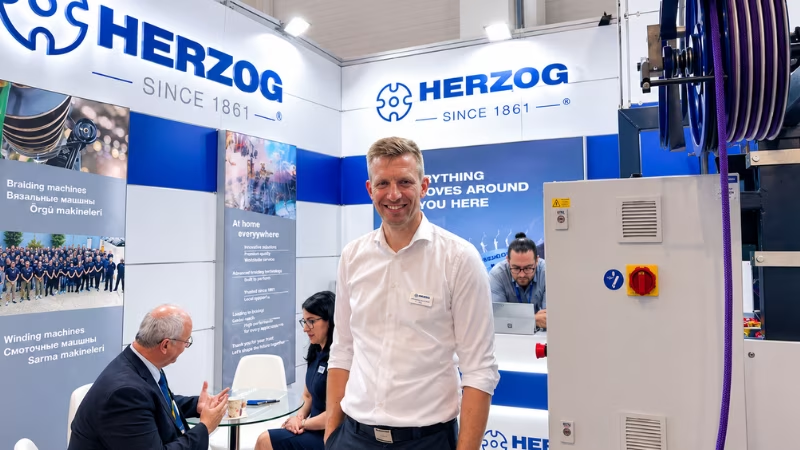
165 Years of German Mechanical Engineering Heritage
Kohan Textile Journal: Welcome, Mr. Knüppel-Spiecker. To introduce HERZOG to our global industrial audience, could you outline your engineering heritage and your targeted product specialization?
Dennis Knüppel-Spiecker: We are HERZOG Germany GmbH. We are a specialized German manufacturer of high-end braiding and winding machinery, catering to almost every industrial application. Our engineering portfolio starts from microscopic medical braids utilized in surgical applications, passes through advanced automotive configurations—such as specialized sleeves and the over-braiding of heavy industrial hoses and cables—and extends all the way to massive subsea and offshore wind infrastructure.
When you look at offshore windmills or deep-water mooring systems, factories require extremely large diameters of heavy-duty rope. Our machinery is globally recognized and highly appreciated across the industry for executing these specialized, high-load configurations.
Kohan Textile Journal: Maintaining true consistency over time is rare in this market. How long has HERZOG been operating under this model?
Dennis Knüppel-Spiecker: We have been built entirely within this industry since 1861. This represents more than 160 years of continuous German manufacturing heritage. We operate strictly as a family-owned enterprise, supporting an internal workforce of up to 150 highly skilled workers. A vast majority of our technical components and mechanical machinery parts are fabricated entirely in-house within our own mechanical workshops, ensuring complete quality control over our engineering output.
Modular Maintenance: The Open-Access Braider Body
Kohan Textile Journal: Turning to your technical layout at ITM 2026, what hardware breakthroughs or modifications are you showcasing to improve factory efficiency?
Dennis Knüppel-Spiecker: At this trade fair, we are highlighting a major structural improvement integrated directly into our machinery: our newly redesigned open-access braider body. In traditional braiding setups, replacing worn spare parts or executing routine printhead maintenance requires complex dismantling, which leads to lengthy machine downtime.
Our new braider body design provides immediate mechanical access to the core movement loops. This allows maintenance engineers to swap components quickly, minimizing production delays and significantly lowering total operating costs. Additionally, we are highlighting our specialized climbing machine configurations, designed specifically to manufacture high-safety climbing and dynamic rescue ropes.
Istanbul as a Global Strategic Hub Amid European Visa Restrictions
Kohan Textile Journal: HERZOG has maintained an active presence in Türkiye for a long time. What is your current assessment of the Turkish market, and what goals brought you to ITM 2026?
Dennis Knüppel-Spiecker: We have supported an active machinery footprint in Türkiye for more than 20 years. However, over the last few cycles, regional sales faced downward pressures due to domestic inflation challenges alongside intense competition from low-cost machinery suppliers, particularly out of China.
That market reality is exactly why we are focusing heavily on this exhibition. Our presence at ITM 2026 is not exclusively about the local Turkish market; it is a calculated deployment to engage the surrounding Middle East, North Africa, and Central Asian regions.
We have noticed a clear shift during recent industrial trade shows in Europe: international buyers seeking to travel to Germany or broader Europe for trade fairs face tightening visa restrictions, expensive flight logistics, and soaring accommodation costs. Istanbul provides an excellent alternative hub here. It features a highly connected, open-access transit network allowing buyers from anywhere on the globe to interface directly with our teams without structural barriers.
Kohan Textile Journal: That is a very clear regional view. How do you approach customer acquisition across the broader Middle East and Africa (MEA) region?
Dennis Knüppel-Spiecker: The MEA market requires dedicated field visibility. Because our braiding systems lean heavily into industrial, high-load technical textiles rather than standard apparel applications—though we do build systems for shoelaces and basic trimmings—finding specialized buyers requires direct engagement. You cannot land these technical accounts by sitting in an executive office in Germany. You must bring your hardware directly to regional exhibitions, showcase the fluid-mechanical capabilities on the floor, and build personal technical trust directly with the mill owners.
The Volatility of Industry Forecasting: “Predicting the Next Three Weeks”
Kohan Textile Journal: Looking out over a wider horizon, how do you foresee the global textile machinery industry evolving over the next few years?
Dennis Knüppel-Spiecker: [Laughs] That is an incredibly tough question to answer right now. A couple of months ago, I attended a trade fair in Germany and was asked how I viewed the next two to three years. My response was simple: under the current global political conditions and macroeconomic volatility, it is difficult to accurately forecast the next two to three weeks, let alone years.
With the sheer volume of geopolitical friction and economic obstacles running simultaneously around the world, making accurate half-year projections is highly speculative. Some operators state they see a distinct “light at the end of the tunnel,” but we must remain highly cautious that this light isn’t an oncoming train.
The only way to navigate this volatility is absolute internal preparation. You have to do your operational homework and maintain absolute technical efficiency. If you fail to protect your own business margins, your competitors will step in, and you will find yourself pushed out of the market entirely.
The Economic Realities of Circular Sustainability
Kohan Textile Journal: Sustainability is a dominant talking point across the textile supply chain. How is HERZOG addressing circular manufacturing practices internally?
Dennis Knüppel-Spiecker: Sustainable manufacturing is a highly complex challenge, particularly within textiles. When virgin raw materials remain artificially cheap, it becomes economically difficult for manufacturers to justify reintegrating expensive recycled materials back into high-performance industrial processes.
While moving toward circularity is an environmental necessity, the industry must find concrete mechanical and regulatory solutions to close the massive pricing gap between virgin polymers and premium recycled products.
In Germany, we have developed a very strong cultural mindset regarding sorting, recycling, and long-term sustainability frameworks. However, we must remain highly realistic: there are many developing countries globally that simply do not have the financial luxury or capital margins to prioritize expensive green initiatives over basic economic survival. They have to run their existing industrial systems exactly as they are to remain solvent. From our perspective, we are not in a position to pass judgment on these regions. We must always ask ourselves how we would act if we were operating under their exact economic constraints.
Read more: Crystal International Publishes Sustainability Report 2025