Why ESG performance now shapes textile competitiveness
ESG performance has moved from a brand-side reporting issue to a hard procurement criterion in textiles because buyers now need suppliers and sourcing countries that can satisfy environmental rules, social due-diligence expectations, and traceability demands at the same time. In Europe, textiles are now explicitly targeted by circular-economy policy:
the European Commission says textile consumption has the fourth-highest impact on the environment and climate among EU consumption domains, the third-highest impact on water and land use, and the fifth-highest on raw material use and greenhouse-gas emissions.
The EU’s textile strategy also links future competitiveness to durable, repairable, recyclable products, recycled-fiber content, reduced hazardous substances, digital product passports, and extended producer responsibility.
That shift matters for trade because textile ESG performance is no longer judged only at the factory gate. Buyers increasingly evaluate whether a country can support compliant chemical processing, credible labor inspection, transparent customs and governance systems, reliable sustainability data, and scalable circular infrastructure.
The World Bank’s Worldwide Governance Indicators frame this broader context through six dimensions that are directly relevant to sourcing risk: voice and accountability, political stability, government effectiveness, regulatory quality, rule of law, and control of corruption. The Bank also notes these indicators are useful as an initial lens for broad cross-country comparisons, even if deeper country diagnostics are still needed.
At the same time, worker-rights conditions remain central. The 2025 ITUC Global Rights Index says only seven of 151 countries surveyed received the top-tier rating, while average regional ratings worsened in three of five regions. It describes the index as the only comprehensive annual worldwide study of violations of workers’ rights, and reports that access to justice, freedom of speech and assembly, the right to strike, and the right to collective bargaining all remain under pressure.
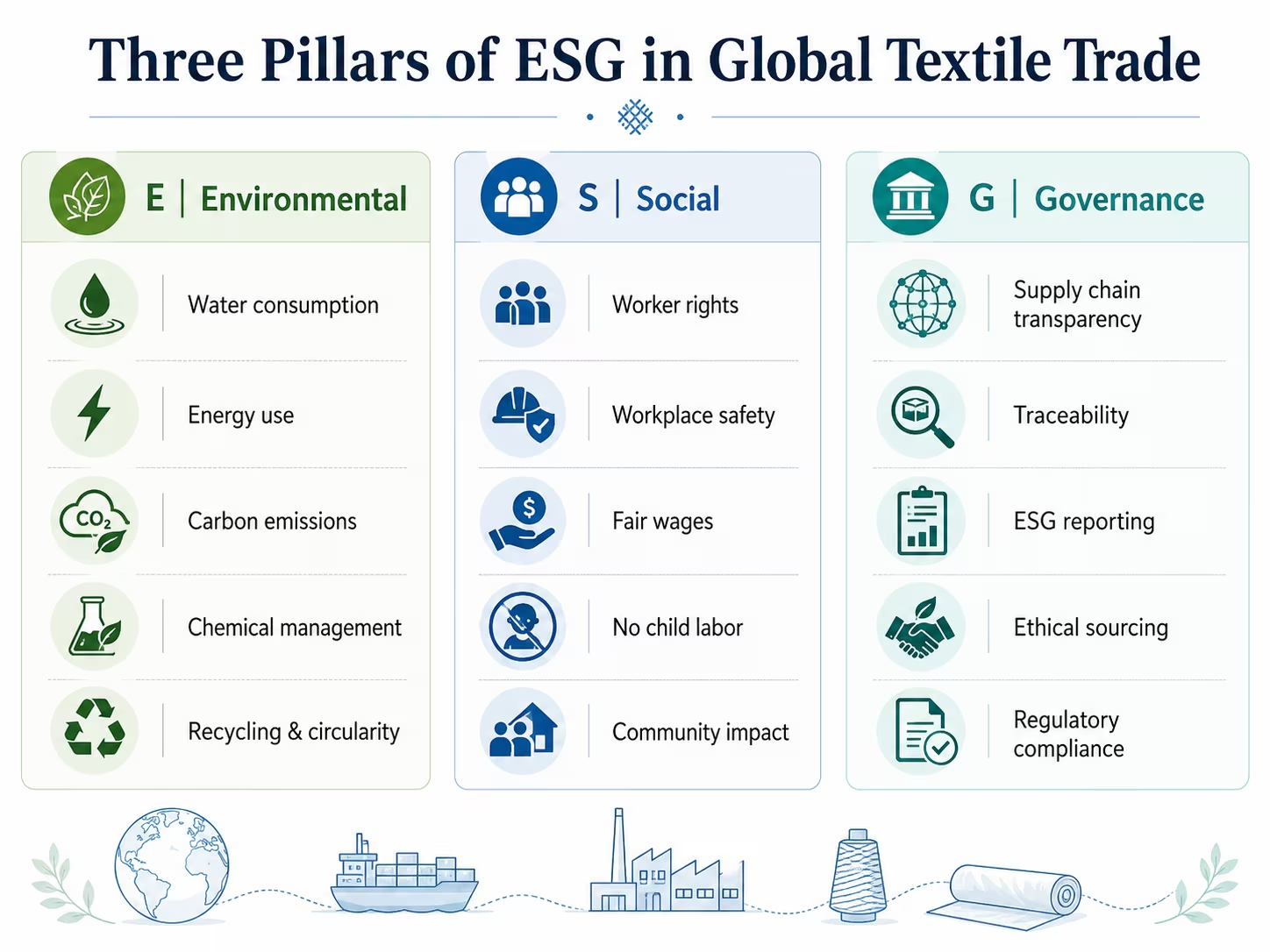
In practice, this means country-level textile competitiveness is increasingly a three-part test. First, can production happen with lower environmental intensity and better chemical discipline?
Second, can it happen under labor conditions that withstand audit and due-diligence scrutiny? Third, can the country provide a governance environment strong enough to support traceability, enforcement, and clean trade? That is the real reason ESG now matters so much in textile trade. It is becoming the operating system for market access rather than a marketing add-on.
How textile ESG should be measured
A useful textile-country ESG framework should combine environmental exposure, social outcomes, and institutional quality rather than rely on a single ranking. For the environmental pillar, the strongest country-level signals are water stress, energy and carbon intensity, waste and circular capacity, and chemical-management performance.
WRI’s Aqueduct 4.0 framework is especially relevant for textiles because it translates hydrological risk into country and subnational indicators and includes baseline annual water-risk metrics, future projections, and country rankings. This matters because textile wet processing is highly water dependent.
For the social pillar, the most informative indicators are rights of association and bargaining, wages and working time, safety, gender conditions, and access to remedy. The OECD garment-and-footwear due-diligence guidance explicitly structures responsible sourcing around six core steps: embed responsible business conduct, identify actual and potential harms, cease/prevent/mitigate harm, track, communicate, and provide for or cooperate in remediation.
It also includes sector modules on child labor, forced labor, working time, occupational health and safety, trade unions and collective bargaining, and wages, alongside environmental modules on hazardous chemicals, water, greenhouse-gas emissions, and bribery and corruption.
For governance, the most practical country metrics are regulatory quality, rule of law, corruption control, disclosure readiness, and value-chain transparency. The World Bank’s WGI remains a strong baseline for public-institution quality, while Transparency International’s CPI offers a simple corruption proxy for the public sector.
Transparency International’s 2025 results cover 182 countries, use 13 independent data sources, and score countries on a 0–100 scale from highly corrupt to very clean. The organization also states that the 2025 global average fell to 42, and that 122 of 182 countries scored under 50.
The image below shows a practical way to organize those indicators when building a country-comparison framework for a textile site article or sourcing dashboard.
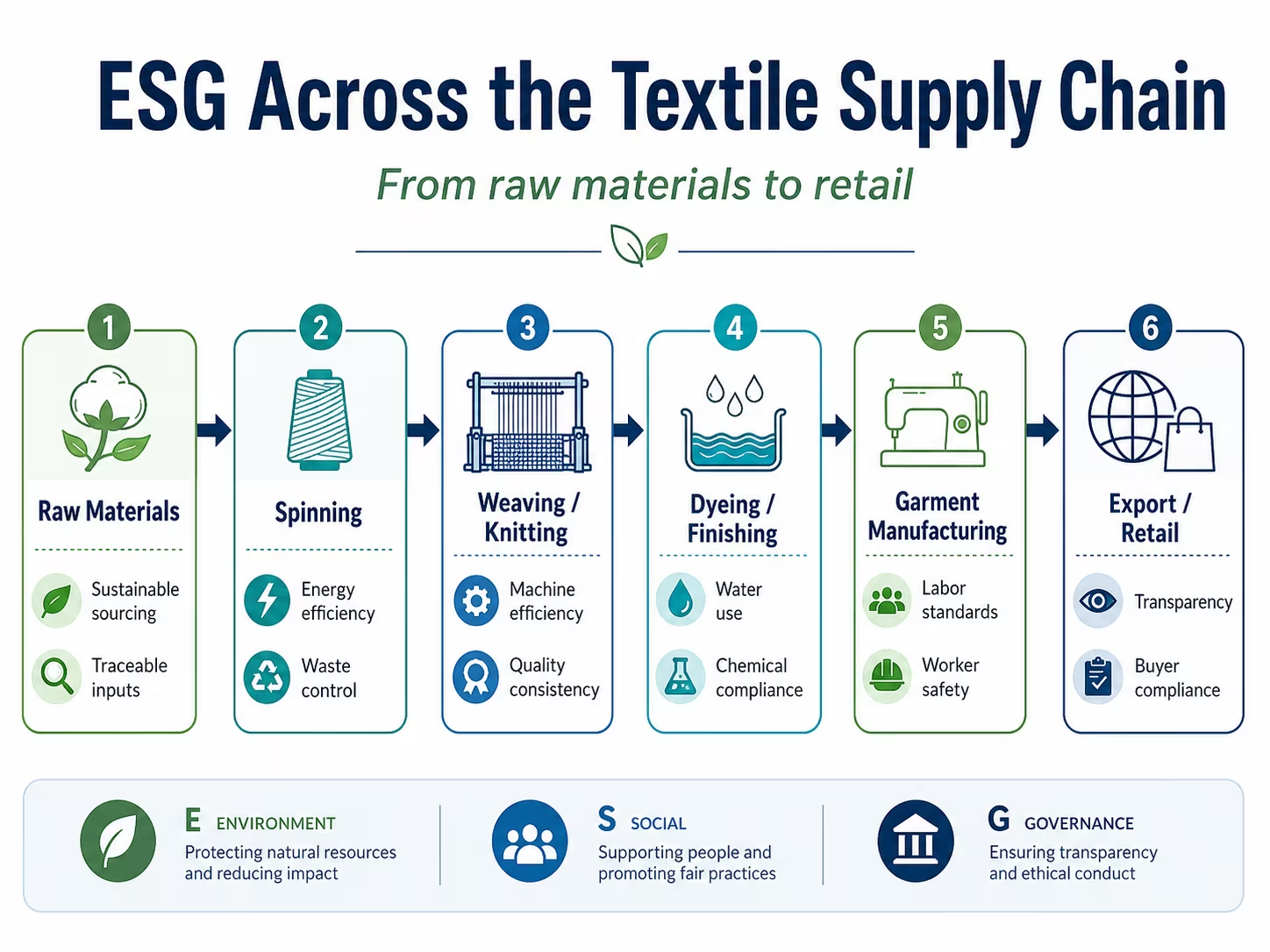
This framework is a synthesis of the most credible textile-relevant indicator families from the European Commission, WRI, OECD, Better Work, ZDHC, OEKO-TEX, the World Bank, and Transparency International. It is not an official industry standard by itself, but it reflects the metrics buyers most often need to triangulate when comparing sourcing destinations.
What the data says about environmental, social and governance performance
Environmental performance is still the most visible part of textile ESG because the resource footprint is so large. The European Environment Agency estimates that textiles consumed in the EU in 2020 required 175 million tonnes of primary raw materials, about 4,000 million cubic meters of blue water, roughly 180,000 square kilometers of land use, and generated 121 million tonnes of CO2e.
It also estimates that textile consumption in Europe was about 15 kilograms per person and that around 80% of the lifecycle impacts linked to Europe’s textile consumption occurred outside Europe.
These figures are important for country ranking because they show why water, energy, and circularity cannot be treated as secondary issues in textile trade. The EEA also notes that less than 1% of textiles worldwide are recycled into new products, underlining how limited true textile-to-textile circularity still is.
The European Commission repeats that only 1% of clothing material is recycled into new clothing, and says about 5 million tonnes of clothing are discarded each year in the EU, or roughly 12 kilograms per person.
Energy transition is the next major differentiator. The IEA’s net-zero pathway says electricity rises to almost 50% of total energy consumption by 2050 and that almost 90% of electricity generation comes from renewables in that pathway, with wind and solar making up nearly 70%.
The same report stresses that electrification is crucial across sectors, but also notes that low-emissions fuels remain essential where energy needs cannot easily or economically be met by electricity. For textiles, that is highly relevant to dyeing, washing, drying, finishing, and other heat-intensive processes.
In other words, mills in countries with cleaner grids and credible low-emission heat pathways will enjoy a structural ESG advantage over mills locked into coal-heavy or fuel-oil-heavy energy systems. That interpretation is an inference from the IEA’s economy-wide findings applied to textile process characteristics described by the EEA.
Chemical management is another decisive performance indicator. ZDHC positions its program around “sustainable chemical management” in fashion and textiles, centered on the Manufacturing Restricted Substances List, implementation tools, and wastewater guidelines.
Its platform describes the MRSL as a list of chemical substances banned from intentional use, while the program’s output tools include wastewater guidelines, wastewater modules, and ClearStream reporting. ZDHC also highlights that its approach aims to stop hazardous chemicals at the source rather than only test finished products.

OEKO-TEX provides a similar facility-level lens from another angle. OEKO-TEX STeP says it sets standards for both social and environmental aspects of production and uses six modules: chemical management, environmental performance, environmental management, social responsibility, quality management, and health and safety.
It also includes an impact calculator for facility-level carbon and water footprints. OEKO-TEX MADE IN GREEN adds product-level traceability through unique product IDs or QR codes and links product-level claims to supplier-country data, wastewater quality, harmful-substance testing, and fair-working-condition requirements.
On the social side, Better Work offers one of the clearest evidence bases in the sector. It says it is active on the ground in 11 countries across three continents and works with around 2,250 factories employing 3.7 million workers. It also reports independent evidence of measurable gains:
factory productivity up to 22%, profitability up to 25%, sexual-harassment concerns down 18%, women’s access to prenatal care up 26%, and the pay gap between women and men down by up to 17%. Those results matter because they show that social compliance is not only a cost center; it can be tied to measurable business performance.
Governance and worker-rights conditions differ sharply by region. Transparency International’s 2025 regional CPI averages show Western Europe and the EU at 64, Asia Pacific at 45, the Americas at 42, the Middle East and North Africa at 39, Eastern Europe and Central Asia at 34, and Sub-Saharan Africa at 32.
The ITUC’s 2025 regional worker-rights averages show Europe at 2.78, the Americas at 3.68, Africa at 3.95, Asia-Pacific at 4.08, and MENA at 4.68, where lower is better. These regional taxonomies are not identical across the two organizations, so the chart below should be read as directional rather than as an exact harmonized ranking. Even so, the pattern is clear: Europe currently sets the benchmark on combined governance and labor-rights performance, Asia-Pacific is mixed but heavily consequential because of scale, and MENA and much of Africa still face a wider ESG confidence gap.
Which regions are setting the pace and which are catching up
Western Europe is setting the strongest textile ESG benchmark, not because it has the world’s cheapest production base, but because it combines stronger public governance with the most advanced regulatory architecture for circularity. The European Commission’s textile strategy ties future competitiveness to ecodesign, durability, repair, recycling, reduced hazardous substances, digital product passports, textile extended producer responsibility, restrictions on textile-waste exports, and action on microplastics.
The EEA’s environmental accounting and the Commission’s strategy together make Europe the clearest reference point for where global buyer expectations are heading.
Asia-Pacific remains the decisive operational region because most textile production still happens there, but its ESG profile is highly uneven. Better Work’s country programs in Bangladesh, Cambodia, Indonesia, Pakistan, Sri Lanka, Uzbekistan and Viet Nam show where structured labor-upgrading systems are already embedded. At the same time, the ITUC says Asia-Pacific’s average worker-rights rating improved only marginally to 4.08 in 2025, and it notes rising violence and tighter restrictions on free speech and assembly in more countries.
The Americas sit in the middle. Transparency International puts the regional CPI average at 42, while ITUC says the Americas’ average worker-rights rating worsened to 3.68, its weakest since the index began. That suggests the region can still compete in ESG-sensitive sourcing where proximity, trade agreements, or cleaner energy systems matter, but it does not currently offer a uniformly strong social-governance profile.
MENA and African sourcing markets are best understood as improving but still uneven. ITUC continues to rate MENA as the worst region for workers’ rights on average, and Transparency International’s regional scores for MENA and Sub-Saharan Africa remain below the global midpoint. Yet these regions also show where ESG capability-building is expanding:
Better Work is active in Egypt and Ethiopia, while ZDHC now highlights chemical-management work in markets including Egypt. The implication is that emerging-market progress is increasingly happening through targeted multi-stakeholder systems rather than through broad-based institutional upgrading alone.
Read more : Emerging Textile Markets in Africa 2026
How ESG is reshaping sourcing, investment and supplier management
For sourcing teams, ESG is changing the geography of “acceptable risk.” Countries that can offer cleaner energy access, stronger wastewater and chemical controls, better labor-enforcement partnerships, and more transparent governance are becoming easier to defend internally to boards, investors, and regulators.
The OECD garment guidance is especially useful here because it effectively turns ESG sourcing into a repeatable operating process: embed responsible conduct, identify harms, mitigate them, track results, communicate transparently, and remediate where needed.
That is also why certifications and shared industry systems matter more than ever. GOTS says version 8.0 strengthens supply-chain accountability from fiber to finished product and introduces mandatory due diligence, enhanced chemical and climate criteria, and new circularity requirements. OEKO-TEX STeP combines social and environmental facility certification, while MADE IN GREEN adds traceability through QR codes and product IDs.
ZDHC’s MRSL, Gateway, wastewater tools, and implementation systems create a common chemical-management language across brands and suppliers. Better Work contributes labor-data transparency and country-program evidence. None of these systems is a substitute for robust state regulation, but together they form the practical compliance stack that many buyers now rely on.
Digital intelligence is becoming the connective tissue. The Digital Product Passport is explicitly part of the EU textile-policy roadmap. ZDHC’s Gateway is designed as a shared database for safer chemical choices and wastewater reporting. Better Work offers a transparency portal. OEKO-TEX provides label checks and QR-based product traceability.
The direction is unmistakable: ESG claims are moving from PDF-based declarations toward structured, queryable, product- and facility-level data.
Investment trends are following that logic. Capital is increasingly targeting decarbonization, renewable energy, next-generation materials, recycling capacity, wastewater systems, and traceability infrastructure rather than only traditional spindle-and-sewing expansion. A visible example is the Fashion Climate Fund, which industry reporting describes as a $250 million initiative intended to finance supplier decarbonization and unlock larger blended-capital flows across the fashion value chain.
The precise scale of broader textile ESG finance remains fragmented across public and private vehicles, but the trend is clear: ESG investment is moving closer to the factory infrastructure that determines energy, water, chemistry, and data performance.
For supplier evaluation, the most robust strategy is not to ask whether a country or factory is “good” or “bad” on ESG. It is to build a risk stack. A practical sourcing scorecard should combine at least five questions. Is the production geography water stressed? Is there a pathway to lower-carbon electricity and low-emission heat?
Are social risks visible through serious worker-rights indicators and grievance channels? Are chemical controls and wastewater rules backed by credible systems? And does the governance environment support transparency, remedy, and predictable compliance? That multi-metric approach is much stronger than relying only on price, lead time, or a single audit score.
Open questions and limitations
This report uses the strongest accessible cross-country and industry sources, but textile ESG benchmarking still has three important data gaps. First, few public datasets combine environmental, social, and governance indicators into one harmonized textile-country ranking. Second, many country indicators are national averages that can hide large subnational differences in water stress, labor enforcement, or energy mix.
Third, regional comparisons can be directional rather than exact because institutions such as Transparency International and ITUC do not always use identical regional groupings.
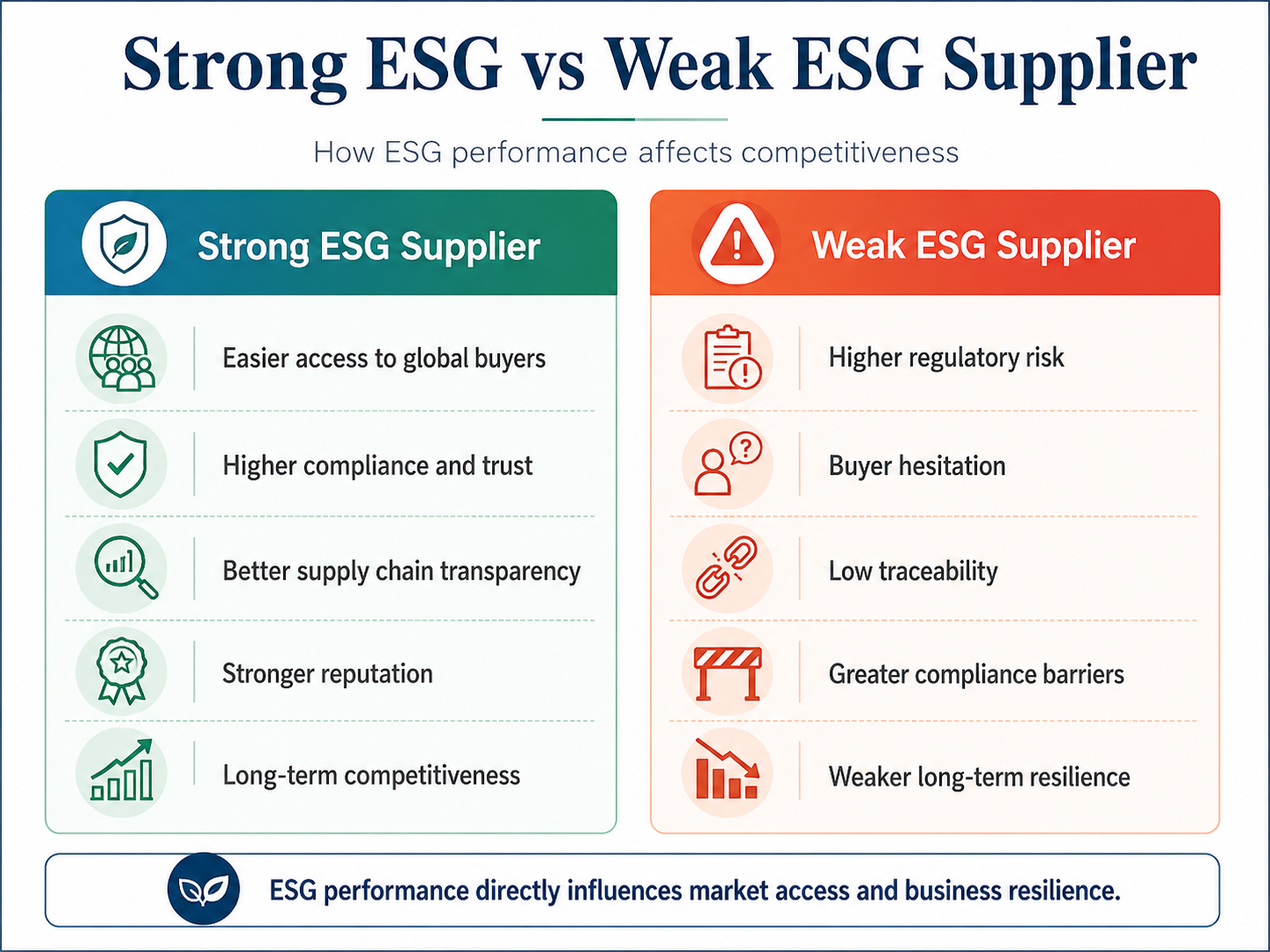
The most important takeaway, however, is high confidence: the countries that will rank best in future textile sourcing are not simply the cheapest producers. They are the ones that can demonstrate cleaner resource use, stronger worker protections, credible governance, and machine-readable traceability at scale.
ESG performance is becoming one of the clearest predictors of which textile hubs will keep or gain market share in the next phase of global trade.