In an exclusive interview with Kohan Textile Journal during Egypt Stitch & Tex Expo in Cairo, Karam Barmada of PrimeTex Machinery & Accessories discusses Egypt’s growing textile industry, foreign investment, competition between European, Turkish and Chinese machinery, the importance of workforce development, and whether Africa could become the textile industry’s next major manufacturing destination.
Interview by Behnam Ghasemi | Kohan Textile Journal
Egypt’s textile industry has attracted increasing attention from international manufacturers, machinery suppliers and investors in recent years. For Karam Barmada of PrimeTex Machinery & Accessories, however, the current momentum did not appear overnight.
Speaking with Kohan Textile Journal at Egypt Stitch & Tex Expo in Cairo, Barmada argued that years of infrastructure development, trade agreements and preparation have helped create the conditions now attracting investment from Türkiye, China and other international markets.
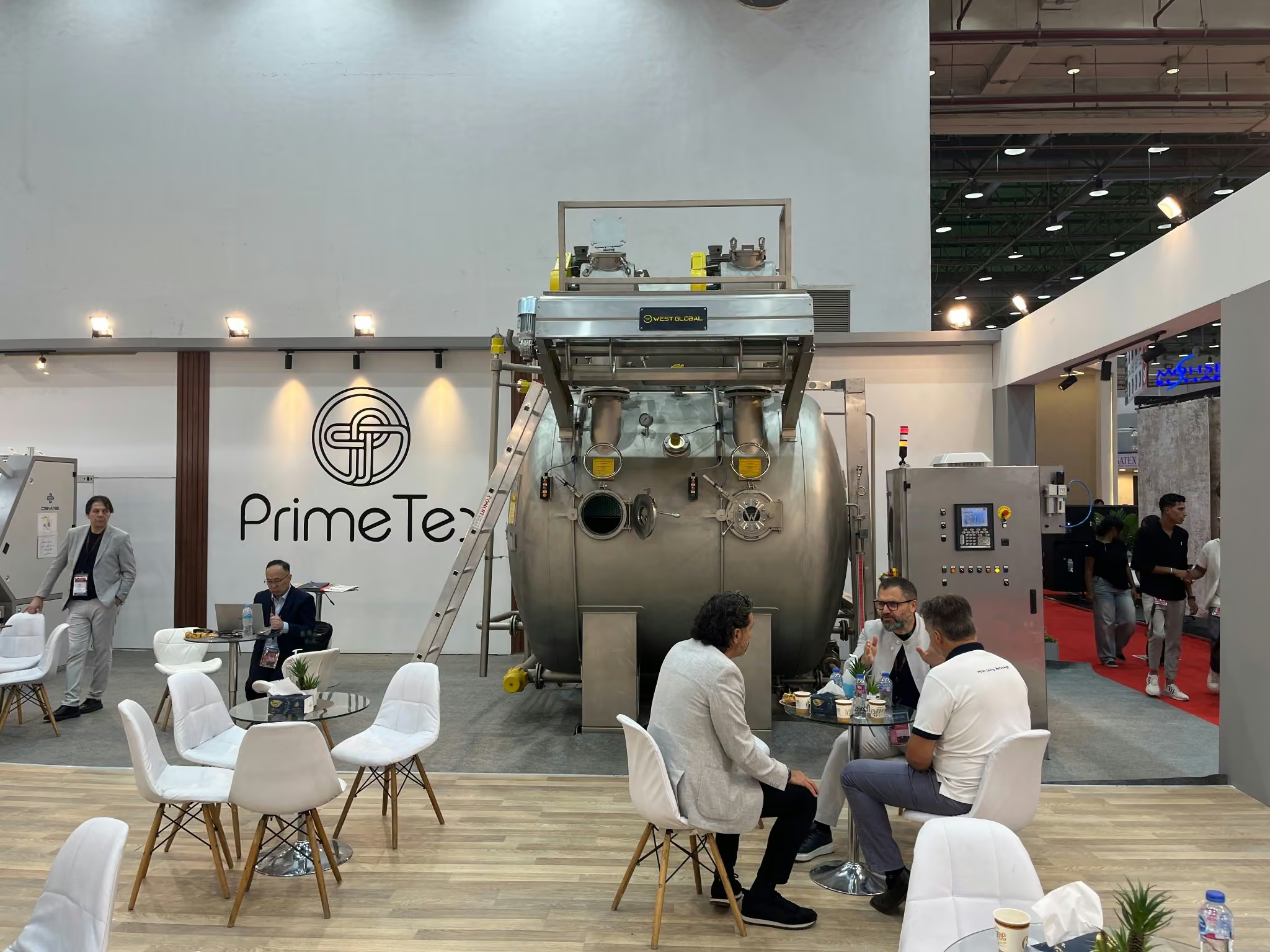
PrimeTex operates in textile machinery and accessories, with particular experience in machinery for dyeing, finishing and printing. This gives Barmada a close view not only of Egypt but also of changing machinery technologies and sourcing decisions across the textile industry.
How do you see the Egyptian textile market today?
Karam Barmada: Egypt did not start this process today. It began several years ago. The government first worked on preparing the infrastructure, so I don’t think the investments we are seeing today are a coincidence. A great deal of work went into creating the conditions for them.
Now Egypt is beginning to see the results of that preparation and investment.
Egypt is also a very special country in terms of its geographical position and human resources. If you combine these factors with energy and other advantages, the country becomes very competitive as an industrial location.
Perhaps in the past, international investors did not fully recognize Egypt as one of the attractive locations for manufacturing and industry. But during the past few years, it has increasingly come into the spotlight.
Why has Egypt become particularly important for textile manufacturing?
Karam Barmada: Textile manufacturing requires several elements to come together. You need people, you need energy, and you need good access to international markets.
Production has become more difficult in some traditional textile manufacturing countries, particularly because of costs. Textiles are extremely cost-sensitive, and Egypt has emerged as an alternative.
Egypt also already had trade agreements in place. But trade agreements alone are not enough. Investors need to be convinced that they can manufacture successfully in a country.
Human resources need to be trained, and infrastructure needs to support industrial operations. In the past, some infrastructure weaknesses created difficulties for investors in Egypt. Today, when you combine improvements in these areas with the country’s existing trade advantages, Egypt becomes much more attractive.
There is another factor that should not be underestimated: the people. Egyptians are hospitable and generally open to foreigners. They communicate easily and can integrate with international investors. That cultural ability to work together can be very important when a foreign company establishes manufacturing operations.
Do you believe Egypt’s textile investment momentum will continue?
Karam Barmada: Yes. I believe Egypt’s future can be even better.
I don’t think this process will stop here. In my view, the development will continue.
There are fundamental reasons behind it. Egypt has geography, people, industrial potential and access to markets. When the different pieces come together, the country becomes an increasingly logical manufacturing location.
Syria is also attracting renewed attention. Could it become another important textile manufacturing market?
Karam Barmada: Syria needs time.
It went through an extremely difficult period. There were first and foremost terrible human losses, but the country also suffered damage to its infrastructure and broader economic environment. Repairing all of this cannot happen immediately.
That does not mean Syria is not an interesting location for investment. Syria has a very advantageous geography and a long history and experience in textiles.
Its proximity to Türkiye is another advantage because knowledge and industrial experience can move relatively quickly between the two countries.
I am positive about Syria’s longer-term potential, but patience is necessary. The situation cannot really be compared directly with Egypt today because they are at different stages.
Chinese textile machinery is becoming increasingly competitive worldwide. What are you seeing in your own sectors?
Karam Barmada: Our main fields are dyeing, finishing and printing, so I can speak particularly about those areas.
Chinese manufacturers have developed considerably, and that is a reality. I follow the Chinese market closely and travel there because ignoring what is happening in China would be a mistake.
But the situation depends very much on the type of machinery.
In some machinery categories, China has become extremely competitive. In certain cases, you could even say that China offers one of the best combinations of quality and price.
But this is not true for every machine and every application.
Where do you see the difference between Chinese machinery and the requirements of markets such as Egypt?
Karam Barmada: China’s domestic textile industry operates on a huge scale. Because manufacturers there can specialize in very large production volumes, machinery can sometimes be designed for relatively specific production requirements.
Our markets can be different.
Many customers need more flexible and smarter machines because their production changes frequently. Fashion changes, fabric types change and customer requirements change.
A manufacturer may need the same machine to respond to different fabrics and different production requirements. In those situations, flexibility becomes extremely important.
That is an area where, depending on the application, some Chinese machines may not yet provide exactly what a particular customer needs.
Is price still China’s biggest advantage?
Karam Barmada: Generally, yes, price is an important Chinese advantage.
But successful Turkish and European machinery manufacturers are also becoming more aware of this competition. They understand that they have to continue developing technologically while also keeping their prices within a reasonable range.
If the price difference is not too large, a customer may still be able to select a Turkish or European machine that offers greater functionality or other advantages.
The price has to make sense, though. You cannot ignore price competition.
How competitive is Turkish textile machinery today?
Karam Barmada: Türkiye has developed considerably, particularly in areas such as dyeing machinery.
There are very good machines being manufactured in Türkiye today. In some areas, the technology has come very close to German and Italian technology.
There have also been important developments in areas such as water savings, fabric quality and production speed.
When you can combine that level of performance with a reasonable price, it becomes a very strong proposition.
For that reason, we don’t automatically move toward China simply because a machine is available at a lower price. We look at the particular technology and application and determine what makes sense for the customer.
Every textile machinery segment is different. My comments particularly concern the dyehouse, printing and finishing sectors serving apparel and home textile fabrics. The competitive situation may be completely different in spinning or other areas of textile production.
Read More: Egypt’s Textile Export Council Joins Euro-Med Textile Value Chain Conference in Tunisia
Many people describe Africa as the textile industry’s next manufacturing destination. Do you agree?
Karam Barmada: It is possible, but I don’t think it will happen in the short term.
Textile manufacturing requires experience. Investment alone is not sufficient. You need people with knowledge, infrastructure and the different parts of the textile supply chain working together.
There are still very large textile manufacturing countries in Asia. Bangladesh and India, for example, have enormous potential, while Uzbekistan has also been developing its textile industry.
These are significant players.
So I believe a major shift of textile production further into Africa would take time. Textile manufacturing is a complicated industry. You can invest in a factory, but making that investment successful is another matter.
Workforce availability is often mentioned as a challenge for foreign textile investors in Egypt. What is your view?
Karam Barmada: This is connected to education and training.
When we talk about infrastructure, people themselves are one of the most important parts of that infrastructure.
Workers need to be trained. Foreign investors arrive with their own standards and expectations, and local employees need time to understand and adapt to those requirements.
But I also think investors themselves need to participate in this process rather than expecting everything from the government.
Instead of hiring 500 people simply to find 200 suitable workers, perhaps you can select 100 people and invest properly in those 100. Train them, give them time and help them develop.
Egyptians are intelligent and can learn quickly. But you need to show them the way and approach the process with patience.
Should foreign investors bring experienced personnel from abroad?
Karam Barmada: For certain positions, yes.
Experienced managers, specialists and operators can be valuable during the establishment of a new operation. But one of their most important responsibilities should be transferring their knowledge to local employees.
A foreign specialist may not want to remain in another country permanently. There can be language, cultural, family and social challenges.
Therefore, while those experienced people are there, they should train others.
Knowledge should not remain with one individual. It should be transferred to the next generation.
If you find people who genuinely want to learn, you should invest your time in them. Nobody is born knowing everything. If someone has the willingness to learn, you can achieve a great deal by developing that person.
So could human capital ultimately become Egypt’s greatest textile advantage?
Karam Barmada: In my opinion, Egypt’s biggest advantage is its people.
Of course, you also have energy, geography and improvements in bureaucracy and the investment environment. All of these can make the country more attractive.
But people come first.
Human resources are the first link in the chain and, in my view, the most important one.
Egypt still has challenges in workforce readiness compared with more mature manufacturing environments, and investors need to understand that. But if companies are prepared to invest in training and people, they can succeed here.
Egypt’s Opportunity Goes Beyond Low-Cost Manufacturing
One of the strongest messages from PrimeTex’s perspective is that Egypt should not be viewed simply as another lower-cost textile production location.
Its emerging position is based on a combination of geography, workforce potential, existing textile experience, trade access, infrastructure development and growing international investment. At the same time, none of these advantages eliminates the challenges facing manufacturers.
Workforce development remains essential. Machinery investors must balance acquisition price against flexibility, quality and production requirements. And international companies entering Egypt need to recognize that building a successful manufacturing operation requires investment in people as much as investment in equipment.
The machinery discussion is also becoming more complex. China can no longer be treated simply as the low-price alternative, as Chinese manufacturers have made substantial progress in several textile machinery categories. Türkiye, meanwhile, has developed a stronger machinery industry of its own, particularly in the dyeing and finishing fields discussed by Barmada. European suppliers continue to compete through technology and specialization.
For Egyptian textile manufacturers, this creates more choice—but also makes investment decisions more demanding.
For Barmada, however, the country’s fundamental opportunity remains strong. If Egypt continues developing its industrial environment while companies invest seriously in training the next generation of textile workers, its current textile investment cycle could have considerably further to run.