






As the global textile machinery industry prepares to gather in Cairo from 24–27 September, Egypt Stitch & Tex 2026 is arriving at a particularly important moment for the Egyptian textile and apparel sector.
The significance of this year’s exhibition goes beyond the event itself. Egypt is attracting renewed attention as a textile and garment manufacturing base, supported by rising apparel exports, manufacturing expansion, new investment interest and a broader drive to modernise the country’s textile value chain.
For international textile machinery manufacturers and technology suppliers, these developments are making Egypt increasingly difficult to overlook. Against this backdrop, the 24th Egypt Stitch & Tex Expo could provide an important snapshot of where the Egyptian textile industry is heading — and where manufacturers are preparing to invest next.

Egypt Is Moving Back Into the Textile Spotlight
Egypt has long occupied a distinctive position in the international textile industry. Its cotton heritage is globally recognised, while its large domestic market, established manufacturing base and geographical position connecting Africa, the Middle East and Mediterranean markets give the country advantages that extend well beyond raw materials.
What is changing is the momentum surrounding manufacturing and exports.
Egypt’s ready-made garment sector has recorded significant export growth. Ready-made garment exports reached $3.394 billion in 2025, up 20% from $2.846 billion in 2024.
The momentum has continued into 2026.
During the first four months of 2026, Egyptian ready-made garment exports reached approximately $1.15 billion, compared with $1.002 billion during the same period of 2025, representing year-on-year growth of around 15%.
This is particularly relevant for textile machinery suppliers.
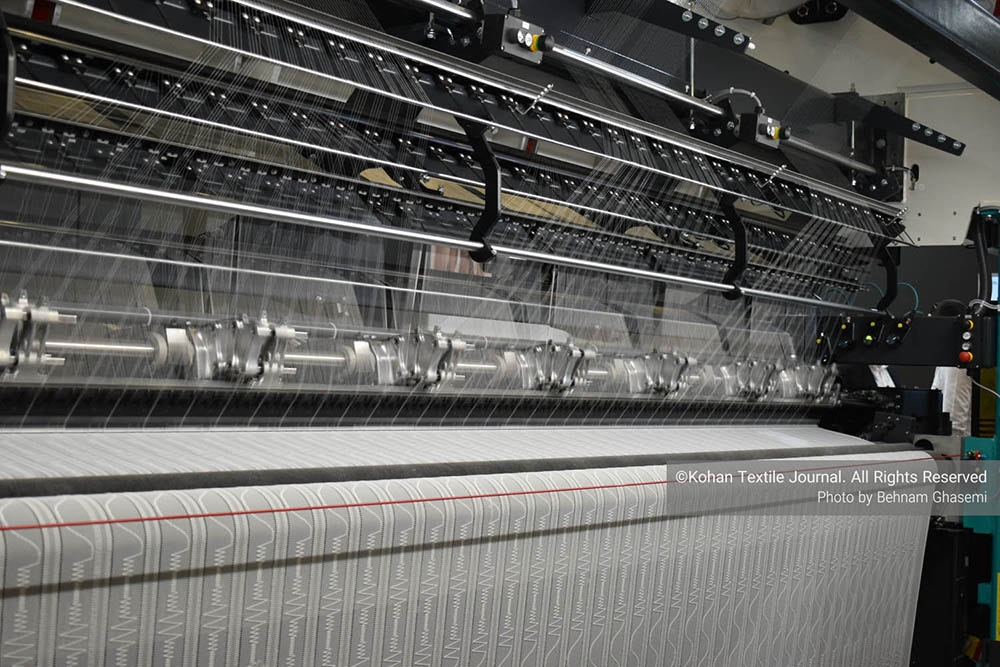
Growing garment exports can create pressure further upstream. Manufacturers seeking to handle larger orders, shorter lead times and increasingly demanding international customers need greater productivity, consistent quality and stronger capabilities across spinning, knitting, weaving, dyeing, finishing, printing, garment manufacturing and automation.
The opportunity for Egypt, therefore, is not simply to produce more garments. It is to deepen and modernise the textile value chain supporting them.
Investment Interest Is Following the Opportunity
Another reason Egypt deserves attention is the investment activity developing around its textile and garment sector.
In January 2026, Egypt’s General Authority for Investment and Free Zones (GAFI) held discussions with a high-level delegation of Hong Kong textile and garment companies to explore investment partnerships in spinning, textiles and ready-made garments.
The figures presented during those discussions help explain the growing international interest.
According to representatives of Egypt’s apparel export sector, Egyptian garment exports to the European Union and the United States increased by 97% and 46%, respectively, over the previous five years. Egypt’s spinning and textile exports also reached $1.13 billion in 2024, representing 48% growth over five years.
That interest has extended beyond a single meeting. In February, another business mission brought 12 Hong Kong apparel and textile companies to Cairo to explore investment prospects and potential manufacturing opportunities in Egypt.
Expansion is also taking place among manufacturers already operating in the country.
GID Textile Egypt currently operates three manufacturing facilities in Borg El Arab, 10th of Ramadan City and Ismailia, employing around 15,000 workers. In June 2026, the company discussed plans with Egypt’s Ministry of Industry to expand production capacity at its existing factories and establish additional facilities.
These developments do not mean every challenge facing Egyptian textile manufacturing has disappeared. They do, however, illustrate why the country is attracting closer attention from international manufacturers, technology suppliers and investors.
For machinery companies in particular, the equation is straightforward: factory expansion requires equipment, export growth requires productivity, and stronger international competition increases the need for quality, efficiency and technology.

Why Textile Machinery Manufacturers Are Paying Attention
For international textile machinery companies, Egypt presents several layers of potential opportunity.
- The first is modernisation.
Manufacturers competing for international orders increasingly need to improve productivity, process consistency, energy efficiency and product quality. This can create demand for newer generations of machinery, automation and production-control technologies. - The second is capacity expansion.
As established manufacturers expand and new investors consider the country, machinery demand can extend across much of the textile production chain — from fibre preparation and spinning to knitting, weaving, dyeing, finishing, printing and garment manufacturing. - The third is Egypt’s geographical and trade position.
Located between Africa, the Middle East and the Mediterranean, Egypt offers manufacturers access to several important regional and international markets. Its trade relationships and proximity to Europe can also be relevant for manufacturers seeking shorter supply chains and alternative sourcing locations.
This does not make future growth automatic.
Investment costs, financing, infrastructure, skills, energy, productivity and competition from other major textile-producing countries remain important factors.
Nevertheless, the combination of rising exports, manufacturing expansion and international investment interest means that Egypt has become a market textile technology suppliers are watching closely.
And that is precisely what makes the timing of Egypt Stitch & Tex 2026 particularly interesting.

Stitch & Tex 2026 Comes at the Right Moment
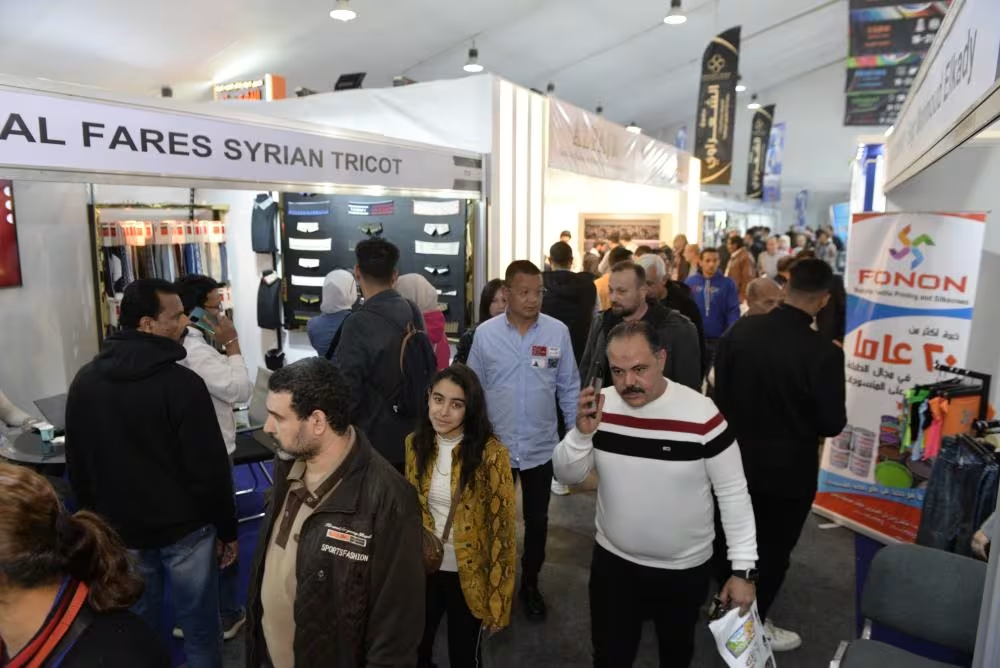
The 24th Egypt Stitch & Tex Expo will take place from 24–27 September 2026 at the Cairo International Convention Center (CICC) in Cairo. The scale of the upcoming edition is significant.
According to information released ahead of the exhibition, Egypt Stitch & Tex 2026 is set to bring together 425 Egyptian and international exhibitors across approximately 40,000 square metres of exhibition space.
The exhibition covers textile and carpet machinery, printing technologies and accessories, bringing machinery manufacturers, technology suppliers, textile producers and industry professionals together in Cairo. But the wider industrial environment surrounding this edition could ultimately prove more important than its size.
Trade exhibitions become particularly relevant when they coincide with periods of investment and industrial change. Manufacturers considering capacity expansion approach machinery exhibitions differently from visitors simply observing new technologies.
The questions become increasingly practical.
How much can a new machine increase productivity? How much energy, water or raw material can it save? Can automation reduce repetitive manual processes? How quickly can an investment generate a return? Can digital technologies shorten product-development and sampling cycles?
And perhaps most importantly, which technologies can help Egyptian textile manufacturers compete more effectively for international orders? These are likely to be among the important conversations taking place in Cairo this September.

Global Technology Companies Are Heading to Cairo
The importance attached to the Egyptian market can also be seen in the presence of established international textile machinery and technology companies.
Japanese computerized flat knitting technology specialist SHIMA SEIKI has confirmed its participation in Egypt Stitch & Tex 2026 together with its Egyptian representative TTS.
The company will present its N.SSR series of computerized flat knitting machines alongside digital technologies including SDS KnitPaint-Online and the SDS-ONE APEX4 3D design system.
The latter demonstrates one of the important transformations taking place across textile and apparel manufacturing: the growing connection between design and production.
SHIMA SEIKI says its APEX4 technology enables realistic fabric simulation and 3D virtual sampling, allowing digital samples to replace parts of the physical sampling process and helping reduce development time, cost and material consumption.
Spinning technology will also have an international presence.
Saurer has confirmed its participation at Egypt Stitch & Tex 2026, with its spinning technologies presented at the stand of ATAG in Hall 1.
Another major technology supplier heading to Cairo is Barmag.
Barmag has confirmed that it will participate in Egypt Stitch & Tex 2026 through its Egyptian representative ATAG, at booth H1C1.
These announcements are particularly relevant because they demonstrate that international machinery manufacturers are not simply watching developments in Egypt from a distance. They are putting technologies, technical teams and local representation in front of Egyptian manufacturers.
As more companies announce their participation in the final days before the exhibition, Cairo is preparing to become a concentrated meeting point between international textile technology and one of the region’s most closely watched manufacturing markets.
Technology and the Next Phase of Egyptian Textiles
The technologies presented at Stitch & Tex should also be viewed within the wider transformation taking place across global textile manufacturing.
Automation is becoming increasingly important.
Digitalisation is moving deeper into production.
Energy efficiency is no longer simply an environmental consideration; it is increasingly an operating-cost issue.
Water consumption remains critical in wet processing.
Digital printing continues to change the economics of shorter production runs and product customisation.
Virtual sampling can reduce development time and physical material consumption.
Advanced process control and artificial intelligence are also gradually moving from industry discussion toward practical manufacturing applications.
For Egyptian manufacturers competing internationally, the adoption of these technologies could influence how effectively they move from competing predominantly on manufacturing cost toward competing on productivity, quality, flexibility and speed.
That makes exhibitions such as Egypt Stitch & Tex more than machinery showcases.
They become places where future investment decisions are compared.
Cairo Could Tell Us Where the Market Is Going
The real measure of Egypt Stitch & Tex 2026 will therefore not simply be visitor numbers or the number of machines displayed.
The more interesting question is what happens after the exhibition.
- Will Egyptian manufacturers continue investing in additional production capacity?
- Which parts of the textile value chain will attract the greatest investment?
- Will automation become more important inside Egyptian textile factories?
- How rapidly will manufacturers adopt digital production and process-control technologies?
- Can Egypt translate the current momentum in garment exports into deeper capabilities across spinning, knitting, weaving, dyeing and finishing?
- And will increasing international interest translate into long-term manufacturing investment?
These are much larger questions than one exhibition can answer.
But from 24–27 September, Cairo will provide an unusually concentrated opportunity to observe how Egyptian manufacturers, international technology suppliers and investors are approaching them.
That is why Egypt Stitch & Tex 2026 matters.
Its importance is not simply that hundreds of textile companies will gather in Cairo. It is that they are gathering at a moment when Egypt’s textile and garment sector is attracting renewed attention through export growth, manufacturing expansion, investment discussions and technological modernisation.
For the international textile machinery industry, Cairo this September is therefore about more than exhibiting machines.
It is an opportunity to understand where one of the Middle East and Africa region’s most established textile industries may be heading next.
Kohan Textile Journal at Egypt Stitch & Tex 2026
Kohan Textile Journal will be actively covering Egypt Stitch & Tex 2026 as part of its continuing focus on the textile, apparel and textile machinery industries across the Middle East and Africa.
For nearly two decades, KTJ has followed the development of textile markets across the region, connecting international machinery manufacturers, textile producers, technology suppliers and industry decision-makers with developments and opportunities emerging across Middle Eastern and African textile markets.
Egypt has an increasingly important place within that coverage.
During Egypt Stitch & Tex 2026, the Kohan Textile Journal editorial team will follow new technologies, machinery launches, investment developments and industry perspectives emerging from Cairo and share them with its international textile audience.
Kohan Textile Journal also welcomes collaboration with companies participating in the exhibition.
Exhibitors, machinery manufacturers, technology suppliers and industry organisations are invited to connect with the KTJ editorial team to share their latest developments and explore opportunities for editorial coverage, executive interviews, company and technology features, video content and wider media partnerships before, during and after Egypt Stitch & Tex 2026.
As the international textile industry turns its attention to Cairo, Kohan Textile Journal will be there to follow the technologies, companies and investment decisions shaping the next chapter of Egypt’s textile industry.











