




In the global dyeing and finishing sectors, manufacturers continuously seek an optimal balance between top-tier mechanical precision and cost-efficient production. As processing mills face volatile energy prices, strict environmental discharge penalties, and shifting tariff walls, legacy equipment layouts can become major economic liabilities.
Today’s market demands highly automated, complete system workflows—from pre-treatment to final stentering—integrated with artificial intelligence and robotics to optimize resource utilization.
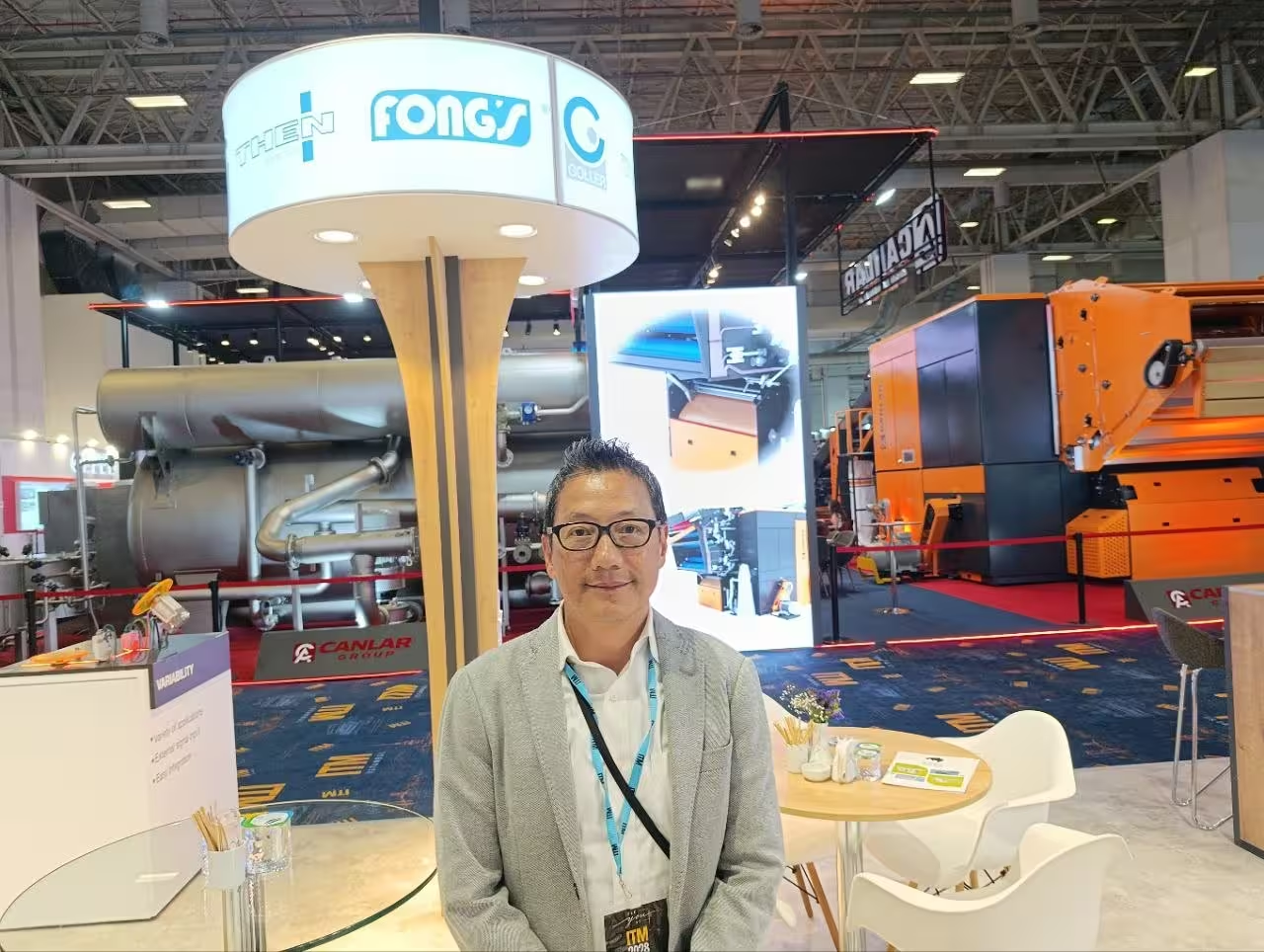
At the International Textile Machinery Exhibition (ITM 2026) in Istanbul, Behnam Ghasemi, Editor-in-Chief of Kohan Textile Journal, met with Mr. Kin Po Boby Loo, Managing Director at CHTC Fong’s International Co., Ltd.. In this exclusive Q&A interview, Mr. Loo outlines the strategic synergy between European R&D and Chinese manufacturing scales, traces their long-term growth to over 1,000 machines in the Turkish market, and delivers a vital macro analysis of how Chinese investments are actively reshaping the Egyptian apparel corridor.
Over 60 Years of Expansion: Building a Complete Finishing Solution
Kohan Textile Journal: Welcome, Mr. Loo. To ground our global readers, could you introduce the corporate history of Fong’s and your extensive brand integration?
Mr. Kin Po Boby Loo: Fong’s is a publicly listed enterprise on the Hong Kong Stock Exchange, originally founded by Mr. Fong in 1963 and listed on the Hong Kong Market Exchange in 1990. We have a solid 60-year track record in the global textile machinery market, handling everything from R&D and manufacturing to sales, marketing, and global technical services.
Over the decades, our group grew through strategic European partnerships and acquisitions:
- 1999: Established a joint-venture partnership with Monforts, setting up the company as Monfongs to produce stenter frames specifically focused on the China market.
- 2002: Acquired Xorella, the industry benchmark for yarn vacuum conditioning and steaming.
- 2004: Acquired THEN, which is globally renowned for its pioneering aerodynamic airflow fabric dyeing technology.
- 2006: Acquired GOLler, a premier wet finishing line brand producing continuous ranges for bleaching, scouring, desizing, mercerizing, and washing.
- 2012: Fully acquired Monforts from Germany.
Today, we are a proud state-owned enterprise, operating as a member of the CHTC Fong’s Group and a member of Sinomach. Because of this 60-year evolution in the dyeing and finishing field, we offer a completely seamless, one-stop solution from initial fabric pre-treatment straight through to final drying and stentering.
The Strategic Synergy: German Engineering Meets Chinese Production Scales
Kohan Textile Journal: Balancing European precision with competitive pricing is a challenge. What engineering and production philosophy drives your current machinery lines?
Mr. Kin Po Boby Loo: Our modern manufacturing model is highly efficient because we successfully combine German engineering with China’s immense production infrastructure. We learn a lot from German technology and engineering. Everyone understands that China’s core strength lies not only in pure manufacturing capacity but also in its world-class facilities, skilled manpower, and significantly lower production costs compared to Germany.
To optimize resources, our management systematically transferred most of the hardware manufacturing and assembly lines from Germany to our specialized production centers in China. However, we strictly retain our core Research & Development, advanced German engineering teams, international sales, marketing, global technical service, and specialized process application technology in Europe and Germany. This gives the client a machine with German-engineered performance at an incredibly competitive cost of ownership.

Read more: Celebrating 40 Years of Pioneering Progress: CTMTC’s Impact on the Textile Machinery Industry
Over 1,000 Installations: A 30-Year Partnership with Turkish Textile Mills
Kohan Textile Journal: Fong’s has a massive presence here. How did you originally establish your footprint in the competitive Turkish market?
Mr. Kin Po Boby Loo: The Turkish market is unequivocally one of the major textile markets in the European area. Fong’s originally entered the Turkish market back in 1997. We partner directly with a highly professional local agent, İptek / itex.
I remember clearly when we first entered the market in Türkiye; there was not a single Fong’s dyeing machine operating in the entire country. We started completely from zero. But through our hard work alongside our local agent, we successfully explored opportunities in the Turkish market. Today, there are over 1,000 Fong’s Group machines successfully running in Turkish mills, spanning our complete brand portfolio of Fong’s, THEN, GOLler, and Xorella systems.
Macro Realignment: Chinese Capital and Egyptian Cotton Cooperation
Kohan Textile Journal: We are tracking significant capital shifts across the Middle East and Africa (MEA). How do you view emerging manufacturing hubs like Egypt?
Mr. Kin Po Boby Loo: Türkiye remains a historical, irreplaceable heavyweight in high-quality textile production for Europe due to its immense engineering knowledge. However, today many manufacturers are looking for opportunities in Egypt. Outside of Türkiye, Egypt is one of the fastest-growing textile markets in the Middle East. Part of the African market is also seeing heavy investments coming from China.
Egypt possesses a natural, dominant advantage: it is a premium cotton-growing area, and they are a global dominator in producing very high-quality cotton. Today, a massive wave of textile investors from China is actively moving capital into Egypt.
This creates a highly effective cooperative ecosystem: Chinese investors make use of the resources from Egypt, share industrial facilities, and provide manufacturing backing that the local market needs, while utilizing Egypt’s premium raw cotton and favorable trade access. As a company under a state-owned group from China, CHTC Fong’s is heavily positioned with complete solutions to support these new installations.
Future Blueprint: Driving Sustainability via Robotics and AI Systems
Kohan Textile Journal: To close, how is your R&D division addressing the strict global demands for sustainable manufacturing?
Mr. Kin Po Boby Loo: In modern dyeing and finishing, you cannot neglect R&D. R&D is one of the major, vital mechanisms to continue delivering high-technology upgrades that reduce liquor ratios and conserve resources for our end-users.
Today, everyone is talking about Artificial Intelligence (AI) and robotics. This is precisely the direction we are heading: integrating smart automation to improve the overall performance of our technology and the service we provide to our end-users. Our ultimate goal is to provide machinery that makes our customers highly profitable and comfortable, giving them total operational peace of mind so they can sleep well at night knowing their production is secure.











