




In the modern fabric finishing sector, machinery efficiency is defined by three critical vectors: resource sustainability, production velocity, and defect-free material handling. As global textile mills face rising energy costs, strict water discharge regulations, and intense cost competition, traditional mechanical rollers and high-volume chemical baths are becoming major economic liabilities. Tomorrow’s premium fabric market belongs to manufacturers who can deliver exceptional software control, soft tactile hand-feel, and green processing with minimal utility overhead.
At the International Textile Machinery Exhibition (ITM 2026) in Istanbul, Behnam Ghasemi, Editor-in-Chief of Kohan Textile Journal, met with Mr. Michele Gabarra, Area Manager at Biancalani srl. In this exclusive Q&A interview, Mr. Gabarra breaks down the Italian pioneer’s air-driven fabric transport systems, their revolutionary 1-liter “Eco-Bleaching” loops, and why open visa pathways have transformed Istanbul into the primary commercial gateway for Middle Eastern and African buying delegations.
Biancalani Redefines Fabric Finishing
Kohan Textile Journal: Welcome, Mr. Gabarra. To give our global readers a clear foundation, could you outline Biancalani’s history and core specializations?
Mr. Michele Gabarra: Biancalani Textile Machinery has been deeply rooted in the industry since 1957. We originally started in the local Italian market, developing specialized equipment for processing wool, and subsequently expanded into a worldwide reality. Today, we are present in virtually every country across the globe where textile manufacturing exists.
Our engineering focus centers entirely on advanced textile finishing machinery. Throughout our history, Biancalani has operated as an innovator; all of our machines are structurally special and uniquely engineered. We always try to approach traditional manufacturing challenges from a completely different technical angle to identify maximum operational efficiencies, low utility consumption, and superior fabric hand-feel. Backed by a strong tradition of industrial patents, we are a global leader in our field, specializing heavily in tumble dryers, upholstery, terry towels, automotive textiles, and fashion apparel.
Kohan Textile Journal: Pressurized air transport is a defining signature of Biancalani’s hardware architecture. How exactly does this fluid-mechanical system operate?
Mr. Michele Gabarra: The strategic use of high-velocity air for fabric transportation is the unifying engineering principle across almost our entire product line. This technology was established in the original, classic patent of our AIRO machine, which was completely invented by Biancalani. We utilize pressurized air streams to propel the fabric loop through its mechanical path. By entirely replacing traditional mechanical rollers with air-driven transport, we eliminate any risk of pull lines, structural distortion, or tension-based fabric defects.
Furthermore, this high-velocity air stream forcefully ejects the fabric against a heavy metallic grid located inside the machine, triggering an intense mechanical softening and tumbling effect. Because this air stream is simultaneously heated, the machine dries and soft-treats the fabric efficiently in a single continuous open width pass.
We have successfully scaled up this air transport mechanism into our continuous, open-width wet processing machinery line: the AQUARIA machine. Today, our primary product pillars are the AQUARIA for continuous open-width wet treatments and washing, and the AIRO 24 for continuous open-width drying and softening. We also continue to manufacture our classic batch AIRO system, which acts as a highly versatile, all-in-one batch module capable of washing, drying, and softening fabrics within a single footprint.
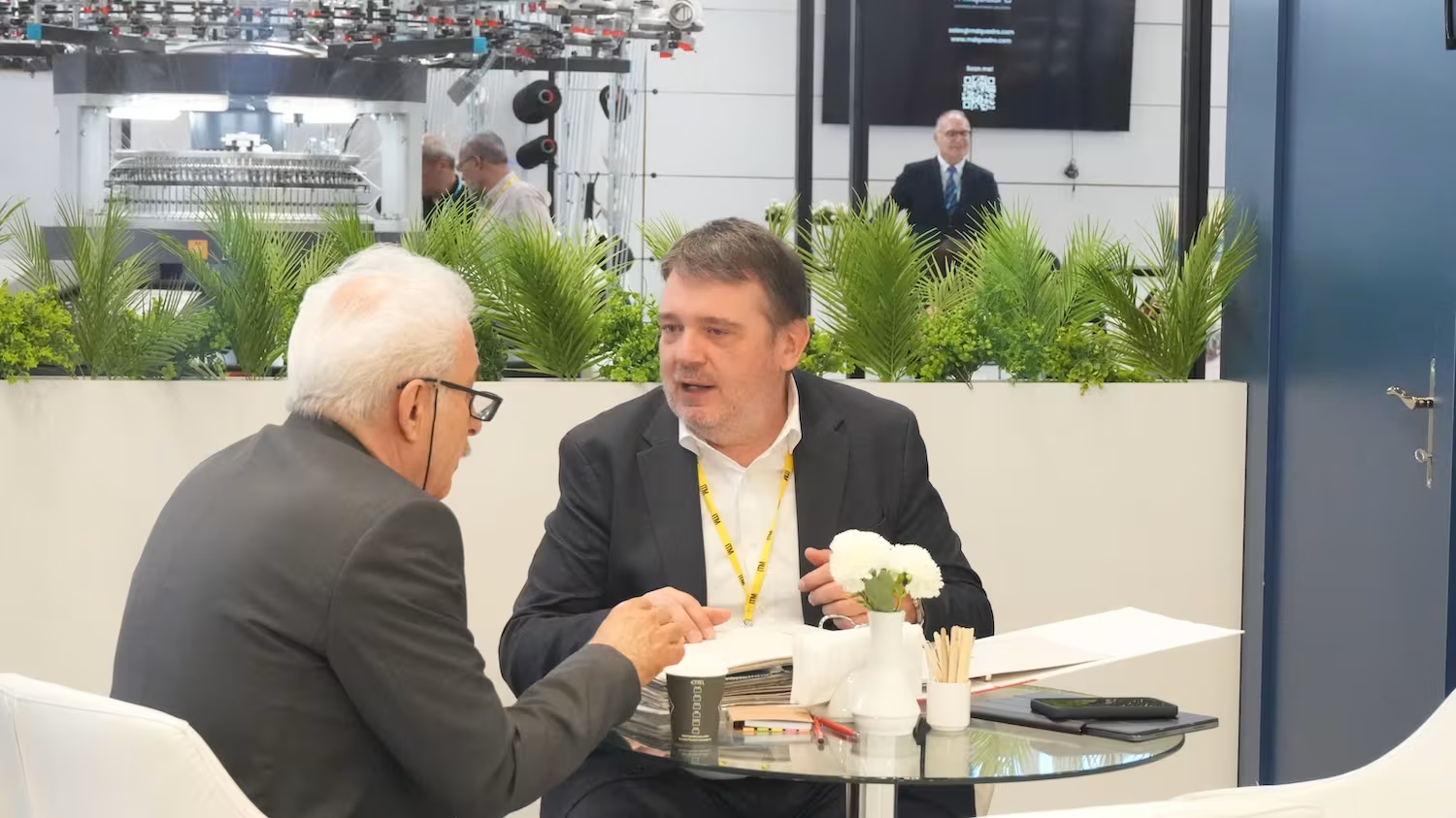
Kohan Textile Journal: Environmental compliance is a major constraint for modern dyehouses. What sustainable breakthroughs are you delivering to reduce chemical and water footprints?
Mr. Michele Gabarra: Within our continuous open-width AQUARIA washing line, we have introduced an extremely radical, green processing breakthrough termed Eco-Bleaching. Traditional chemical bleaching processes demand immense volumes of liquid hydrogen peroxide, caustic soda, and chlorine components. Our Eco-Bleaching protocol completely eliminates liquid hydrogen peroxide, caustic soda, and chlorine from the chemical bath, creating a completely clean, green, closed-loop treatment.
Read more: All You Need to Know About Biancalani
Crucially, our water consumption during this cycle is remarkably low. The machine architecture is engineered to continuously filter and recycle all internal processing liquors, dropping total fluid requirements down to roughly 1 liter of water per kilogram of processed textile material.
Because we do not dump harsh caustic agents or chemical acids into the drainage channels, there is no need for secondary acid neutralization treatments, yet the optical whiteness and tensile results perfectly match traditional chemical methods. This is achieved through a powerful combination of intense mechanical air action, adjustable fabric dwelling times, and high-frequency liquor circulation inside the washing module. For standard processing, such as washing printed fabrics, the AQUARIA consumes less than one-quarter of the water required by traditional washing washers. This platform is also highly effective for the fibrillation of cellulosic fibers like Lyocell and Tencel, as well as enzyme washing and turning polyester-modal blends into premium, cupro-like garments.
Kohan Textile Journal: Turnout at ITM 2026 has been incredibly strong. How do you evaluate the current visitor demographics and your strategic relationship with the Turkish market?
Mr. Michele Gabarra: Biancalani has maintained a direct, highly active footprint in Türkiye for more than 35 years. We support an immense operational machine base here, having sold over 1,200 batch AIRO units and nearly 700 continuous AIRO 24 lines directly into the region. Despite recent international economic adjustments and inflation pressures, our long-term commercial expectations for Türkiye remain incredibly solid because Turkish manufacturers possess an exceptional degree of industrial resilience and production strength. We are already logging a powerful reopening of active project negotiations on the stand.
Following a quiet opening morning, the exhibition floor has been completely packed. At the Biancalani stand, we have been hosting active buying delegations non-stop every ten minutes, with multiple overlapping technical meetings reminiscent of peak ITMA cycles.
Furthermore, we are welcoming an immense volume of international buyers traveling out of the Middle East, North Africa, and Eastern Europe. Obtaining travel visas for Türkiye is significantly faster and more accessible for MEA textile executives than navigating the tightening visa restrictions currently enforced across Italy or the wider European Union. This logistical accessibility turns Istanbul into a vital global crossroads for our international machinery contracts.
Kohan Textile Journal: Thank you, Mr. Gabarra, for this detailed technical presentation and market analysis.
Mr. Michele Gabarra: Thank you very much, Behnam. It is an absolute pleasure to share our innovations with Kohan Textile Journal.











