




Benninger’s must-see dyeing and finishing solutions at ITMA Asia + CITME 2025
Benninger, a complete system supplier with leading technologies for continuous wet processing and discontinuous dyeing, as well as technical textiles, reinforces its commitment to sustainable textile production with resource-efficient machinery that increases both top and bottom line performance. At ITMA Asia + CITME 2025, Benninger will showcase a brand-new singeing machine for knitwear alongside proven solutions from its extensive portfolio.
Benninger places sustainability and responsibility at the heart of its operations. Benninger’s solutions can process today’s and tomorrow’s fibers and blends with the highest first-time-right rates. Visitors to the upcoming ITMA Asia + CITME 2025 in Singapore are invited to engage with experts on sustainable dyeing and finishing. The Benninger booth, B202 is located in Hall 8.
No chemicals, no discharges
No water, no chemicals, less waste, and lower costs – it sounds like a dream. Singeing by Benninger is a purely physical process in which a gas-heated flame burns off small, undesired surface hairs, resulting in a smooth, hairless surface and a shiny fabric appearance.
In conventional singeing, a wet chemical treatment with enzymes, known as biopolishing, is often applied. However, this method has the disadvantage of high utility consumption, and microdust remains in the fabric. These microdust particles have a severe impact on workers’ health in the garment industry and may cause lung cancer. Increasingly, brands are beginning to ban bio-polished fabrics from their supply chains due to NGO pressure.
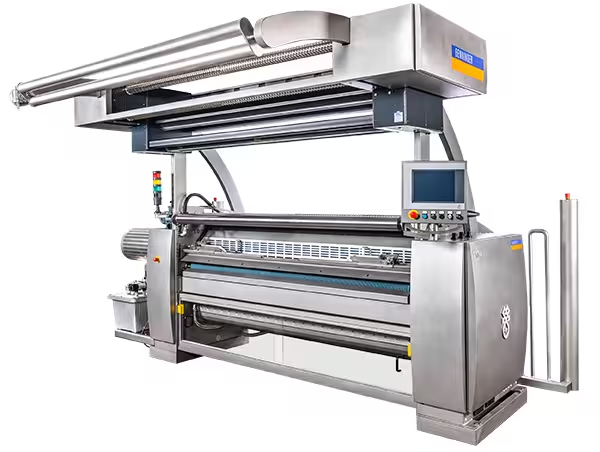
The Benninger SingeRay is the first choice for upgrading knitwear fabrics while eliminating the need for biopolishing. Singeing is a highly selective process that removes only undesired short fibers. Compared to biopolishing, the weight loss is lower, which means more input is converted into saleable fabric, while also contributing to a smaller environmental footprint.
The SingeRay is equipped with two burners and the silicon carbide burning chambers ensure complete combustion of the gas at a constant burner temperature, thanks to four cooling channels. The flame width can be adjusted and ensures low gas consumption. The dust is separated in a wet deduster. A single SingeRay machine offers a production capacity of up to 30 tons per day.
The sustainable way of discontinuous dyeing
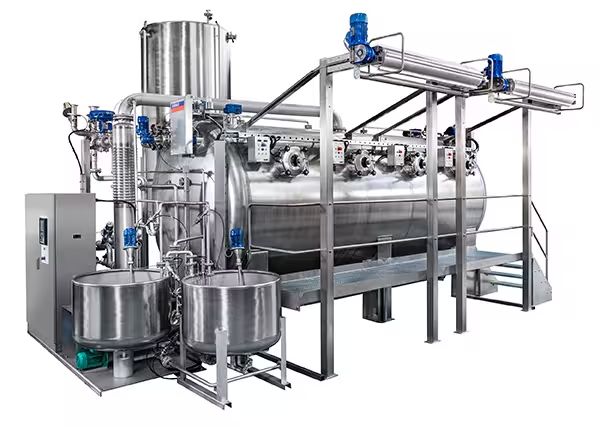
Benninger has developed the fastest, most versatile, and most economical jet dyeing machine in the industry, ensuring dramatically shorter process times. The FabricMaster is not only a robust and reliable system but also the future benchmark of the industry.
Its versatile performance paves the way to conquer new markets. Innovated with Benninger’s passion for perfect fabric quality, it ensures the production of the widest range of fabrics at the lowest cost and with unmatched water consumption levels.
The result of decades of engineering excellence and in-depth understanding of the factory floor, the FabricMaster represents a breakthrough in the discontinuous dyeing industry. Designed for processing all types of fabrics and fibers, it combines outstanding features for safe fabric transport, smooth liquor transfer, effective liquor penetration, high rope speeds, and shorter cycle times, while ensuring smart utilization of resources.
Salt-free dyeing of woven fabrics and knits
Salt-free dyeing without the use of additional energy is only possible with the cold pad batch (CPB) dyeing process. This method is gaining popularity in tropical and subtropical regions, prompting Benninger to further optimize CPB systems for such climatic conditions. At the heart of our CPB system is the Benninger Küsters DyePad. Benninger is the only textile machinery manufacturer with expertise in the original S-roller technology, ensuring consistently even dyeing across the entire fabric width.
Flexibility, dramatically improved accessability on the new knit CPB, high reproducibility, and ease of operation are key advantages of the cold pad process. It accommodates the full spectrum of open-width dyeing with reactive dyestuffs at a low investment cost. Equipped with two swimming rollers, the Küsters DyePad has been a trusted and reliable solution in the piece dyeing sector for decades.











