



From a wooden loom in Tabriz in 1929 to international exports, Bargh Lameh played a pioneering role in the development of Iran’s home textile industry.
The history of Iran’s industrial towel manufacturing dates back to 1929, when 16-year-old Javad Bargh Lameh established a small weaving workshop in Tabriz using a wooden loom.
Originally known as Javad Towel Weaving, the workshop is widely recognised as one of Iran’s earliest industrial towel-making enterprises. In 1931, its products were presented at the Exhibition of Modern Inventions in Tabriz’s Golestan Garden.
Together with his brothers, Bargh Lameh gradually expanded production, and the company’s towels became known in Tehran’s markets as Javadi Towels.
From Traditional Weaving to Industrial Production
The early production process was labour-intensive. According to the company’s historical records, woven towels were carried to the Gazaran district of Tabriz for washing before being returned to the workshop.
As the business developed, the family invested in improving weaving, bleaching and dyeing processes.
A historical account published by the East Azerbaijan Cultural Heritage Department describes how the second generation introduced European weaving and printing technologies during the 1960s, replacing manual equipment with modern machinery.
The factory reportedly expanded to 63 weaving machines, reaching a daily production capacity of approximately 3,300 kilograms of towels.


Iran’s Early Towel Exports
Bargh Lameh also became an early exporter of Iranian home textiles.
According to the company’s historical records, exports began in 1949, initially targeting Iraq. By 1978, annual towel exports had reportedly reached nearly USD 1 million, with products sold in Arab and European markets.
These figures, also documented in a historical article published by the Tehran Chamber of Commerce, illustrate the commercial scale the business had achieved before the 1979 Iranian Revolution.
From Textile Factory to Industrial Heritage
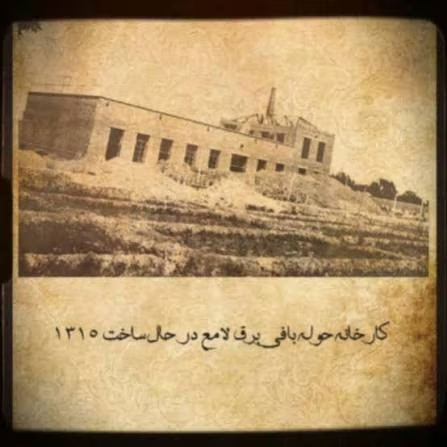
Following the 1979 Revolution, the original factory underwent changes in ownership and eventually ceased operations in 2002.
The historic factory complex in Tabriz has since been recognised as part of Iran’s industrial heritage.
A 2024 academic study published in the Culture of Islamic Architecture and Urbanism Journal examined the architectural and historical significance of the Bargh Lameh factory and its potential for adaptive reuse.
Read more: Top Five Towel Manufacturing Companies in Iran
The researchers identified the site as an important surviving example of Tabriz’s early industrial development.
The story of Bargh Lameh represents an important chapter in Iran’s home textile manufacturing history: the transition from small-scale weaving to mechanised towel production and international exports.
Although the original factory is no longer operating, its industrial legacy remains part of the history of textile manufacturing in Iran.