




At Colombiatex 2026, global fiber producers gathered to explore new market opportunities and respond to shifting industry dynamics. Among them was Aksa Akrilik, the world’s leading manufacturer of acrylic fibers, actively expanding its presence in emerging regions such as South America.
In this exclusive interview with an Area Sales Manager at Aksa Akrilik, conducted by Behnam Ghasemi, key insights are shared on the evolving role of acrylic fibers, market expansion strategies, sustainability challenges, and the long-term outlook for the textile industry.
Q: What brought Aksa Acrylic to Colombiatex, and how do you evaluate the South American market?
Aksa Acrylic is currently the world’s largest producer of acrylic fibers, supplying a wide range of markets across Europe, Africa, the Middle East, and beyond. While South America is geographically more distant for us, it remains a strategically important region where we already hold a notable market share.
Our goal is to further strengthen this position. At a time when global consumption of acrylic fibers has experienced some decline compared to other synthetics, we are focusing on differentiation—introducing new products beyond standard acrylic fibers to better respond to evolving market needs. Events like Colombiatex provide valuable opportunities to present these innovations and engage directly with regional stakeholders.
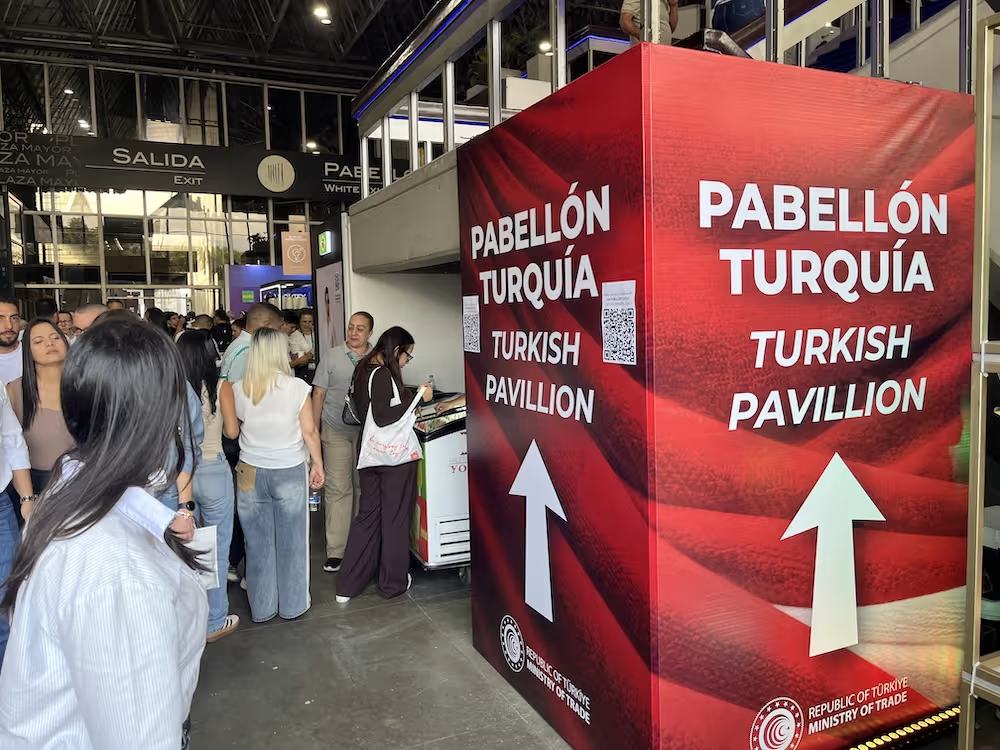
Q: Turkey’s presence in Latin America seems relatively recent compared to countries like Italy or India. Why is that?
This is not limited to textiles—Turkey is generally strong in sales but has historically lagged in marketing. The global visibility of Turkish textile products has not always matched their actual quality and capabilities.
Countries like Italy, India, and even China have invested heavily in long-term market positioning and branding. For Turkey, this needs to evolve into a broader national strategy rather than relying on individual company efforts. Turkish textiles have the quality, heritage, and production strength to compete globally, but stronger and more consistent international positioning is essential.
Q: Given the climate conditions in Colombia and Latin America, where do acrylic fibers fit into the market?
Although Colombia has a tropical climate, acrylic fibers still have strong applications—particularly in higher-altitude regions such as the Andes, where temperatures are significantly cooler.
Acrylic is widely used in blends, especially with wool, to produce traditional garments and functional textiles. Its versatility allows it to perform across different climates and applications. This is one of its key strengths: it is a durable, long-lasting fiber that can find relevance in almost every market.

Q: With textile production shifting to lower-cost countries, how do you see Turkey’s future in the textile industry?
Despite current challenges, Turkey will remain a textile country. The relocation of production to countries like Egypt or Syria is largely driven by lower labor costs. However, these markets lack the depth of know-how, experience, and production culture that exists in Turkey.
While moving production may reduce costs, it often comes at the expense of quality. Turkey’s strength lies in its technical expertise, design capabilities, and industrial vision—factors that cannot be easily replicated.
Q: Aksa is known for strong investment in R&D. How does innovation shape your strategy?
As a global acrylic fiber producer, we operate in a competitive environment where some players rely primarily on price advantages. Our strategy is fundamentally different.
We focus on innovation and product development. Through facilities such as our operations in Yalova, we continuously develop new fiber solutions and applications. This is not only about maintaining competitiveness—it is about securing the future of acrylic fibers as a category.

Read more: Why Iran Struggles to Succeed in Synthetic Fiber Production Despite Abundant Petrochemical Resources
If innovation does not come from leading players, the entire segment risks stagnation. At Aksa, we see it as our responsibility to drive this progress.
Q: Are you working on new fiber blends or next-generation products?
Yes, particularly through our yarn-focused operations, we are developing blended and effect-driven products that respond to changing market expectations.
These include combinations that enhance performance, aesthetics, and functionality. While Aksa focuses on acrylic fiber production, our extended ecosystem enables us to introduce more advanced and differentiated solutions to the market.
Q: Sustainability is a major topic globally. How is Aksa addressing this shift?
Sustainability is indeed a central focus for the entire industry. At Aksa, we have introduced several product developments aligned with this trend, including biodegradable solutions, recycled acrylic fibers, and other innovative materials.
However, one of the most overlooked aspects of sustainability is durability. Acrylic fibers are inherently long-lasting. When a product has a longer lifecycle, it reduces the need for frequent replacement—ultimately lowering environmental impact.
In that sense, longevity itself is a key sustainability advantage.
Q: There are ongoing discussions in Europe regarding fiber safety and emissions. How do you respond to these concerns?
Some discussions have emerged around chemical emissions such as formaldehyde, but these are not unique to acrylic fibers. Similar considerations apply across multiple fiber types, including natural fibers.
In practice, acrylic continues to be widely used—particularly in markets where performance and quality are critical.
Q: Acrylic fibers remain dominant in carpet production, especially in markets like Iran. Why is that?
Iran is one of the most important markets for acrylic-based carpets. The country has a deeply rooted carpet culture, and acrylic fibers play a key role in maintaining product quality.
Unlike some markets that have shifted toward cheaper alternatives such as polypropylene or polyester, Iranian manufacturers continue to prioritize quality. Acrylic fibers contribute to the premium positioning of these carpets, which are exported globally, including to Europe and the United States.
In many ways, acrylic is what defines the value of machine-made carpets in these markets.
Conclusion: Acrylic Fibers Still Have a Strategic Role to Play
While the global fiber landscape is evolving, acrylic fibers continue to hold a unique position—combining durability, versatility, and performance across multiple applications.
For companies like Aksa Acrylic, the future lies not in competing on price alone, but in redefining the value of acrylic through innovation, sustainability, and global market engagement.
For Turkish companies looking to explore opportunities and establish a presence at Colombiatex 2026, it is strongly recommended to coordinate through the official representative of the event in Turkey, Kuzey Expo Fuarcılık. With its regional expertise and industry network, Kuzey Expo Fuarcılık provides comprehensive support to facilitate participation and maximize business outcomes in the Latin American market.
For further information and participation inquiries, you may contact:
Mobile: +90 546 576 55 00
Email: info@kuzeyexpo.com











