




Rabat-Salé-Kénitra is emerging as a diversified manufacturing region within Morocco’s textile industry, combining established textile production, technical manufacturing capabilities and expanding industrial infrastructure around Kénitra, Salé and Témara.
Morocco’s Rabat-Salé-Kénitra (RSK) region hosts a mix of textile manufacturers, from traditional weaving and carpet-making to modern technical-textile producers, supported by free-zone infrastructure, government incentives, and a strategic Atlantic-coast location between Casablanca and Tangier.
Rabat-Salé-Kénitra is not Morocco’s largest textile region, but it is a growing one. Most of its textile activity is found in Salé, Témara and Skhirat, while the Atlantic Free Zone in Kénitra is given over largely to automotive and electronics. The biggest textile project announced in the region so far is Sunrise Group’s planned integrated plant in Skhirat.
Rabat-Salé-Kénitra Industrial Zones at a Glance
| Location | Where | Type | Textile relevance | Key figures | Source |
|---|---|---|---|---|---|
| Atlantic Free Zone (AFZ) | Kénitra, ~10 km east of the city | Free zone / Industrial Acceleration Zone | Limited — focus is automotive and electronics | 345 ha at launch, ~600 ha by March 2025; nearly 40,000 jobs (2022) | CDG; REA Consult; Hespress |
| Attasnia industrial zone | Témara, south of Rabat | Local mixed-use industrial zone | Textile units alongside electronics and chemicals | Not published | — |
| Sunrise Group textile unit | Skhirat | Planned integrated textile plant | Yarn, fabric and garment production | Part of a MAD 2.3 billion two-plant program (with Fès), announced March 2025 | KTJ |
| Ameur Economic Activity Zone | Salé Prefecture | New zone by Rabat Région Émergence | Light industry, logistics, warehousing | ~10 ha; estimated budget MAD 180 million | Rabat Région Émergence (announcement) |
A Strategically Positioned Industrial Hub
Since the early 2000s, Morocco has pursued industrialization as a pillar of its economic transformation, introducing a new Investment Charter with tax reductions, free trade zones, and simplified administrative procedures for investors. Because of its proximity to key transport corridors and its position as the administrative capital region, Rabat-Salé-Kénitra is naturally placed to become an industrial hub — sitting directly on the Atlantic axis between Casablanca (Morocco’s economic capital) and the Tangier-Med port complex to the north.
Despite this potential, the region has historically remained under-industrialized relative to its geographic advantages — a gap that regional authorities and national industrial policy are now actively working to close.
Read more: Morocco Textile Investment Guide (2026)
The Atlantic Free Zone (Kénitra): The Region’s Industrial Engine
The centerpiece of RSK’s industrial ambitions is the Atlantic Free Zone (AFZ) in Kénitra, located roughly 40 km north of Rabat. Launched in 2012 under the National Pact for Industrial Emergence, the Atlantic Free Zone originally covered 345 hectares — 198 ha of industrial zone and 147 ha of free zone, according to its developer CDG — and has since grown to around 600 hectares (March 2025, REA Consult). It operates under Industrial Acceleration Zone (ZAI) status, offering:
- A full corporate tax exemption for five years, followed by a reduced rate thereafter
- VAT and customs-duty exemptions
- Full freedom for foreign exchange conversion, profit repatriation, and capital transfer
- A “Plug & Play” one-stop-shop model that removes much of the administrative burden facing new investors
Originally built around the automotive sector — with the Stellantis (formerly PSA) plant acting as a major anchor and drawing global suppliers such as Saint-Gobain and Lear Corporation — the zone has since diversified into a broader industrial platform.
Today, AFZ hosts multinational groups from Asia, Europe, the United States, the Maghreb and the Middle East; by 2022, the zone had created nearly 40,000 jobs, according to its management. The platform is mainly dedicated to automotive and electronics, alongside aeronautics, agro-industry, data centres, metal machining, logistics and packaging activities.
While AFZ’s core focus remains automotive and electronics, textile and apparel manufacturers operating in the broader RSK region can access other zones and incentive frameworks, discussed below, that support export-oriented industry.
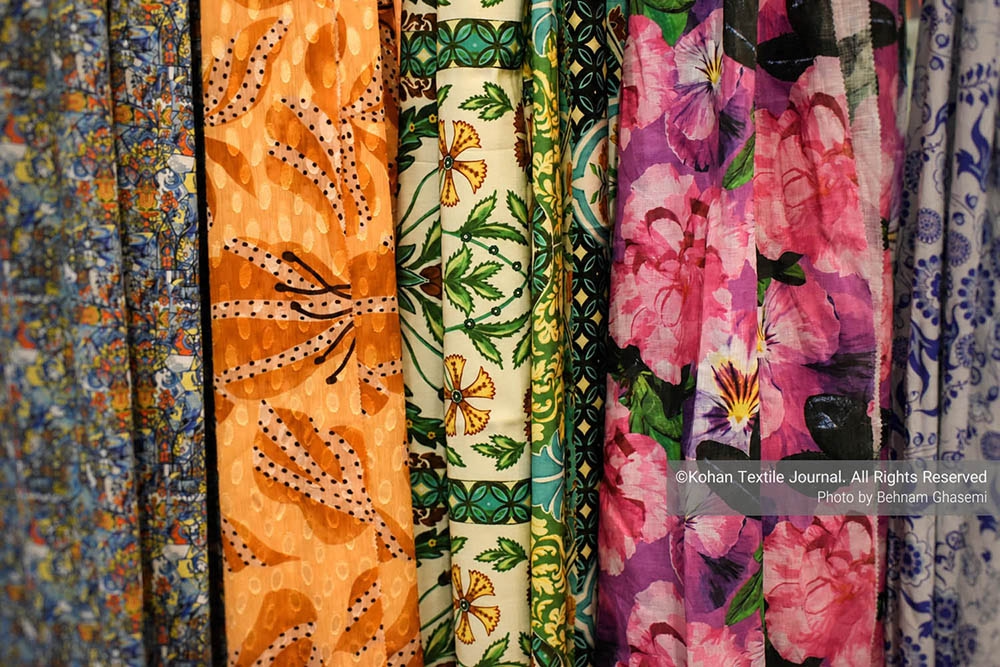
A Long-Standing Textile Base Beyond the Free Zone
Within Morocco’s broader textile manufacturing landscape, Rabat-Salé-Kénitra represents a diversified regional production base. Textile activity here is not limited to the Kénitra free zone — the broader region hosts an established base of textile and related manufacturing activity, including:
- Weaving and finishing operations (terry/toweling fabrics, bathroom linens)
- Hand-knotted carpets and traditional textile crafts
- Cotton spinning and yarn production
- Technical textile applications: tarpaulins, tents, PP/jute sacking, awnings
- Embroidery, screen printing, sublimation, and textile finishing services
Local industrial zones such as Attasnia in Témara (just south of Rabat) already combine textile units alongside electronics and chemical manufacturers, reflecting the region’s mixed-industry character even outside the flagship Kénitra platform.
The region’s most significant recent textile development is in Skhirat, a coastal town near Rabat. In March 2025, the Moroccan government announced a MAD 2.3 billion agreement with China’s Sunrise Group to establish two vertically integrated textile units in Skhirat and Fès. Together, the projects are expected to create 7,000 direct jobs and more than 1,500 indirect jobs, while supporting an integrated textile supply chain covering yarn, fabrics and garment production.
New Industrial Land Supply and Regional Push
Regional authorities are actively expanding industrial capacity to attract further investment:
- Rabat Région Émergence (RRE), the region’s development agency, has launched a new Economic Activity Zone (EAZ) in the commune of Ameur (Salé Prefecture) — roughly 10 hectares of modern, modular infrastructure aimed at light industry, logistics, and warehousing, with an estimated budget of MAD 180 million.
- A parallel tender has been issued for urban planning and architectural studies for a dedicated industrial zone in the same area.
- AFZ itself has expanded from its original 345 hectares to around 600 hectares, underscoring the region’s momentum as a manufacturing and export base.
Together, these projects reflect a deliberate regional strategy: positioning Rabat-Salé-Kénitra as a diversified, investment-friendly industrial hub — not solely reliant on the automotive sector that first put Kénitra on the map, but increasingly open to textile, logistics, and light-manufacturing investment as well.
Why Rabat-Salé-Kénitra Matters for Textile Manufacturing
For textile manufacturers evaluating North Africa as a sourcing or production base, Rabat-Salé-Kénitra offers a distinctive combination:
- Proximity to Europe — Atlantic-coast access and highway/port connectivity make the region attractive for exporters targeting EU markets.
- Established free-zone tax regime — the AFZ’s ZAI status provides multi-year tax exemptions and customs advantages already tested and used by dozens of multinational manufacturers.
- Existing textile ecosystem — from traditional weaving and carpet-making to modern technical textiles, the region already has textile know-how and a trained workforce base to build on.
- Active regional investment in new industrial land — new economic zones under development signal continued government commitment to expanding capacity for light industry, including textiles.
Read more: Morocco Textile Nearshoring for European Brands: Opportunities and Risks
As Morocco continues to position itself as a nearshoring alternative for apparel and textile brands seeking shorter, more resilient supply chains to Europe, Rabat-Salé-Kénitra’s combination of free-zone incentives, port and highway access, and an existing industrial base make it a region worth watching for textile-sector investment in the years ahead. For the national picture, see our guide to Morocco’s textile industry.











