In modern textile manufacturing, the engineering behind industrial ventilation, plant climatization, and air conditioning is no longer treated as a background utility, but as a primary driver of mill profitability and operational sustainability. High-speed spinning frames, weaving looms, and processing lines generate immense ambient thermal loads and airborne waste. Without highly optimized, mechanically efficient air handling loops, textile factories face soaring electricity costs, unstable micro-climates, and frequent equipment failures. In today’s landscape, achieving global competitiveness requires facilities to drastically reduce their carbon footprint while managing volatile energy prices.
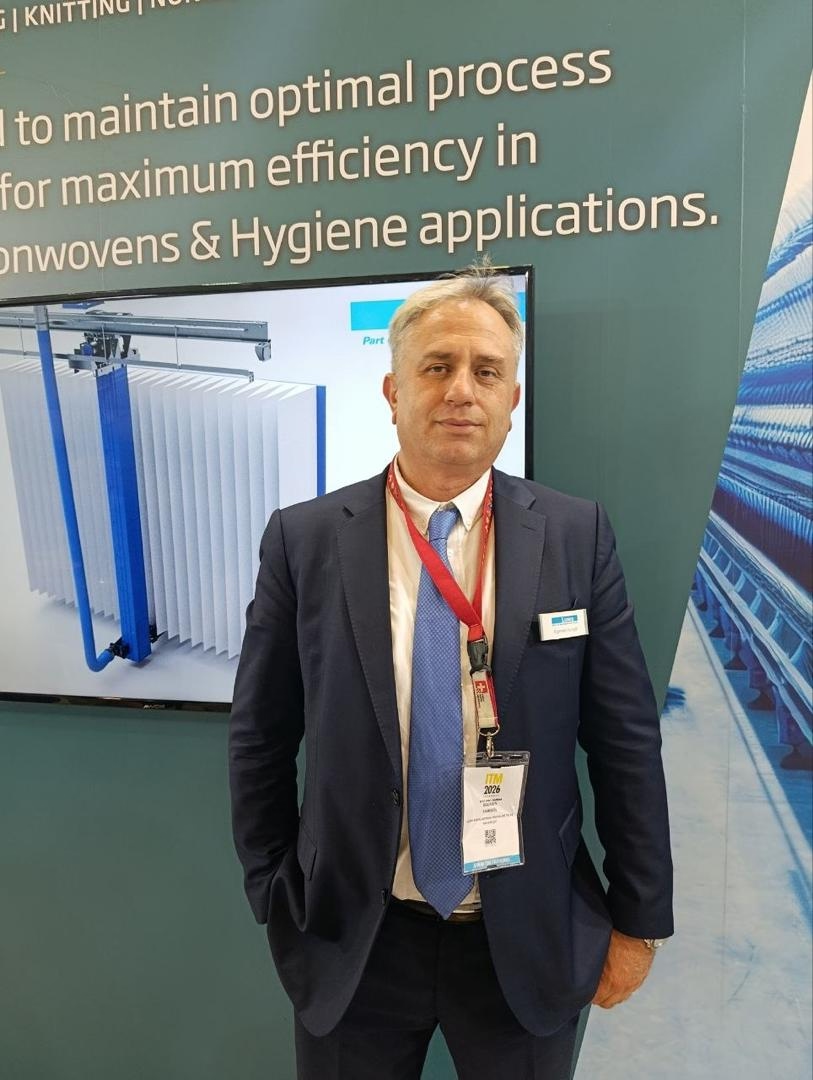
At the International Textile Machinery Exhibition (ITM 2026) in Istanbul, Behnam Ghasemi, Editor-in-Chief of Kohan Textile Journal, met with Egemen Sarıgöl, General Manager of Luwa Havalandırma Teknikleri Sanayi ve Ticaret Ltd. Şti., to discuss how the Swiss-founded engineering pioneer is reshaping fluid dynamics through advanced materials, the ongoing macroeconomic stabilization across European and Turkish markets, and the logistical realities behind the targeted structural migration of textile confection and finishing lines into emerging North African corridors.
The Engineering Heritage of Industrial Air Engineering
Kohan Textile Journal: Welcome, Mr. Sarıgöl. To establish a solid baseline for our global readers, could you break down Luwa’s operational history, engineering background, and your precise industrial focus today?
Egemen Sarıgöl: Luwa is a Swiss-founded company established back in 1935. Historically, we operated as a highly diversified engineering group serving a wide range of industrial applications, making Luwa the pioneering ancestor of modern industrial ventilation and air handling systems. Over the years, following structural changes by previous ownership where non-core corporate arms were sold off, the Luwa name became entirely dedicated to specializing within the global textile sector.
Today, we leverage a deep repository of specialized engineering know-how dating back to 1935. This deep mechanical expertise makes Luwa one of the very rare, elite global firms capable of executing complex, large-scale industrial air engineering at a global level.
Read More: ITM 2026: The Meeting Point Of Green Transformation And The Digital Future In The Textile Industry
Aerodynamic Innovation: Carbon Fiber Fan Technology
Kohan Textile Journal: Turning to your machinery layout at ITM 2026, what technological innovations are you highlighting to address the current manufacturing challenges in the textile industry?
Egemen Sarıgöl: At this edition of the exhibition, we haven’t brought heavy air-handling machinery structures to the stand, but we are showcasing breakthrough developments in fluid dynamics and energy efficiency. In modern textile climatization and air conditioning systems, the single most critical operational factor is energy consumption. To combat this, we are executing targeted engineering projects focused on radical energy conservation.
As a direct result of these efforts, we have introduced our proprietary carbon fiber fan technology. When contrasted against our previous legacy iterations, this carbon fiber wheel delivers massive advantages in aerodynamic and energy efficiency. Furthermore, it achieves a 40% reduction in physical weight compared to traditional aluminum fan configurations. This lightweight construction yields an incredibly efficient operational profile, and since its initial commercial rollout two years ago, it has driven excellent sales figures globally.
Global Manufacturing Infrastructure and Agency Networks
Kohan Textile Journal: Could you outline Luwa’s global manufacturing footprint, corporate office hubs, and how you manage regional distribution?
Egemen Sarıgöl: Luwa operates as a fully decentralized, global corporate entity. We manage two primary vertical manufacturing plants: Luwa Shanghai and Luwa India. Supporting these manufacturing bases, we maintain direct corporate offices in the United States, Türkiye, Indonesia, and Singapore.
Our corporate headquarters and central management remain located in Zurich, Switzerland. For all international regional markets outside of these direct corporate office locations, we coordinate our specialized field operations through an extensive network of professional commercial agencies and representatives.
Navigating Market Consolidation and Structural Regional Shifts
Kohan Textile Journal: The global textile landscape has been navigating a prolonged economic downturn. How do you analyze these macro market conditions, and what structural changes are you witnessing in regional hubs?
Egemen Sarıgöl: The textile sector has been enduring a severe commercial stagnation for the past 2 to 2.5 years. This is not a localized trend; we are looking at a deep, global macroeconomic challenge. Having operated through previous industry crises, I can state that this stagnation has lasted much longer than typical cycles, which usually correct within 6 to 8 months. This extended 2.5-year market freeze is impacting every operator across the chain. In Türkiye, these issues are compounded by domestic economic and structural adjustments, causing the pressure to compound locally. Consequently, new capital investments have significantly slowed down, though we maintain an optimistic long-term outlook.
Regarding regional migration, macroeconomic pressures and shifting transport costs—specifically rising global freight and shipping rates —along with falling consumer demand are reshaping the field. While there was a strong wave of planned textile investment moving from Türkiye into Africa, we now observe that this migration is mostly concentrated on the apparel and garment assembly sides shifting to Egypt , particularly home textile finishing and confection segments. Major vertical firms are continuing their long-term investments there. However, because textile production is a core, deep-rooted skill set in Türkiye, I am entirely confident that manufacturing volume will ultimately return home.
The Core Philosophy of Circular Textile Sustainability
Kohan Textile Journal: Sustainability is a dominant theme across modern manufacturing. What is Luwa’s core corporate philosophy regarding sustainable operations?
Egemen Sarıgöl: Within the modern textile industry, true sustainability must focus on fundamentally reducing environmental footprints, enabling a real circular economy, and ensuring equitable, fair labor conditions. As an engineering firm, Luwa strictly maps its corporate pathway to support these precise goals.
However, because our primary manufacturing setups are centralized directly within Luwa Shanghai and our Indian plants, specific technical inquiries regarding plant-level sustainability milestones and materials are best addressed directly by our localized engineering teams on the ground.