




The establishment of a solid fibre-to-fibre recycled PET polyester (FFrPET) industry is critical if the textile and clothing industry is to achieve environmental sustainability, according to “Fibre innovations aid the creation of circular textile and apparel supply chains”—a 16-page report from the global business information company Textiles Intelligence.
PET polyester will remain by far the most widely used type of fibre in textile and garment production for the foreseeable future, despite strong growth in usage of other fibres—notably cellulosic fibres, natural fibres and those derived from bioplastics. In fact, polyester production is predicted to surpass 80 mn tons by 2030, which will account for well over half of total fibre production.
In order to establish routes to the production of FFrPET, a number of large-scale projects are now under way. These involve some major companies which have a number of advantages over start-ups in building a workable circular system for this material, including the size and scale of their operations and the funding which is at their disposal. As a result, the scaling up of the FFrPET industry is gaining considerable momentum.
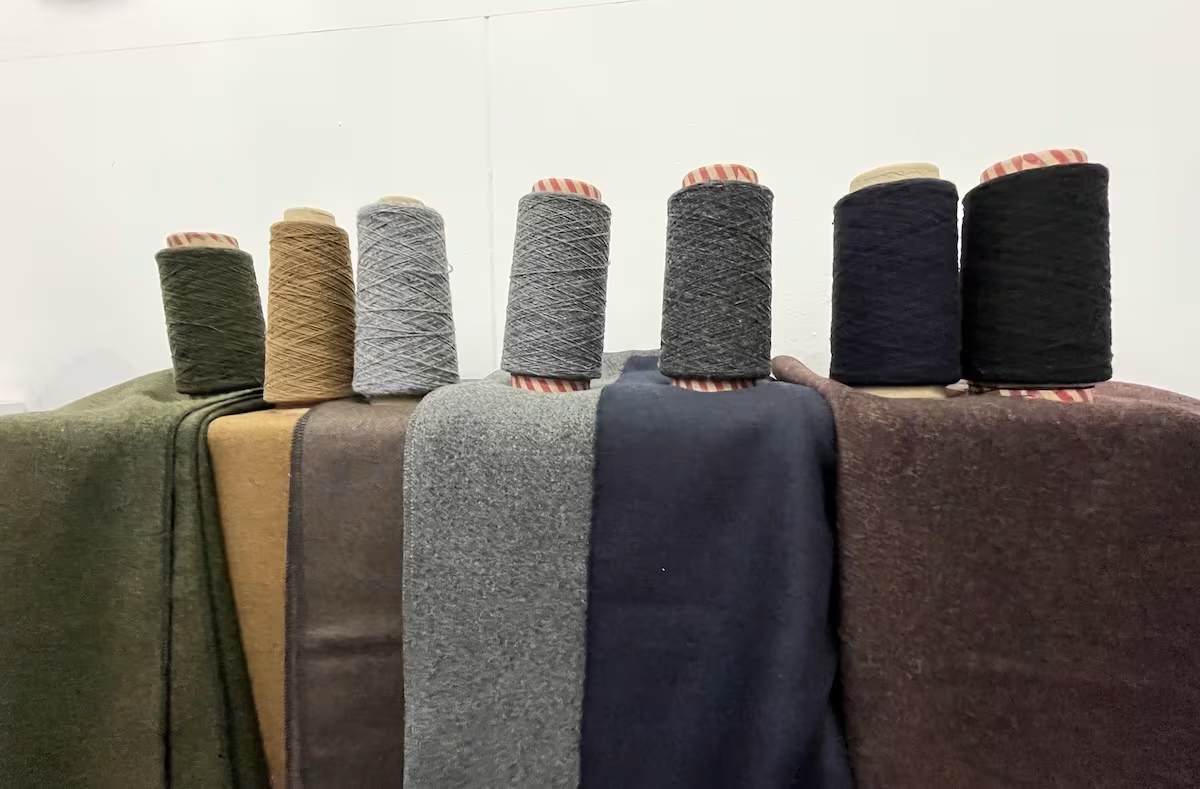
Polyester Recycling Capacity Expands Globally
Eastman, for example, is investing in recycling plants based on a process called methanolysis. At present, it has the capacity to recycle 110,000 tons of polyester annually at one plant in the USA. However, plans are in place to start two more plants—one in France and another in the USA—and, as a result, the company is expected to triple its overall capacity in 2026.
Read more: Coming Full Circle on Sustainability: 100% Polyester Carpet Systems
Meanwhile, Suez and SK Geo Centric (SKGC) are collaborating in the establishment of a PET plastic and fibre recycling plant in France based on Loop Industries technology. The technology is used to depolymerise PET plastic and polyester fibre waste and the resulting monomers can be recycled infinitely to produce virgin quality PET resin without degradation of quality. As such, the new recycling facility will manufacture 100% recycled and infinitely recyclable virgin quality PET resins and have a planned capacity of 70,000 tons per annum.
Indorama and Carbios are collaborating in the construction of an enzymatic PET bio-recycling production plant. The plant will have the capacity to process around 50,000 tons of post-consumer PET waste a year, which is equivalent to 2 bn PET bottles or 2.5 bn PET trays. Carbios has developed a line which integrates all preparation stages and uses a fully automated enzymatic biorecycling process to transform textile waste from used garments or from cutting scraps into a raw material which is suitable for depolymerisation.
Andritz Group is involved in a number of recycling projects in France through its Andritz Laroche subsidiary. Also, it is collaborating with Pellenc ST and Synergies TLC in the establishment of an industrial-scale business, called Nouvelles Fibres Textiles, which combines Pellenc ST’s automated sorting technologies with Andritz recycling machines.
Meanwhile, Inditex has formed a strategic partnership with Ambercycle to support the construction of the latter’s first commercial-scale textile regeneration factory. Ambercycle has developed a chemical process for breaking down polyester into its constituent monomers, and these monomers can then be used again to make regenerated polyester fibres. As part of its partnership with Ambercycle, Inditex has signed a three-year agreement under which it has committed to buying a significant proportion of the annual production of these fibres.











 industry is critical if the textile and clothing industry is ...)