Executive summary
Textile recycling has become a data and sorting problem as much as a materials-science problem. The world generates about 92 million tonnes of textile waste annually, while the fashion and textiles sector accounts for roughly 2–8% of global greenhouse gas emissions, 9% of microplastic pollution reaching the oceans, and about 215 trillion liters of water use.
At the same time, recycled fibers remain a small minority of global fiber output: Textile Exchange reports that recycled fibers were 7.6% of the global fiber market in 2024, but less than 1% came from pre- and post-consumer recycled textiles rather than bottle-based or other feedstocks. In other words, the core circularity problem is not just collection; it is the inability to identify, separate, and route complex textile waste into recycling processes that can actually use it.
AI is now being deployed precisely at that choke point. In the current market, the most mature systems combine near-infrared spectroscopy, hyperspectral imaging, RGB computer vision, machine-learning classification, and, increasingly, robotics for singulation, picking, trim removal, and quality assurance. Peer-reviewed studies show that deep-learning models on NIR spectra can classify pure fibers and common blends with high accuracy, while commercial systems from companies such as TOMRA, PICVISA, VALVAN/Fibersort, Matoha, Refiberd, NewRetex, DataBeyond, and others translate that capability into conveyor-based or handheld tools. The strongest commercial pattern is not “AI replacing the whole plant,” but AI augmenting a layered workflow: pre-sort for reuse, identify composition and color, isolate contaminants, then produce recycler-specific feedstock fractions.
The environmental case is strong, but only when AI improves fraction purity enough to unlock higher-value recycling or reuse. Published life-cycle evidence suggests that lower-burden mechanical routes can outperform incineration or virgin material production, while some early-stage chemical and enzymatic routes still carry large process impacts or uncertain economics.
Public return-on-investment data remain sparse, yet disclosed examples show that industrial sorting infrastructure is capital-intensive and profitability depends heavily on downstream demand and policy support, not only on labor savings. This is why regulation matters: the EU’s 2025 separate-collection requirement and 2025 Waste Framework Directive revision create a structural pull for automated textile sorting, extended producer responsibility, and better traceability.
The next phase of the field will be decided by four things: open and standardized datasets, better handling of difficult classes such as elastane/coatings/multilayer items, tighter coupling of digital traceability with sensor-based classification, and policy mechanisms that make sorted recycled output economically bankable. Without those, AI can improve sorting operations locally but will not scale textile-to-textile recycling globally. With them, AI becomes part of the enabling infrastructure for a circular textile economy rather than a standalone “smart sorting” feature.
Textile waste and the recycling bottleneck
The latest high-confidence public picture is stark. UNEP says the world produces about 92 million tonnes of textile waste each year; clothing production roughly doubled between 2000 and 2015 while average garment use duration fell by 36%. Textile Exchange reports that the share of recycled fibers in global output remained just 7.6% in 2024, and that less than 1% of all fiber produced came from pre- and post-consumer recycled textiles. That combination explains why textile recycling has become strategically important: the waste stream is huge, but true closed-loop fiber recovery is still marginal.
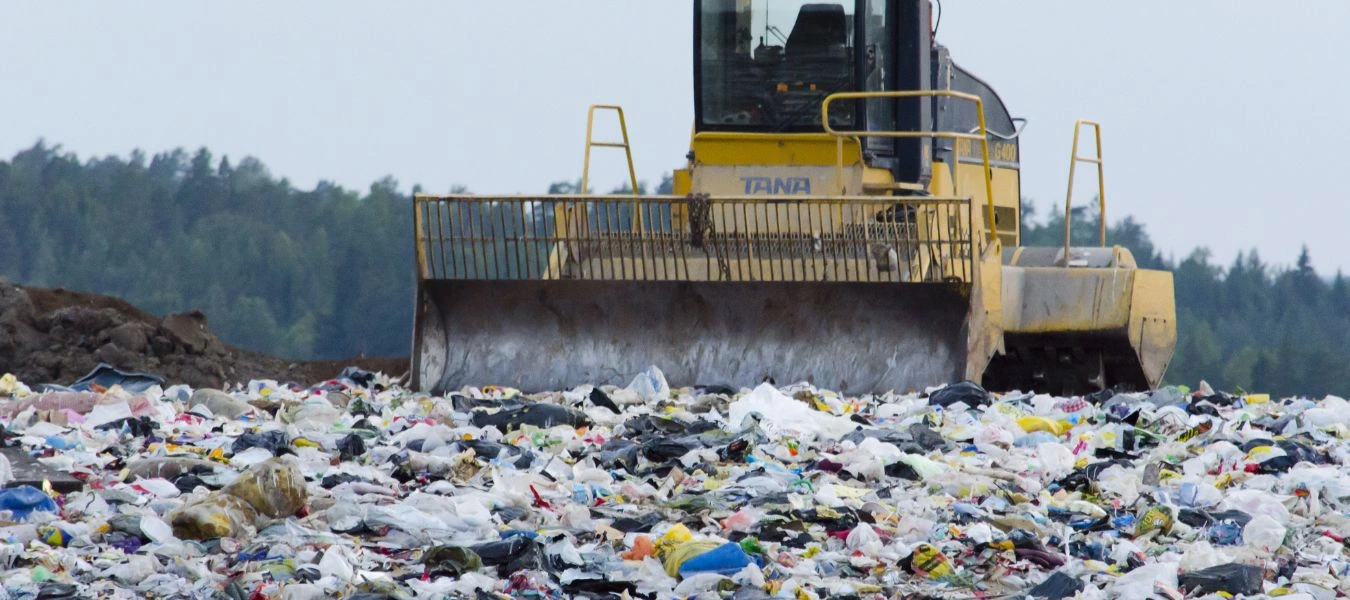
For regional official statistics, Europe currently offers the best operational picture because the European Environment Agency’s textile indicators are built on Eurostat data. The EEA reports that EU Member States generated about 6.94 million tonnes of textile waste in 2022, or 16 kg per person. It also reports that the average capture rate for separate collection in 2022 was just under 15%, meaning about 85% of household textile waste still entered mixed waste. In the United States, EPA estimates that textiles in municipal solid waste reached 17.03 million tons in 2018, with a textile recycling rate of 14.7% and 11.3 million tons landfilled.
The waste stream is also dominated by end-of-use consumer products, not just factory scrap. In the EU, the EEA estimates that 82% of textile waste in 2020 was post-consumer; the remainder came from manufacturing waste and unsold textiles. The EEA also estimates that 4–9% of textile products placed on the EU market are destroyed before use, equivalent to 264,000–594,000 tonnes annually. In U.S. municipal waste, EPA says the main source of textiles is discarded clothing, with smaller contributions from furniture, carpets, tires, footwear, and nondurable household goods such as sheets and towels.
| Scope | Key figure | Why it matters | Evidence |
|---|---|---|---|
| Global | 92 million tonnes of textile waste per year | Demonstrates the scale of the waste problem AI systems are trying to address | UNEP. |
| Global | 2–8% of global GHG emissions; 215 trillion liters of water use; 9% of ocean-bound microplastics | Textile circularity has material climate, water, and pollution implications | UNEP. |
| Global fiber market | Recycled fibers were 7.6% of total fiber output in 2024, but less than 1% came from recycled textiles | Most “recycled” fiber today is still not textile-to-textile | Textile Exchange. |
| EU | 6.94 million tonnes of textile waste in 2022; 16 kg/person | Shows the volume entering collection and treatment systems | EEA. |
| EU | Capture rate just under 15%; 85% not separately collected | Sorting capacity is meaningless if feedstock is not captured | EEA. |
| EU | 82% of textile waste is post-consumer; 4–9% of products destroyed before use | Waste policy must address both households and unsold stock | EEA. |
| U.S. | 17.03 million tons generated; 14.7% recycled; 11.3 million tons landfilled in 2018 | Confirms weak diversion even in a large mature market | EPA. |
The recycling bottleneck is not simply “more waste than capacity.” It is that recycling processes are feedstock-specific. Mechanical opening, solvent dissolution, depolymerization, pulping, and monomer recovery each require input streams with constrained fiber compositions, contamination levels, and sometimes color or trim conditions.
The South Australian study of European textile sorters found that textiles are increasingly routed through a combination of manual and automated sorting so that reusable items are separated first, contaminants are removed, and the remainder can be classified for mechanical or chemical recycling. That same study emphasizes that a viable sorting industry needs demand and offtake markets for sorted output before infrastructure is built.
AI technologies and technical workflows
The field has converged on a functional division of labor among technologies. RGB computer vision is strongest for garment category, shape, orientation, color, and obvious contaminants. NIR spectroscopy is strongest for material composition. Hyperspectral imaging expands that composition signal spatially and supports richer classification, especially when combined with RGB or inductive sensing. Robotics is most valuable not for fiber identification itself, but for singulation, grasping, trim removal, transfer, and fully automated material routing. Increasingly, advanced systems use sensor fusion to combine several of these layers because no single sensor handles blend complexity, occlusion, deformation, contamination, and actuation by itself.
A good example of the spectroscopy route is the peer-reviewed work by Riba and colleagues. Their 2022 study used NIR spectroscopy plus CNNs to classify seven pure fibers and binary mixes, based on 370 textile samples. They found 100% correct classification for pure fibers and 90–100% for binary mixtures, and showed that a PCA + CVA + CNN workflow reduced dimensionality from 2,201 variables to 6 for the seven-class pure-fiber study. That is a useful template for industrial sorting: collect spectra, normalize and reduce dimensionality, train a compact classifier, then deploy it on an inline optical system.

A second, more explicitly real-time example comes from Du and colleagues. Their 2022 Resources, Conservation and Recycling paper built an online NIR identification model for 13 kinds of waste textiles, using spectra from 901–2500 nm converted into 40×40 grayscale images and classified with a CNN implemented on Baidu’s PaddlePaddle platform. On an external validation set of 526 samples, both CNN models achieved more than 95.4% accuracy, and the complete online recognition-and-sorting time per sample was less than 2 seconds. Just as importantly, the system was tied to a self-developed inline device with sample delivery, NIR detection, intelligent identification, and purge sorting.
RGB vision addresses a different problem: garment type and routing before, beside, or after composition analysis. Tian and colleagues’ 2024 study on post-consumer garment classification shows why generic image classification is not enough for recycling plants. In plant conditions, deformation, occlusion, and visually similar categories drove prior work down to 68.28% accuracy, far short of industrial needs.
Their attention-enhanced machine-vision pipeline used industrial RGB imaging, expert annotation in recycling plants, and plant deployment with high-pressure air injectors. On a 3,300-image test set spanning 11 garment categories, the proposed method lifted performance to human-level (>90%) and held up during a two-week online deployment. Here, AI was not trying to identify fiber chemistry; it was solving the routing and sorting-control problem that sits around the chemistry problem.
Public datasets are still the weakest link. For years, textile-sorting research relied on private spectral libraries or relatively small curated sample sets. VTT’s 2021 REISKAtex paper tested 253 fabric pieces and found 73% correct recognition across broad classes, while also documenting exactly why recognition fails in the real world: coatings, finishing, thickness, structural effects, ageing, and blends. In 2026, OpenTextile-NIR became the first open-access NIR-hyperspectral textile dataset, with 71 post-industrial samples, more than 11 million spectra, and more than 6 million annotated spectra plus RGB photos and metadata. That is a meaningful step forward, but it is still tiny relative to the diversity of real second-hand garments circulating globally.
| AI layer | Typical task | Common sensors and models | Public performance examples | Practical limitation |
|---|---|---|---|---|
| RGB computer vision | Garment category, color, shape, contaminant detection | Industrial RGB cameras; CNN backbones; attention modules | Tian et al. improved garment-category accuracy from 68.28% to >90% on a 3,300-image test set and in two-week deployment. | Poor at inferring fiber chemistry from appearance alone; performance degrades with deformation and occlusion. |
| NIR spectroscopy | Fiber-composition identification and coarse blend separation | Fiber-optic NIR; 1D spectra; PCA/CVA; CNNs | Riba et al.: 100% for pure fibers and 90–100% for binary mixes on 370 samples. | Sensitive to coatings, thickness, finishing, and complex blends. |
| Inline NIR + deep learning | Real-time conveyor sorting | NIR 901–2500 nm; spectra converted to 40×40 images; CNN | Du et al.: >95.4% on 526-sample external validation; <2 s per sample; 13 textile classes. | Requires controlled inline hardware and an up-to-date spectral library. |
| Hyperspectral imaging | Spatially resolved composition, contaminant detection, richer class libraries | VIS-NIR or NIR-HSI cameras; ML classification; regression | PICVISA uses HSI plus AI to classify multiple fibers, color, and contaminants; OpenTextile-NIR provides >11 million spectra for algorithm development. | More data-intensive than single-point NIR; elastane and difficult blends remain challenging. |
| Sensor fusion | Robust handling plus classification | RGB/RGBD + NIR/HSI + tactile or inductive sensors | A 2025 hybrid research system using multiple cameras, tactile sensing, CNNs, and VLMs reported 96.72% garment-type precision and 93.44% color identification. | Still early-stage for textile plants; integration complexity is high. |
| Robotics and actuation | Singulation, pick-and-place, trim removal, route switching | Robot arms, 3D vision, grippers, air jets | Commercial systems connect sensing to air-jet sorting, robotic picking, or trim removal modules. | Soft, deformable, multilayer garments remain hard to grasp and unfold reliably. |
|
Collection and input
pre-sort |
→ |
Singulation and
orientation |
→ |
Sensing
RGB / NIR / HSI / metal-inductive |
→ |
Pre-processing
segmentation, normalization, detection |
→ |
Model inference
fiber / garment / contaminant regression |
→ |
Confidence threshold
met? |
↗ |
Automated
air-jet or robotic pick |
→ |
Trim removal and
decontamination |
→ |
Traceability record
composition, color, route |
→ |
Reuse / mechanical
recycling / chemical recycling / export |
| ↘ |
Manual QA or lab
verification |
|||||||||||||||||
This generalized workflow reflects the architectures described in peer-reviewed inline NIR systems, RGB-attention sorting systems, the VTT REISKAtex pilot, Siptex, and commercial systems from PICVISA and VALVAN. The critical design choice is the confidence gate: plants that force every item into a class risk contaminating downstream output, while plants that route uncertain items to manual QA protect feedstock purity.
Commercial systems and pilot projects
Commercial reality is now sufficiently mature that AI for textile sorting can no longer be treated as a laboratory curiosity. The most significant industrial proof point remains Siptex in Malmö, operated by Sysav and developed with IVL and partners. IVL describes it as the world’s first automated industrial-scale sorting plant for post-consumer textiles.
The plant uses NIR/VIS scanning to sort mixed textile waste by fiber type and color, includes a purification step, and at full operation can sort about 24,000 tonnes per year. The South Australian benchmark study adds that Siptex was built with four TOMRA AUTOSORT units, had setup costs of about €5.1 million and total capital expenditure of about €7 million, and initially faced difficulty finding stable markets for sorted fractions.
PICVISA represents the next pattern: hyperspectral plus AI plus sensor fusion. In public case material with Specim, PICVISA says its textile sorting machine uses a Specim FX17 hyperspectral camera operating from 900–1700 nm, plus RGB systems for color and inductive sensors for metal detection. At Coleo Recycling in A Coruña, PICVISA says the solution classifies and traces about 5,000 tonnes of textile waste annually.
The company also says it has built a classification library of more than 20 compositions and explicitly identifies elastane as a continuing challenge, with regression-based classification under development. Separate case studies show the same ECOSORT TEXTILE platform deployed in a pilot facility at Lipor in Porto and in Textile House Slovakia, where the host sorting center processes more than 100 tons of goods daily and uses ECOSORT to improve fiber-type classification for circular products.
VALVAN’s Fibersort illustrates a slightly different commercialization path. Public product material says Fibersort uses AI models on NIR spectroscopy to predict fiber concentration and an RGB camera for color sorting. In semi-automatic form it runs at 1 piece per second, and Siemens says that in practice the system can process about 2,000 garments per hour. The official brochure gives more granular capacities: a manual scanning table handles one textile every five seconds, or about ±240 kg/h, while a semi-automatic line reaches about ±1,200 kg/h and supports 6 to 50 categories per conveyor. VALVAN’s own materials emphasize that a large and continuously updated dataset is essential to accuracy; that is a telling admission from a vendor that dataset management is now part of equipment performance.
A related Nordic route is NewRetex in Denmark. NewRetex describes its system as a fully automatic robotic plant with sensor, robot, and automation technology for intelligent sorting and traceability. On its official materials, the company says its pilot plant processes about 10 tons per week and was planned to scale to as much as 40,000 tonnes annually. Public reporting around the U.K. rollout says a NewRetex single-line sorter supplied to Circle-8 Textile Ecosystems is designed for about 25,000 tonnes per year. The high-level lesson is that the commercial frontier is moving from “smart classifier” to “sorting line plus traceability layer plus recycler-facing feedstock specification.”
At smaller scale, Matoha shows how AI-enabled spectroscopy can augment manual operations rather than replace them. Its FabriTell Handheld (Gen 2) is publicly priced at £4,199, uses reflectance NIR spectroscopy from 1550–1950 nm, and reports identification speed of under 1 second for cotton, polyester, elastane, acrylic, wool, acetate, nylon, and 13 two-component blends. Matoha also says it has deployed 700+ devices in 60+ countries with 24 million+ measurements made. For charities, sorters, quality labs, and pilot recyclers, this class of tool matters because it lowers the threshold for composition verification where building a full automated line is not yet economical.
In the startup category, Refiberd is one of the clearest AI-native entrants. The company says it has built a proprietary AI-based hyperspectral imaging system for broad-fiber material detection. Public third-party reporting around its commercial validation says it has run 12 pilots and processed over 100,000 textile samples. A partner announcement from Photon etc. said Refiberd could divert up to 70% of textile waste to higher-value recyclers, though that claim is not publicly audited and should be treated as a company-side performance estimate rather than a standardized benchmark.
Two recent deployments show how quickly the market is moving outside Europe. In China, DataBeyond says its AI-driven textile waste sorting line at Zhangjiagang Shanhesheng Environmental Technology processes about 2 tonnes per hour and can separate >90% purity polyester, cotton, and nylon fractions, along with spandex blends.
AP reporting from the same site adds that the machine can sort 100 kilograms in 2–3 minutes and that unrecyclable waste at the plant reportedly fell from 50% to 30% after installation. In Australia, Salvos Stores Textile Recovery Facility in Queensland uses AI and robotics to sort and decontaminate textiles, remove buttons and zippers, and prepare feedstock for reuse and recycling; Queensland says the public investment was A$4.97 million and the facility is intended to recover about 5,000 tonnes per year.
| System or company | Location | AI and sensor stack | Public throughput or scale | Public cost signal | Public outcomes and limits |
|---|---|---|---|---|---|
| Siptex | Malmö, Sweden | NIR/VIS optical sorting; purification step; compressed-air routing | 4.5–5 t/h; up to 24,000 t/y; capable of distinguishing 16 fiber types | ~€7m total capex, inferred at ~€292 per tonne of annual capacity | Industrial-scale proof point; early market/offtake difficulty reported. |
| PICVISA ECOSORT + Coleo | A Coruña, Spain | HSI 900–1700 nm + RGB + inductive sensing + AI | ~5,000 t/y traced at Coleo | Not publicly disclosed | >20 compositions in library; elastane remains challenging. |
| PICVISA ECOSORT + Lipor | Porto, Portugal | Two ECOSORT TEXTILE optical sorters with AI and hyperspectral vision | Pilot unit; scale-testing for Portugal | Not publicly disclosed | Aimed at testing models for collection and recycling at national scale. |
| Fibersort / VALVAN | Belgium and multiple deployments | NIR spectroscopy + RGB + AI | 1 piece/s; about 2,000 garments/h; semi-auto ~1,200 kg/h | Quote-based; not public | Mature equipment family; accuracy depends on large, updated textile database. |
| NewRetex | Denmark; U.K. rollout | Sensors + robotics + AI + traceability | Pilot 10 t/week; scale ambitions to 40,000 t/y; U.K. line ~25,000 t/y | Not publicly disclosed | Strong emphasis on automated sorting plus traceability of output fractions. |
| Matoha FabriTell | U.K.; global devices | Handheld NIR 1550–1950 nm + ML/AI | <1 s per scan; 700+ devices deployed; 24M+ measurements | £4,199 per handheld unit | Useful for manual-sort augmentation and QA, not a full plant replacement. |
| Refiberd | California, U.S. | Proprietary AI + high-definition hyperspectral imaging | Facility capacity not public | Not publicly disclosed | 12 pilots; >100k samples processed; diversion claims are company-side estimates. |
| DataBeyond / Shanhesheng | Zhangjiagang, China | AI vision + hyperspectral recognition | ~2 t/h; 100 kg in 2–3 min | Not publicly disclosed | >90% purity fractions reported; one plant reportedly cut unrecyclable waste from 50% to 30%. |
| Salvos Textile Recovery Facility | Brisbane, Australia | AI + robotics + decontamination + trim removal | ~5,000 t/y | A$4.97m public investment, inferred at ~A$994 per tonne of annual capacity | Focused on resale optimization plus ready-to-recycle feedstock preparation. |
Environmental, economic, and regulatory implications
The environmental logic of AI sorting is mostly indirect. A camera or NIR scanner does not, by itself, save major emissions; what matters is whether improved sorting shifts material from mixed waste or low-grade use into higher-value reuse or fiber recovery. Reviews of textile reuse and recycling consistently find benefits relative to landfill and incineration, with reuse usually outperforming recycling when strong displacement of virgin production is achieved.
For recycling specifically, the 2021 Ecologic study for the European Commission found that mechanical recycling of polyester had a direct climate burden of about 215 kg CO2e per tonne treated, while the avoided climate burden of virgin polyester production was roughly 1,080 kg CO2e per tonne input. That is why purity matters so much: poor sorted output destroys the substitution benefit that justifies the recycling route in the first place.
The chart above compares direct process burdens only, not avoided virgin-material credits, so it should be read as a process-intensity comparison rather than a full net-impact ranking. In the same Ecologic study, cotton pulping was estimated at about 361–1,090 kg CO2e per tonne treated, while one enzymatic polycotton route came in at about 9,180 kg CO2e per tonne input and was only at TRL 5/6. By contrast, the same report cites earlier literature on NMMO solvent recycling of polycotton showing total savings of about 5.5 tonnes CO2e per tonne of textile material under those model assumptions, illustrating how large the spread across technologies still is.
Water intensity varies just as much. The Ecologic study reports mechanical recycling water consumption at roughly 20 liters per tonne of input material, while an enzymatic polycotton route used about 38 m³ per tonne of textile input and one chemical polycotton route reported about 272 m³ per tonne of washing losses. For PA6 hydrolysis, Aquafil figures cited in the same study indicate roughly 30 m³ per tonne of recycled PA6 pellets.
That spread is one reason why AI-enabled sorting is economically and environmentally valuable even before recycling chemistry improves: better sorting lets plants reserve the most resource-intensive routes for the feedstocks that actually require them.
Economically, disclosed numbers are still frustratingly thin. What is public suggests a pattern. Siptex’s €7 million capex for 24,000 t/y of annual capacity implies about €292 per tonne of annual capacity; Salvos’ A$4.97 million for 5,000 t/y implies about A$994 per tonne of annual capacity.
In processing terms, the Ecologic study estimated mechanical recycling of spinnable polycotton or PA6 output at about €180–500 per tonne of output depending on yield, while the studied enzymatic polycotton route had estimated costs of about €1,950 per tonne of recycled PET fibers output and was described as only close to break-even under favorable assumptions about coproduct values. These are not directly comparable to sorter-only economics, but they show how strongly profitability depends on yield, purity, and downstream value realization.
At continental scale, the most important 2026 economic signal is from BCG and ReHubs. Their analysis estimates that getting Europe to about 2.7 million tonnes per year of textile-to-textile recycling by 2035 — roughly the scale required to begin reaching meaningful economics — would require €8–11 billion in additional capital expenditure and €5–6.5 billion in annual operating expenditure.
BCG also warns that under baseline assumptions some links in the chain, especially polyester recycling, face compressed or negative margins. In plain terms, AI sorting improves plant economics, but it does not by itself solve recycled-fiber price competitiveness versus virgin polyester or cotton.
Regulation is therefore not background context; it is a primary market driver. In the EU, the Waste Framework Directive already required separate collection of textiles from 2025, and the revised Waste Framework Directive entered into force in October 2025.
Directive (EU) 2025/1892 requires Member States to establish textile EPR schemes by 17 April 2028, covers producers including distance sellers into the EU, requires producers to work through producer responsibility organisations, and allows fee modulation based on ecodesign criteria and even fast- or ultra-fast-fashion practices. The same framework requires reporting of reuse, recycling, fiber-to-fiber recycling, and exports, and the Commission states that separately collected textiles must undergo sorting before possible shipment so that waste is not falsely labeled as reusable.
Supply-chain implications follow directly from all of this. Recycling plants do not buy “textile waste” in the abstract; they buy standardized, spec-compliant feedstock. The South Australian benchmark report notes that markets for recovered output should ideally exist before infrastructure is built. Its Portugal case study of Valérius 360 shows why: the company accepts feedstock already sorted by composition and colour, can make yarn with up to 50% recycled content, and avoids dyeing because color sorting is already done upstream. In other words, AI sorting has value when it reduces uncertainty for the next actor in the chain — spinner, pulp producer, depolymerizer, or brand buyer — not merely when it classifies garments more elegantly.
Read more : AI in Textile Industry Set for Explosive Growth, Reaching $21.4 Billion by 2033
Barriers, risks, and research needs
The first barrier is dataset quality and representativeness. Much of the literature still relies on datasets that are either small or highly curated. Riba et al. worked with 370 samples; the VTT REISKAtex study tested 253 fabrics; OpenTextile-NIR is an important milestone but still contains only 71 post-industrial samples despite its large spectral volume. Commercial vendors repeatedly emphasize proprietary or continuously updated databases. That creates a predictable risk of bias and domain shift: models trained on clean or known inputs may fail on aged, dirty, coated, or geographically different post-consumer garments.
The second barrier is difficult material classes. VTT’s work shows that coatings, finishing, thickness, loose knit structure, ageing, mercerisation, and multilayer construction all degrade recognition. In that study, coated textiles often produced side-dependent results because the face presented to the sensor changed the classification; aged cotton frequently fell from “100% cotton” into a lower-purity class; and the authors state that there was, in their setup, no reliable way of categorising multilayered samples. PICVISA, from the commercial side, says elastane remains difficult. These are not edge cases: they are common characteristics of modern apparel.
The third barrier is the split between garment appearance and fiber composition. RGB systems can become robust enough for garment-type routing, but they cannot infer polymer chemistry reliably from appearance. NIR and HSI can infer chemistry, but they are affected by surface treatments and geometry. That is why sensor fusion is emerging.
The 2025 hybrid research system combining multiple cameras, tactile sensing, CNNs, and visual-language modeling achieved 96.72% garment-type precision and 93.44% color identification, which is promising. But it is still closer to a frontier research architecture than a default plant design, and its deployment complexity is far higher than that of conveyor-plus-air-jet optical sorters.
The fourth barrier is economic and market risk. Siptex reportedly struggled early on to find stable demand for sorted material and to maintain consistent downstream-facing volumes. BCG and ReHubs now argue that Europe needs a coordinated scale-up to reach a viable tipping point, which is a polite way of saying the sector is not yet naturally self-sustaining. Public pricing opacity among industrial vendors reinforces the same conclusion: buyers are still procuring custom systems into an immature market, not shopping standardized commodity equipment in a mature one.
The fifth barrier is governance and leakage. The EEA reports that EU exports of used textiles rose from just over 550,000 tonnes in 2000 to 1.4 million tonnes in 2019, and remained at 1.4 million tonnes in 2023. It also warns that exported textiles can follow complex pathways involving reuse, re-export, recycling, landfilling, burning, or open dumping.
This matters for AI because automated sorting expands capture and throughput, but without traceable reporting and enforcement some of that “improved sorting” can still culminate in externalized waste burdens. The revised EU waste rules are clearly trying to address that by tightening how separately collected textiles are treated and reported.
Finally, there is a social transition issue. Existing collection and first-stage sorting in many countries still relies on social-economy actors and manual sorters. The Spanish Formació i Treball case in the South Australian study employed about 700 people, many at risk of social exclusion, across collection, sorting, and distribution activities. The EU directive also explicitly integrates social-economy entities into collection systems.
That means deployment strategies that frame AI as pure labor elimination are likely to be politically brittle and practically counterproductive; the realistic goal is to automate tasks that are unsafe, repetitive, composition-blind, or bottlenecked, while preserving and upgrading human roles in reuse judgment, exception handling, QA, and traceability.
Read more : AI in Textile Industry Set for Explosive Growth, Reaching $21.4 Billion by 2033
Recommendations, timeline, and references
Recommendations
The research priority is to move from closed, local models to shared benchmarking infrastructure. The field needs open datasets that pair ground-truth composition with RGB, VIS-NIR, HSI, contamination, trim, finishing, and ageing metadata across real post-consumer garments. OpenTextile-NIR is the right direction, but it is still only a first step. Without public benchmarks, every vendor can claim “high accuracy” on a different distribution of clothes, and buyers cannot compare systems meaningfully.
Model design should move from coarse class labeling to blend-aware regression with uncertainty estimation. Commercial and academic evidence already shows why: elastane, coatings, and low-percentage impurities matter disproportionately to recycler acceptance. Systems should not only predict classes such as “cotton-rich” or “polyester-rich”; they should estimate likely composition ranges, detect out-of-distribution items, and provide confidence scores that support manual exception handling. PICVISA’s public interest in regression-based classification points directly in this direction.
Policy should reward sortability by design. The new EU textile EPR framework already allows fee modulation linked to ecodesign criteria and, where appropriate, to fast- and ultra-fast-fashion practices. That should be used aggressively to favor mono-material construction where possible, detachable trims, lower use of problematic blends where performance requirements permit, and better physical or digital labeling of composition. Circularity will remain expensive if products continue to be optimized only for low-cost production and short-term wear.
Supply chains need digital-physical fusion, not digital passports alone. DPP-style transparency is useful, but company and research sources agree that labels or upstream data are incomplete and physical verification remains necessary. The durable architecture is therefore a hybrid one: use DPPs, labels, or product IDs when present, but verify composition and condition physically with NIR/HSI/vision before routing output to high-value recycling. That reduces fraud, export mislabeling, and error propagation.
Governments and brands should address the economics of scale directly. The evidence now suggests that AI sorting is directionally effective but structurally under-monetized unless policy also supports collection, offtake, and recycled-output demand. Practical levers include minimum recycled-content requirements, green public procurement, multi-year offtake contracts for compliant recycled feedstock, and EPR fee designs that transfer some of the cost burden of poor design choices back to producers. Otherwise, plants will sort better but still struggle to sell the output at prices that justify the investment.
A just-transition lens should be built into rollout plans. Since collection networks often involve charities and social-economy organizations, the best deployments are those that automate chemistry-blind and ergonomically poor tasks while expanding skilled work in QA, model supervision, reuse triage, maintenance, and data management. It is neither socially necessary nor operationally optimal to frame textile AI as a fully lights-out replacement strategy today.
Technology maturity timeline
Foundation
quantified the
systemic circularity
gap in fashion
pure-fiber and
blend
discrimination in
VIS-NIR textile
sorting
industrial-scale
automated sorting
launched in Malmö
mapped real-world
failure modes such
as coatings, ageing
and blends
systems reported
>95% validation
accuracy and <2 s
per item
RGB sorting
reached >90%
garment-category
accuracy in plant
deployment
adopted;
multimodal
sensor-fusion and
robotics moved
from pilots toward
commercialisation
dataset published;
BCG and
ReHubs quantified
textile-to-textile
recycling
investment gap
for Europe
This timeline reflects the shift from circularity diagnosis and NIR pilot work into industrial-scale plants, then into model-centric optimization, open datasets, and multimodal robotic systems. The technology is no longer precommercial in the broad sense, but it is still unevenly mature across tasks: composition sensing is relatively mature; deformable robotic handling, blend regression, and standardized benchmarking are not.
Open questions and limitations
Public evidence is still incomplete in three places. First, vendor pricing and ROI are mostly confidential, so cross-vendor cost comparisons remain approximate. Second, many company performance claims — especially on diversion, purity, or labor reduction — are not yet standardized or independently audited. Third, the newest multimodal and robotic systems often appear first as preprints, case studies, or vendor materials rather than long-horizon peer-reviewed field evaluations.
The conclusions in this article are therefore strongest on waste scale, sensing methods, peer-reviewed classifier performance, disclosed plant capacities, and EU regulatory direction; they are somewhat weaker on commercial ROI and on exact apples-to-apples comparisons between competing vendors.