




In the rapidly changing world of nonwovens—where sustainability, digitalization, and circularity increasingly define competitive advantage—very few technology providers have had an impact as extensive and influential as Trützschler Nonwoven. With a legacy rooted in German engineering excellence and decades of focused research and development, the company has become one of the most trusted and innovative partners for nonwoven manufacturers worldwide. Read on Kohan Textile Journal.
The Global Force Shaping the Future of Nonwoven Technology
Trützschler’s footprint extends across hygiene, medical, filtration, automotive, construction, and technical textile segments. But what truly distinguishes the company is its commitment to designing solutions that not only meet today’s production needs, but also anticipate the challenges of tomorrow—particularly in recycling, intelligent automation, and sustainable resource management.
This comprehensive article offers a deep look into Trützschler Nonwoven’s technological strengths, innovation roadmap, sustainability strategy, and long-term industry vision.
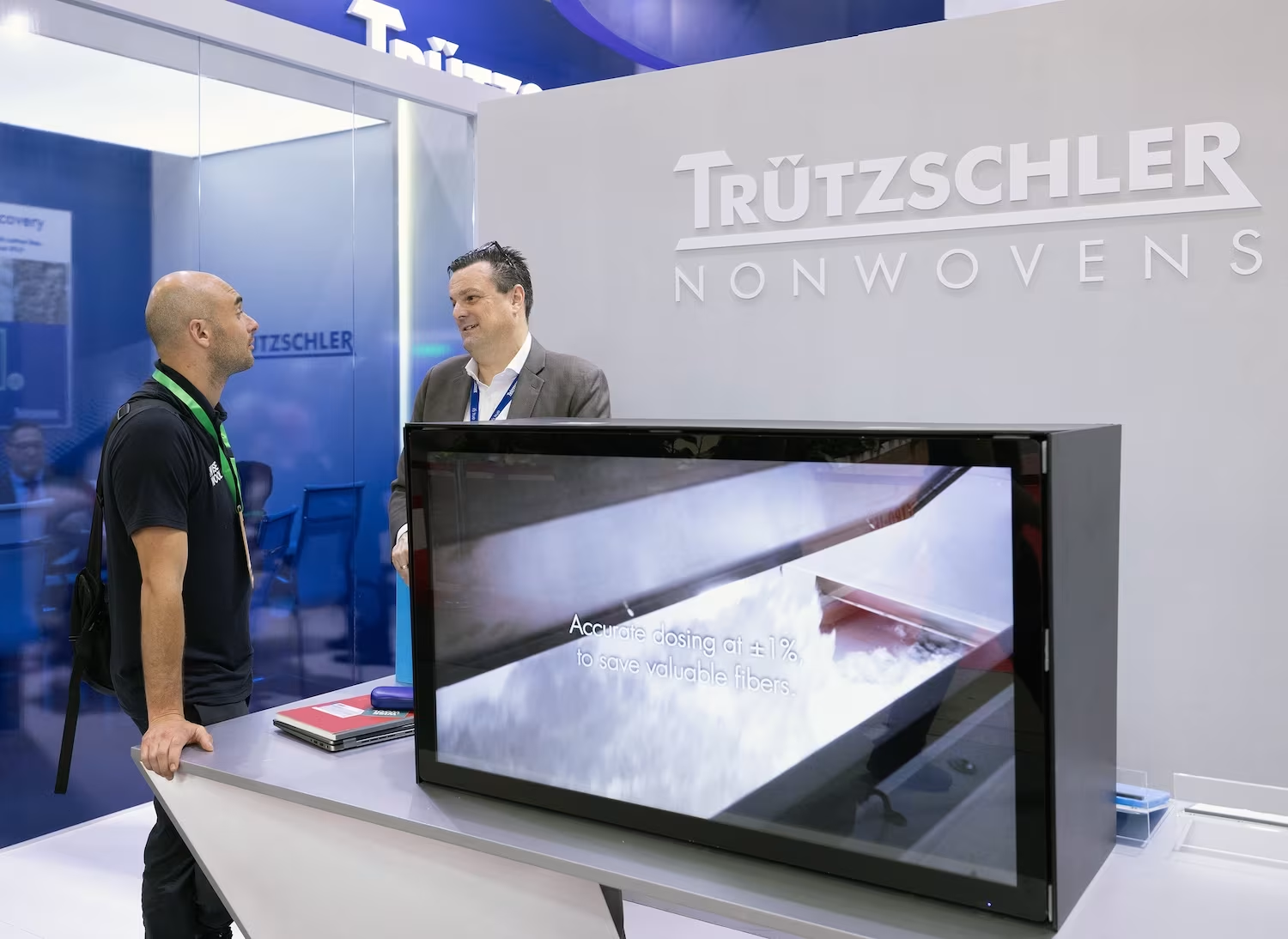
What is Trützschler Nonwoven Stands for?
Trützschler Nonwoven stands out for its ability to cover the entire production chain of nonwovens—from fiber preparation to finished fabric. Unlike machine builders that specialize in one or two stages, Trützschler has developed a uniquely comprehensive portfolio that enables manufacturers to run fully integrated, perfectly balanced production lines. The company’s solutions are designed around three strategic priorities:
1. Precision-controlled Fiber Management
Fiber opening, blending, and carding are executed with unmatched consistency. Trützschler’s fiber preparation systems ensure optimal fiber homogeneity, which is essential for fabric quality, production stability, and raw-material efficiency.
2. High-performance Web Formation
Through advanced carding systems, aerodynamic solutions, and wetlaid technology (through the Voith partnership), Trützschler produces webs that are uniform, clean, and adapted to a wide range of applications—from baby wipes to automotive felts.
3. Intelligent Bonding and Finishing
Needle-punch, spunlace, thermal bonding, drying, winding, and finishing systems allow manufacturers to tailor nonwoven characteristics with exceptional accuracy.
Together, these capabilities create a manufacturing ecosystem where every step reinforces the next—delivering productivity, stability, and long-term value.
Also Read: Trützschler Leads Nonwoven Transformation
Recycling at the Center of Trützschler’s Technology Strategy
While many companies discuss sustainability as an aspiration, Trützschler incorporates it directly into its engineering philosophy. The company has long recognized that the future of nonwovens depends on access to recycled fibers and stable circular production processes.
Challenges of Post-Consumer Textiles
One of the greatest obstacles to large-scale textile recycling is variability in fiber quality. Trützschler regularly evaluates global waste streams and highlights an important industry truth: mechanically recycled fibers—especially from mixed garments or fast fashion—tend to be short, weak, and inconsistent. This makes them difficult to use in high-quality nonwovens.
The company emphasizes that the recycling problem is not simply technological; it is structural. Without proper collection, sorting, and material preparation, factories cannot achieve stable production results.
How Trützschler Is Building the Solution?
To address this, Trützschler has established one of the world’s most advanced facilities for recycled fiber testing:
The Nonwovens Customer & Technology Center (NCTC)
Here, manufacturers bring their waste fibers or post-consumer blends for real-world trials. The center simulates complete production lines, tests fiber behavior, and develops optimized configurations to ensure industrial-scale stability.
The company continues to refine its webs, carding systems, and bonding technologies so that recycled fibers—natural or synthetic—can be used more efficiently and in more product categories. In this way, Trützschler directly supports the global transition toward circularity.
Circular Economy Integration: Designing Machines for the Future
Global brands, policymakers, and consumers increasingly demand products with reduced environmental impact. Trützschler’s machinery portfolio is built to ensure that nonwoven factories can meet these expectations.
Also Read: All you need to know about ZARA
Advanced Fiber Utilization
The company’s X-Series cards (NC-X and NCT-X) are among the market’s most advanced solutions for minimizing waste. Their adjustable suction system captures and reintroduces fiber edges into the blending process, improving yield and reducing material costs.
Cotton Waste as a High-Value Resource
Trützschler’s expertise in cotton—one of the company’s historical strengths—allows it to convert comber noils and other spinning wastes into high-quality nonwovens. The resulting products serve hygiene, cosmetic, and medical applications where soft and natural materials are in demand.
These engineering achievements demonstrate Trützschler’s determination to enable circular production without compromising performance or productivity.
Expanding Possibilities in Emerging Regions: Focus on Africa
As textile waste grows worldwide, emerging economies—especially in Africa—face new challenges and opportunities. Trützschler observes that second-hand clothing imports provide temporary benefits but hinder long-term industrial development. Much of this imported waste ultimately becomes landfill.
Africa’s Untapped Potential
Trützschler envisions Africa becoming an important hub for local nonwoven production, especially in:
- Road construction and geotextiles
- Filtration media
- Hygiene products including wipes and diapers
- Industrial and insulation materials
The company has taken active steps to introduce investors and policymakers to the potential of nonwoven manufacturing, emphasizing that building local capacity can strengthen both industry and environmental management across the continent.
Digital Transformation: T-ONE and the Rise of Smart Nonwoven Manufacturing
Digital intelligence is becoming a defining factor in factory competitiveness. Trützschler’s answer to this shift is T-ONE, a modular, data-driven platform that unifies production monitoring, process control, quality assurance, and machine optimization.
What T-ONE Brings to the Factory
T-ONE collects and analyzes all production-relevant data from the line, allowing manufacturers to:
- Stabilize quality
- Automate recipe management
- Optimize energy consumption
- Reduce downtime with predictive maintenance
- Document production for audits and traceability
Importantly, T-ONE can integrate seamlessly into existing IT systems—ERP, MES, and third-party software—making it adaptable for a wide range of factories.
New AI enhancements scheduled for launch in 2026 position T-ONE as one of the most future-ready digital platforms in the textile machinery sector.
Energy Efficiency: A Core Component of Trützschler Engineering
As energy prices rise worldwide, manufacturers seek technologies that reduce consumption without affecting throughput. Trützschler has made significant advancements in this area.
The MPD Modular Dryer
The MPD Modular High-Performance Dryer is engineered to lower energy consumption by more than 10% through optimized airflow and heat transfer. It is ideal for high-speed lines, especially spunlace and wetlaid processes where drying is one of the most energy-intensive stages.
The dryer is also compatible with hydrogen and biogas, enabling future decarbonization.
Optimized Machinery for Different Market Needs
Trützschler does not focus solely on high-end lines; it also produces streamlined equipment such as the NC-Xe card, designed to make advanced technology more accessible for standard needle-punching operations.
This dual strategy—premium innovation + cost-optimized solutions—allows the company to serve both global corporations and regional manufacturers.
Looking Ahead: Trützschler’s Vision for the Next Decade
The future of nonwovens will be shaped by sectors that demand safety, sustainability, and high performance—from filtration and medical fabrics to hygiene wipes and automotive materials. Trützschler anticipates growth in both durable and disposable categories, but emphasizes that sustainable production models must be developed simultaneously.
The company believes that recycled fibers will eventually become a major feedstock in the industry, though significant supply-chain improvements are still needed. Its NCTC center will continue supporting customers with testing, prototyping, and process optimization, ensuring reliable production conditions even with complex materials.
At the same time, digitalization and energy efficiency will guide Trützschler’s machinery development, enabling manufacturers to remain competitive in increasingly demanding markets.
Also Read: Change in the Board of Directors of the Trützschler Group SE
Conclusion
Trützschler Nonwoven stands today not only as a supplier of advanced machinery, but as one of the most influential strategic partners shaping the future of the nonwoven industry. With deep expertise in engineering, recycling innovation, smart automation, and sustainable manufacturing, the company plays a pivotal role in guiding factories toward circular, digital, and high-performance production models.
As global expectations shift toward greener and more intelligent production systems, Trützschler’s integrated approach and long-term vision position it as a cornerstone of the industry’s future.











