Exclusive Interview by Behnam Ghasemi, Editor-in-Chief of Kohan Textile Journal
The global spinning industry is navigating one of its most challenging periods in recent years. Economic uncertainty, geopolitical tensions, rising energy costs, labor shortages, and increasing sustainability requirements are forcing spinning mills to rethink their strategies and investment priorities.
At the same time, digitalization, automation, recycling, and intelligent production systems are opening new opportunities for manufacturers seeking to improve productivity and remain competitive in a rapidly changing market.
To gain deeper insights into these developments, Kohan Textile Journal spoke with Maren Schubert, Corporate Communications & Social Media Manager at Trützschler, one of the world’s leading suppliers of spinning preparation, card clothing, and nonwovens technologies.
In this exclusive interview, Ms. Schubert shares her perspective on the current state of the global spinning industry, investment trends in Türkiye, opportunities across the Middle East and Africa, the future of nonwovens and recycling, and the technologies that are expected to shape the next generation of textile manufacturing.

Q: The global spinning industry is navigating a period of economic uncertainty and geopolitical tensions. From Trützschler’s perspective, what are the most pressing challenges facing spinning mills today?
Maren Schubert :
Geopolitical tensions, such as the conflict in the Middle East, and a volatile global economy are reducing consumption and investment in new machinery. Nevertheless, Trützschler remains focused on delivering innovation and added value.
At the same time, our customers face challenges such as labor shortages and rising energy costs. Our R&D activities are running and we are investing in automation solutions like T-CAN, which help reduce dependency on manual labor and increase efficiency.
By staying close to our customers and developing value-adding technologies, we support them through these challenging times.
Q: Türkiye remains one of the world’s leading textile manufacturing hubs. Why does Trützschler continue to view Türkiye as a strategically important market?
Maren Schubert :
Türkiye offers many strategic advantages: its geographic proximity to key European markets, a strong domestic cotton production including recycling initiatives and a modern infrastructure for textile manufacturing.
The country is also known for its high-quality textile products and the strong expertise of its textile companies. Thanks to these strengths, we continue to see Türkiye as a powerful and future-oriented textile hub.
However, spinners in Türkiye are currently facing challenges such as inflation, difficulties in obtaining loans, a decline in exports due to weak global demand, rising labor costs and low capacity utilization in spinning mills.
At the same time, the Turkish market has always been very resilient. Our Turkish customers are constantly finding ways to adapt to their challenges. We help our clients in Türkiye to stay competitive by investing heavily in R&D and offering cutting-edge technology as well as excellent local service.
Q: What investment trends are you currently observing among Turkish spinning mills? Which technology areas are attracting the greatest interest?
Maren Schubert :
We are seeing great interest in our carding technology, especially our next generation TC 30i card in combination with our IDF 3 integrated draw frame for direct spinning and IDF vortex spinning, resulting in higher quality and increased production.
We are also developing automation solutions supported by digital systems that simplify operations and reduce personnel needs. Our automated can transport system T-CAN was developed in response to growing labor costs and labor shortages in the textile industry.
Digitalization also continues to be a trend. This includes both the digitalization of machinery itself as well as new business models and digital services. With MyMill, our cloud-based platform, customers can monitor and optimize their spinning mill operations.
Q: Digitalization, automation, sustainability, and energy efficiency are increasingly shaping investment decisions in textile manufacturing. How is Trützschler helping mills improve productivity while reducing costs and environmental impact?
Maren Schubert :
We see digitalization as a key enabler for smarter, more efficient textile production. We are already applying this in our products through monitoring systems. Our digital innovation for spinning mill optimization, MyMill, enables internal benchmarking of shift data and machine productivity, delivers machine status updates, and supports fast, data-driven decision-making through transparent analytics and predefined reports.
In automation, T-CAN is a strong example of how we respond to customer needs. Our goal was to create a solution that not only reduces operational costs but also enhances quality and consistency in sliver handling. It’s a leap forward in making spinning mills smarter. We will build on this in the future and continue to develop cutting-edge innovations that respond to the needs of our customers.
Sustainability is equally important. We are advancing more sustainable fiber processing technologies and, with TRUECYCLED, we offer a dedicated solution in spinning preparation for the recycling of textile waste.
Energy efficiency is another important pillar. For instance, our Pre-Cleaner CL-X processes up to 2,000 kg per hour while consuming 30% less energy than the current benchmark. Where previously two machines were needed to clean cotton effectively, the CL-X now handles the task alone. The TC 30i also contributes significantly: in customer applications, it achieved up to 40% higher productivity while reducing energy consumption per kilogram of output.
Read more : Trützschler’s Integrated Draw Frame IDF 3: Unlocking the Full Potential of Short Fiber Processing
Q: How do you see the future of the spinning industry in Türkiye, the Middle East, and Africa over the next few years?
Maren Schubert :
Türkiye offers many strategic advantages: its geographic proximity to key European markets, strong domestic cotton production and a modern textile manufacturing infrastructure. The country is also well known for producing high-quality textiles and for the deep expertise of its textile companies. Building on these strengths, we continue to view Türkiye as a powerful, future-oriented textile hub.
At the same time, geopolitical tensions, particularly the ongoing conflicts in parts of the Middle East, make it difficult to provide reliable short-term forecasts for the region.
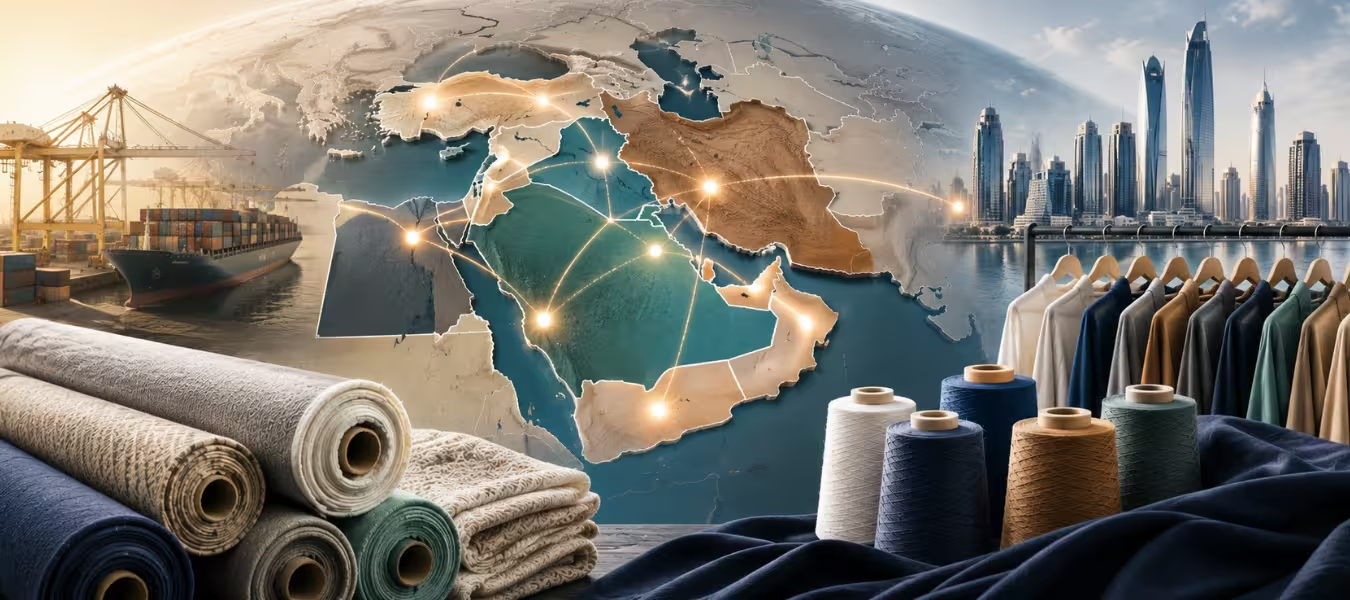
There are encouraging developments, especially in North Africa. Egypt, for example, is seeing significant investment, supported by its excellent cotton production, skilled workforce, and continuous adoption of state-of-the-art machinery.
Other markets such as Ghana, Ethiopia, South Africa, and Kenya also hold considerable long-term potential. With a large, eager workforce, good cotton production, and the possibility for greater industrial activity, we remain hopeful that these markets will start to capitalize on the opportunities available.
Our expectation is that Africa’s textile sector will experience a positive development in the future, and we’re optimistic about the prospects.
Read more : Maviş Tekstil Achieves 33% Productivity Increase with Trützschler’s TC 30i and IDF 3
Q: How do you evaluate the future of the nonwovens industry and related investments in Türkiye and the Middle East?
Maren Schubert :
Türkiye remains the largest nonwovens producer in Europe and a key hub between East and West. At the same time, the current geopolitical situation in neighboring regions creates uncertainty, increasing costs for resources and thus affects investment decisions.
In the Middle East, the situation is different: there are only very limited local nonwovens capacities, but strong raw material availability for petroleum-based fibers and clear ambitions to develop the industry.
We see interest in both hygiene and technical applications, in Türkiye as well as in the Middle East. However, projects often move forward slowly due to questions around security, financing, and long-term stability.
Q: Africa is increasingly being viewed as a promising market for recycling and nonwovens. Do you agree with this perspective?
Maren Schubert :
We see Africa as a promising long-term market for nonwovens. The growing population and the emergence of a middle class will increase demand, especially for hygiene products such as baby diapers and later also dry and wet wipes.
There are interesting opportunities in technical applications like construction and filtration as well. However, building a competitive nonwovens industry requires significant investment, stable infrastructure, and reliable supply chains – so development will likely start with smaller, local initiatives.
When it comes to recycling, I would take a realistic view. Nonwoven recycling is still at a very early stage globally. Post-consumer products often are contaminated and made from complex material combinations and fiber blends.
It is not yet clear how efficient, scalable recycling into high-quality fibers for new nonwovens will look. So while the potential is there, it will take time and significant technological progress to unlock it.
Q: Looking ahead, what major technological developments do you believe will shape the future of spinning over the next five to ten years?
Maren Schubert:
Close collaboration with our customers and a deep understanding of market trends remain essential.
By focusing on smart solutions that enhance productivity, quality, and sustainability, we stay at the forefront of technological developments.
We believe excellent spinning preparation is crucial for yarn quality, which is why we’ve developed intelligent, self-optimizing machines – and connect them through digital monitoring systems.
Editor’s Insight
What stands out most from this discussion is that the future competitiveness of spinning mills will not depend solely on machinery investments, but on how effectively manufacturers integrate automation, digital intelligence, sustainability, and operational efficiency into their production strategies.
While challenges such as geopolitical uncertainty, rising costs, and labor shortages continue to affect textile producers worldwide, the industry is clearly moving toward smarter and more connected manufacturing environments. Technologies that reduce dependency on manual labor, improve transparency through data, and support sustainable fiber processing are becoming essential rather than optional.
For textile manufacturers in Türkiye, the Middle East, and Africa, the coming years may present both challenges and significant opportunities. Those willing to invest in innovation and modernization will likely be best positioned to benefit from the next phase of growth in the global textile industry.