




Introduction
The global nonwovens industry is navigating a period of uncertainty, shaped by geopolitical tensions, cautious investment decisions, and changing market demands. While some regions are slowing down, others continue to invest aggressively in new technologies and production capacities.

At INDEX 2026, one of the world’s leading exhibitions for nonwovens technologies, Behnam Ghasemi , Editor in chief at Kohan Textile Journal had the opportunity to speak with Jutta Stehr, Head of Marketing at Trützschler Nonwovens, about the company’s experience at the show, current market developments, emerging technologies, and the strategic priorities guiding Trützschler through today’s challenging business environment.
In this exclusive interview, Ms. Stehr shares valuable insights into the growing demand for hygiene nonwovens, the rise of flexible production concepts, the increasing role of digitalization, and why customer proximity remains at the heart of Trützschler’s global strategy.

Interview
Kohan Textile Journal:
What is your overall evaluation of Trützschler Nonwovens’ participation at INDEX 2026?
Jutta Stehr:
Our impression from Techtextil was confirmed at INDEX. For us as a machinery supplier, activity was rather limited. Many of our existing customers were present with their own booths, which led to good discussions, but the usual number of new contacts was clearly lower. Overall, it was a quieter show, reflecting the current market situation rather than the importance of the industry itself.
Kohan Textile Journal:
How was the atmosphere at the exhibition, and what were the general expectations of investors and customers regarding the future of the nonwovens market?
Jutta Stehr:
The atmosphere was a bit cautious. Especially producers from Europe and the Americas are holding back on new investments, and some even decided not to attend due to the high costs.
At the same time, there are regions moving ahead: China in particular, and to some extent India and South Asian countries, are less affected by geopolitical tensions and continue to invest. This was visible at INDEX—for example, our Chinese sister company Trützschler Textile Machinery (Jiaxing), short TTMJ, signed several contracts for new production lines for innovative products.
So while uncertainty dominates in some regions, others are clearly in a growth phase.
Read more : Trützschler’s Integrated Draw Frame IDF 3: Unlocking the Full Potential of Short Fiber Processing
Kohan Textile Journal:
How do you evaluate current market trends in the nonwovens sector?
Jutta Stehr:
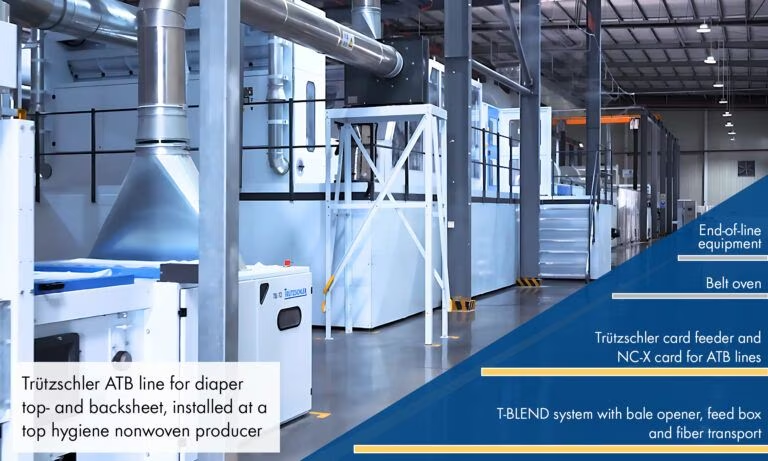
Discussions at INDEX were very strongly focused on hygiene nonwovens—mainly air-through bonding, which is currently one of the hottest topics in the market for producing ultra-soft, voluminous nonwovens used in diaper topsheets and backsheets, as well as hydroentangling.
We also see rising interest in flexible production concepts based on pulp composites such as CP (Carded/Pulp), CPC (Carded/Pulp/Carded), and SPC (Spunlaid/Pulp/Carded).
In uncertain times, these solutions offer manufacturers a good balance. They allow producers to manufacture both composite and single-layer nonwovens and adapt more easily to changing market demand. That flexibility is currently a key driver behind many investment decisions.
Kohan Textile Journal:
Which technologies, solutions, or innovations presented at your stand attracted the most interest from visitors?
Jutta Stehr:
Two areas attracted particularly strong interest at our booth.
First, our solutions for finest-fiber air-through bonding generated significant attention. These technologies are currently in high demand, especially in China, where ultra-soft and bulky hygiene nonwovens are becoming an important differentiator. We expect this trend to gradually spread to other regions as well.
Second, our digital solution T-ONE, especially the camera-based anomaly detection system, attracted considerable interest from visitors. Similar to what we experienced at Techtextil, many nonwoven producers are actively searching for ways to optimize production through preventive actions and early issue detection.
For us, this confirms that digitalization in nonwovens production is no longer a future topic—it is something the industry is ready to implement today.
Kohan Textile Journal:
In today’s uncertain and challenging market environment, what is Trützschler’s strategy for maintaining stable growth and supporting customers worldwide?
Jutta Stehr:
The last two to three years have been challenging for the industry, and we have taken several measures to respond to changing market requirements.
Our local structures have become increasingly important. The Trützschler Group has always focused on staying close to customers and providing the right level of solutions for each market. Today, market responsibility lies with our regional companies, including TTMJ in China, Trützschler Tekstil Makinalari in Türkiye, and American Trützschler in the United States.
Sales and service are managed locally, while engineering, product adaptations, and new developments continue to be coordinated from our German sites in close cooperation with regional teams.
At the same time, we have broadened our portfolio. In addition to the flexible high-tech and high-performance solutions for which Trützschler is known, we now also offer fit-for-purpose machinery—quality-driven, reliable, and application-focused solutions with optimized complexity and cost.
This means placing greater emphasis on machinery business alongside complete production lines. One example is our fine-fiber air-through bonding concepts, where customers can combine our fiber preparation and carding technologies with selected third-party equipment.
We also see strong demand for upgrading existing assets. Many customers are not ready to invest in entirely new lines but want to make their current production facilities future-ready.
To address this need, we have significantly expanded our service offering, including consulting, comprehensive modernizations, complete refurbishments, and retrofits. In one recent project, replacing the dryer in a hydroentangling line with the latest model increased production capacity by around 30% while reducing energy consumption by up to 40%.
Overall, our strategy is straightforward: stay flexible, stay close to the market, and support customers with practical solutions—regardless of their starting point.
Read more : Maviş Tekstil Achieves 33% Productivity Increase with Trützschler’s TC 30i and IDF 3
Editor’s Insight
INDEX 2026 revealed a nonwovens industry operating at two different speeds. While Europe and North America remain cautious amid economic and geopolitical uncertainty, Asia—particularly China—continues to invest in new production capacities and advanced technologies.
The interview with Jutta Stehr highlights three key themes shaping the future of nonwovens manufacturing: flexibility, digitalization, and efficiency. From innovative air-through bonding solutions for hygiene applications to AI-driven anomaly detection systems such as T-ONE, manufacturers are increasingly seeking technologies that improve productivity while reducing operational risks.
Perhaps the most significant takeaway is that investment decisions are no longer driven solely by capacity expansion. Instead, producers are prioritizing adaptable production concepts, modernization of existing assets, and digital tools that deliver measurable operational improvements. As market conditions remain unpredictable, companies that can combine technological innovation with practical, customer-focused solutions are likely to emerge as the industry’s strongest performers in the years ahead.











