Business situation weakens slightly, but the industry stays cautiously optimistic
Global Business Situation Weakens Across All Regions
The International Textile Manufacturers Federation (ITMF) has published the results of its 39th Global Textile Industry Survey (GTIS), conducted from 14 to 22 July 2026 among companies along the entire global textile value chain. Worldwide, 10% of participants rated their business situation as good, 53% as satisfactory and 37% as bad — a balance of -26pp, down from -17pp in May but still well above the 2023 lows. All regions are now in negative territory, from South Asia at -3pp to North & Central America at -58pp. Brands and retailers were the only segment with a positive balance (+11pp); machinery manufacturers were weakest at -40pp, while garment producers fell sharply from +5pp in May to -25pp.
![Graph 1: Business situation [World]](https://kohantextilejournal.com/wp-content/uploads/2026/08/Graph-1-Business-situation-World.avif)
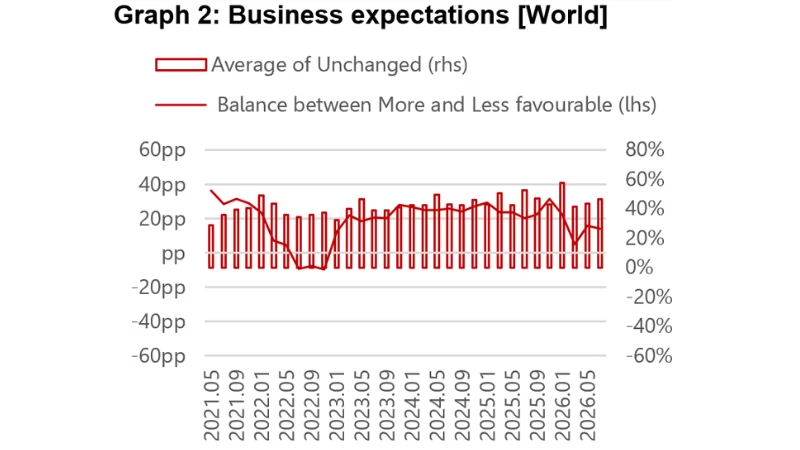
Business expectations for the coming six months eased marginally from +16pp to +14pp, with 47% of respondents anticipating no change. Africa (+50pp) and South Asia (+32pp) were the most optimistic regions and machinery manufacturers the most confident segment (+36pp).
Order Intake, Backlogs and Capacity Utilization Decline
Order intake dropped to -27pp from -9pp in May, suggesting the May reading was an outlier. The average order backlog eased to 2.3 months and global capacity utilization slipped to 71%, ranging from 75% in South-East Asia to 64% in North and Central America.
Weak Demand and Geopolitics Remain the Industry’s Leading Concerns
Weak demand and geopolitics remain the industry’s leading concerns for 56% and 46% of the respondent, respectively, while raw material prices, energy costs and tariffs have all receded — tariffs to just 10%, down from a peak of 40% in September 2025. Order cancellations fell to 2% globally, and the inventory index improved despite still being under average, with stocks accumulating downstream at brands and retailers while upstream segments stay lean.