



Intertextile Shanghai 2026
cinte techtextil 2026
itma 2027

Results of the 38th ITMF Global Textile Industry Survey

The global textile industry appears to be turning a corner, but this is more likely a fragile and possibly temporary improvement than the start of a durable recovery. According to the 38th ITMF Global Textile Industry Survey, conducted worldwide during the second half of May 2026, business sentiment, order intake, order backlogs and capacity utilization all improved versus March — yet every indicator remains weak by historical standards, and rising costs cast doubt on how long the upturn can last.

The new survey shows a business situation balance rising to −17 percentage points (pp) from −25pp in March. Business expectations climbed to +16pp (from +5pp), order intake to −9pp (from −25pp), backlogs to 2.5 months and capacity utilization to 74%. Order cancellations stayed contained and inventories lean low. The direction is encouraging, but the levels rest on a thin and fragile cushion.

ITMF Textile Survey Reveals Regional Performance Differences
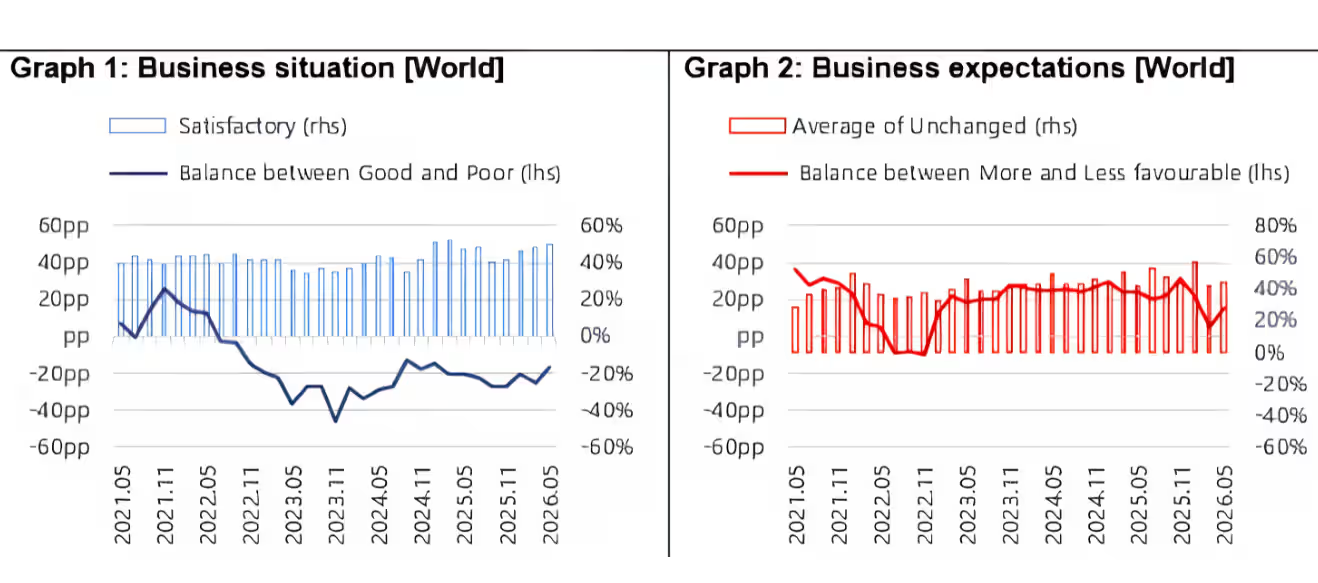
ITMF Textile Survey 2026 highlights global textile industry recovery trends

The upturn was geographically uneven. Africa led on business situation, order intake, backlog and expectations, alongside gains in Europe and North & Central America. The Asian production hubs lagged, with East Asia weakest on both current conditions and the six-month outlook. Along the value chain, segments closest to the end-consumer slightly fared best, while capital-goods and upstream segments trailed.

Read More: Results of the 37th ITMF Global Textile Industry Survey

Cost and demand pressures persist: weak demand remains the major concern for 53% of participating textile manufacturers, followed by raw-material prices (52%) and energy prices and geopolitics (42% each). The survey links rising costs to the war in Iran, which has pushed crude oil to around USD 100 and lifted gasoline prices by roughly 50% since March, feeding inflation and squeezing margins. Whether the May reading holds will depend largely on energy prices and the resolution of ongoing conflicts.


LEAVE A REPLY

Please enter your comment!
Please enter your name here

spot_img
spot_img
spot_img
spot_img
spot_img
spot_img
spot_img
AMEC AMETEX
spot_img
spot_img

Related News

Digital Pigment Revolution By ITACA Spain

An Exclusive Interview with Vicente Bagán, Vice Chairman of...

Recycled Fibers: The Vital Data For Quality and Profitability

Uster’s new Recycling Opening Index guides spinners to the...

Why You Should Visit RTS Textiles Group: A Global Hub for Workwear and Protective Fabrics

In today’s textile and apparel industry, buyers are no...

YKK Announces Decision to Construct a New Factory in India

YKK Corporation (Headquarters: Chiyoda-ku, Tokyo; President): Koichi Matsushima; hereafter,...

Auto-Doff System For Texturing Machines

Barmag (Suzhou) Technology Co., Ltd. and Hitech Automation Solutions...

KipaÅŸ Textile Expands Sustainable Production Capacity with New Monforts Machinery Investment

Turkish integrated textile manufacturer KipaÅŸ Textile has strengthened its...

Indo Texnology: Automating Textile Manufacturing Through AI, Inspection and Intelligent Material Handling

Interview with Jaivardhan T, Director – Global Sales &...

The Architecture of Precision: Mastering Multi-Layer Fluid Loops and Cross-Border Corridors in Circular KnittingIntroduction and Background

ISTANBUL, TÜRKİYE – In the modern high-performance circular knitting...

Milliken Becomes First Textile Manufacturer to Sign IAFF PPE Code of Conduct

Milliken & Company has become the first textile manufacturer...

Keeping Products Moving With Swedish Automation At FILTECH 2026

Taking place in Cologne from June 30th to July...

Kenya Exports More Apparel to the US but Earns Less, Raising Concerns for Textile Industry

Kenya’s textile and apparel industry achieved a record export...








