




SASA Polyester has evolved from an established Turkish polyester producer into one of the most strategically important integrated polyester and petrochemical platforms in Türkiye. From polyester staple fibre and filament yarn to PET resin, PET chips and one of Europe’s largest PTA investments, the company now sits at the centre of a value chain that connects petrochemicals with textiles, nonwovens, home furnishings, carpets, packaging, automotive applications and other industrial markets.

What Is SASA Polyester?
SASA Polyester Sanayi A.Ş. is a Türkiye-based manufacturer of polyester staple fibres, filament yarn and POY, PET resin, PET chips and related polyester materials. The company’s principal manufacturing complex is located in Adana, where decades of polyester-production experience are now being combined with much larger and more integrated facilities.
The company’s products reach a wide range of end uses. Polyester manufactured by SASA can ultimately be found in apparel, woven and knitted fabrics, home textiles, carpets, bedding, nonwovens, hygiene materials, filtration products, geotextiles, automotive components, artificial leather, packaging, medical applications and other industrial products.
This breadth explains why SASA can be viewed differently by different parts of the market. A spinning mill may know SASA primarily as a supplier of polyester staple fibre. A texturiser may focus on POY. A home textile manufacturer may encounter filament or fibrefill products. A packaging producer may instead view SASA principally as a PET resin and chips supplier.
SASA Polyester at a Glance
Capacity figures reflect the company’s current public corporate information following major facilities commissioned in 2025. Future project figures are targets and should not be read as current operating capacity.

From 1966 to the Erdemoğlu Era
SASA began polyester production in 1966, giving the company six decades of accumulated experience in synthetic fibres and polymer manufacturing. Its development has passed through several ownership and technology phases, including a period connected with DuPont before the company ultimately returned to the SASA identity.
A decisive new chapter began in 2015, when Erdemoğlu Holding acquired control of the company. The acquisition was followed by a broad investment programme focused on modernisation, automation, capacity growth and vertical integration.
Kohan Textile Journal has followed this strategy for several years. In an earlier interview on Erdemoğlu Group’s large-scale investment strategy, Chairman İbrahim Erdemoğlu described the importance of producing strategic raw materials domestically and outlined the group’s ambition to move SASA further upstream.
That direction is central to the modern SASA story. Instead of expanding only the final polyester products it already knew how to manufacture, the company increasingly invested in the raw materials, polymerisation capacity and infrastructure required to build a more integrated platform.
Why SASA Matters to Türkiye’s Textile Industry
Türkiye has one of the most diversified textile manufacturing ecosystems in its region. The country produces yarn, woven and knitted fabrics, denim, apparel, carpets, home textiles, technical textiles and nonwovens for domestic and international markets.
Polyester connects many of these sectors. Staple fibre can be processed into spun yarn. Filament yarn can be used in apparel, upholstery, home textiles and other fabrics. Polyester polymers and chips provide feedstock for fibres, yarns, films, packaging and specialised industrial applications.
SASA is therefore positioned upstream from a large number of textile production decisions. Kohan Textile Journal has previously included SASA among the leading yarn and synthetic-fibre producers in Türkiye, reflecting its position within the raw-material base supporting the country’s much larger downstream textile industry.
The strategic value of nearby raw-material production becomes more visible during periods of freight disruption, currency volatility, geopolitical uncertainty or changes in Asian supply. Domestic production does not remove global risk, but it can shorten supply chains and reduce dependence on imported intermediate materials.
For Turkish manufacturers competing on short lead times and flexibility, this matters. A more integrated domestic polyester supplier can potentially support faster planning, more stable replenishment and stronger alignment between raw-material production and downstream textile demand.
How SASA’s Integrated Polyester Value Chain Works
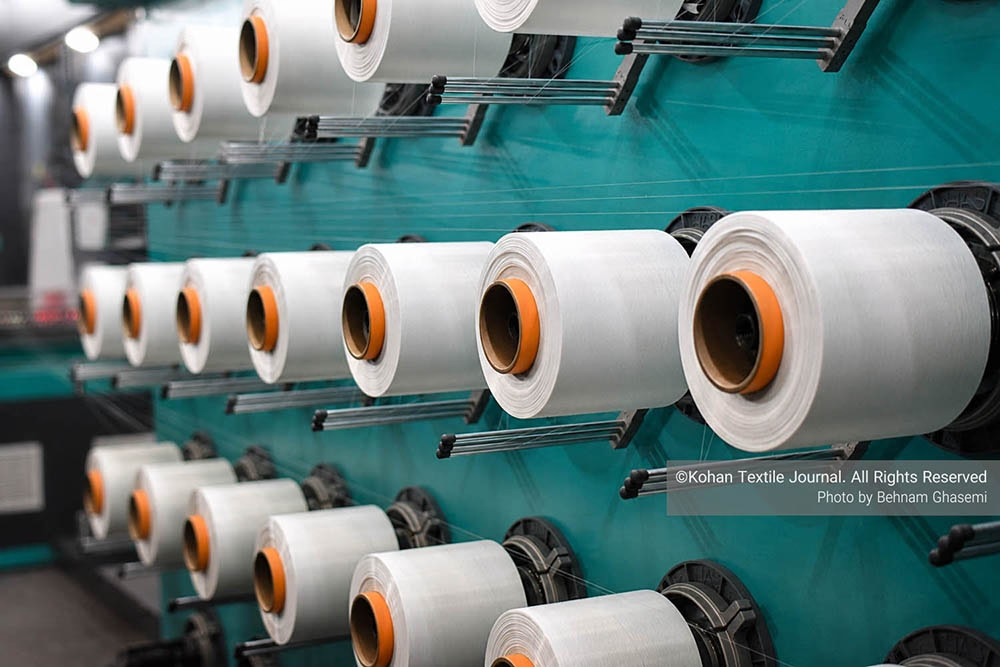
To understand SASA’s transformation, it is useful to look at the polyester value chain itself.
Polyethylene terephthalate, or PET, is produced from key petrochemical inputs including Purified Terephthalic Acid (PTA) and Monoethylene Glycol (MEG). These inputs are reacted to create polyester polymer, which can then be processed into chips, staple fibre, filament yarn and products for packaging or industrial applications.
Petrochemical feedstocks → PTA and MEG → PET polymer → PET chips / polymer melt → polyester staple fibre / POY / filament yarn → textiles, nonwovens, packaging and industrial applications
Historically, a polyester producer that imports major feedstocks remains exposed to international petrochemical pricing, logistics and foreign supply. SASA’s strategic response has been to bring more of this chain under its own control.
Vertical integration does not mean complete independence from global petrochemical markets. SASA still requires several petroleum-derived inputs. What integration does provide is greater control over one of the most important intermediate stages in polyester production and the potential to coordinate raw materials, polymerisation and downstream capacity more closely.
The PTA Plant: A Turning Point for SASA Polyester
The most important symbol of this upstream strategy is SASA’s Purified Terephthalic Acid plant in Adana.
The facility has an annual production capacity of approximately 1.75 million tonnes of PTA. It entered commercial production in 2025 and represents one of the largest industrial steps in SASA’s transition from a polyester converter toward an integrated petrochemical and polyester producer.
Kohan Textile Journal covered the milestone in detail in SASA Completes Türkiye’s Largest PTA Production Facility. The project is important because PTA is one of the principal raw materials required to manufacture PET and polyester.
For SASA itself, the industrial logic is direct. A company manufacturing large volumes of polyester consumes large quantities of PTA. Producing this material internally can reduce dependence on imported PTA and create greater control over feedstock availability.
The implications extend beyond the company. Türkiye has a large polyester-consuming textile industry, so domestic PTA production potentially strengthens a much wider value chain. It can also help position the country further upstream in petrochemicals rather than concentrating value creation only in yarn, fabric and finished textile products.
This shift is one of the reasons the SASA story should not be understood only through the lens of fibre production. The company’s trajectory is increasingly a story about industrial integration.
PET Resin and PET Chips: Beyond Conventional Textiles
SASA’s PET business broadens its exposure well beyond conventional apparel and home textiles.
PET resin and PET chips can be processed into textile fibres and yarns, but they also serve packaging, film, bottle, medical and industrial applications. This gives SASA access to demand cycles that can differ from those of the fashion and textile markets.
The company uses MTR — Melt to Resin — technology in its PET resin and chips operations. This production route is designed to produce high-viscosity material through a more direct process and can lower energy consumption compared with conventional multi-stage approaches.
In 2025, SASA commissioned a new PET chips facility with approximately 330,000 tonnes per year of capacity, bringing its stated total PET chips capacity to approximately 850,000 tonnes per year.
The importance of this expansion is strategic as well as quantitative. A broader polymer portfolio allows the company to participate in markets including food and beverage packaging, films, medical components and high-strength industrial applications while continuing to feed the textile chain.
That diversification can reduce dependence on any single end-use market and allows SASA to extract value from the same underlying polyester chemistry across multiple sectors.
Polyester Staple Fibre: From Spinning to Nonwovens
Polyester staple fibre remains one of SASA’s core product groups. The company’s fibre portfolio serves textile spinning, nonwoven applications and fibrefill markets.
In conventional textile manufacturing, staple fibre can be used in spinning systems to produce polyester yarns or blends with fibres such as cotton, viscose and other materials. Polyester’s dimensional stability, durability and versatility make it important across apparel and household textiles.
SASA also supplies fibres for a much wider technical market. Its nonwoven fibre portfolio includes products suitable for automotive applications, filtration, geotextiles, construction, hygiene, artificial leather and other technical uses.
This is important because the future of polyester is not limited to clothing. Technical textiles and nonwovens have become major growth areas where fibre properties can be engineered around carding performance, thermal behaviour, colour stability, hydrophilicity, bonding and durability.
A major polyester fibre investment commissioned in 2025 added approximately 402,500 tonnes per year of capacity, including low-melt fibre capability. SASA states that its total fibre capacity has consequently increased to around 800,000 tonnes annually.
Low-melt fibres are especially relevant for thermally bonded nonwovens and composite structures. Their inclusion demonstrates how capacity expansion can also create access to more specialised downstream applications.
POY, DTY and Filament Yarn: Connecting SASA to Apparel, Home Textiles and Interiors
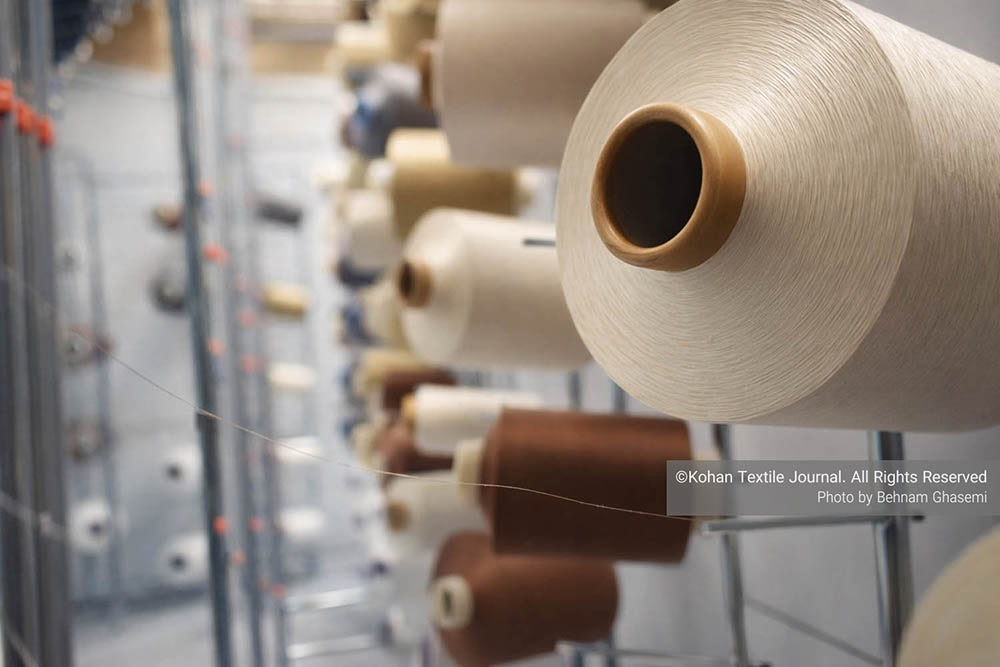
Another important pillar of the company’s portfolio is filament yarn, including Partially Oriented Yarn (POY) and textured polyester yarns.
POY is an intermediate filament product that can be further processed through texturing to create bulk, elasticity, softness and other surface or performance characteristics. Textured polyester filament is widely used in apparel, hosiery, home textiles, upholstery, denim and other fabric categories.
This connects SASA directly to several sectors in which Türkiye has strong manufacturing capabilities. The country’s home textile, apparel and interior-textile industries all consume polyester in different forms.
The broader growth of polyester in textiles has also been examined by Kohan Textile Journal in FASHION – Why Not Polyester, which discusses the material’s expanding share in the global fibre market as well as the sustainability debate surrounding it.
For SASA, filament production is therefore both a large-volume business and a bridge into differentiated textile applications where yarn structure, lustre, colour, bulk and performance characteristics can be engineered for specific markets.
Building Scale: SASA’s Approximately 2-Million-Tonne Polyester Platform
The combined effect of recent investments has been a substantial increase in production scale. SASA’s current corporate information places its total polyester production capacity at approximately 2 million tonnes per year.
Scale matters in polyester because the industry is capital intensive. Polymerisation, spinning and fibre plants require large investments, high utilisation and disciplined energy and maintenance management.
Large scale can also provide advantages in raw-material purchasing, product diversification and continuity of supply. A producer operating several integrated production lines has greater ability to offer different polymer, fibre and yarn grades while serving customers with substantial annual requirements.
At the same time, scale increases the importance of operational reliability. A shutdown in a large continuous-production environment can quickly affect substantial volumes. This is why maintenance strategy, spare parts, automation and technical partnerships become central to long-term economics.
Technology, Automation and Artificial Intelligence
SASA’s expansion has not been based only on physical capacity. Modern polyester manufacturing depends heavily on automation, process monitoring, data quality and production control.
Small variations in polymer chemistry, temperature, spinning conditions or yarn parameters can create problems much later in the textile value chain. Large continuous plants therefore benefit from systems capable of detecting deviations early and maintaining stable process conditions.
SASA has invested in highly automated production technologies and has also explored broader artificial-intelligence applications. Kohan Textile Journal covered this development in Big Step From SASA for Artificial Intelligence Applications, following the company’s cooperation with Berlin-based ZEKI, the Centre for Experiential Artificial Intelligence and Digitalisation.
Potential applications of AI in a large industrial environment include predictive maintenance, anomaly detection, production optimisation, quality analysis, energy management and digital security.
The industrial value of AI, however, depends on more than installing software. Successful implementation requires reliable production data, engineering knowledge and integration between digital systems and the physical manufacturing process.
Why Production Reliability and Equipment Partnerships Matter
At SASA’s scale, production reliability is a financial issue as much as a technical one.
Kohan Textile Journal reported how SASA strengthened its cooperation with Oerlikon Neumag through customer-service and secure remote-service agreements for staple-fibre systems. The article, SASA Places Customer Service Order with Oerlikon Neumag, illustrates an important aspect of world-scale manufacturing that is sometimes overlooked.
Building a high-capacity production line is only the beginning. Long-term competitiveness also depends on maintenance, original parts, technical know-how, remote support, operator capability and the ability to avoid unplanned downtime.
This becomes particularly important when polyester production runs continuously. The economics of a large plant can be significantly affected by availability, line efficiency and quality consistency over many years.
Energy, Sustainability and the Challenge of Polyester
Polyester’s global scale is also one of its biggest sustainability challenges.
Conventional virgin polyester is derived from fossil-based petrochemical feedstocks. As brands and regulators increase their focus on carbon emissions, traceability and circularity, large polyester producers face pressure to improve energy efficiency and develop lower-impact material pathways.
SASA has invested in renewable-energy capacity and energy-efficiency projects alongside its manufacturing expansion. At industrial scale, even relatively small reductions in energy intensity can create meaningful absolute savings.
But energy is only part of the debate. The long-term direction of polyester increasingly includes recycling and circular feedstocks.
Circular Polyester and the CARBIOS Opportunity
Mechanical recycling of PET bottles into polyester fibre is already widely established. Textile-to-textile recycling is more difficult because clothing can contain multiple fibres, dyes, finishes, elastane and other components.
Advanced recycling technologies are attempting to address this challenge by breaking polyester down into chemical or molecular building blocks that can be used again.
In 2024, SASA and CARBIOS entered discussions regarding a potential licence for an enzymatic PET biorecycling facility in Türkiye. Kohan Textile Journal covered the development in CARBIOS and SASA Discuss 100k ton PET Biorecycling Facility.
The proposed concept concerned capacity to process approximately 100,000 tonnes of prepared PET waste per year. Importantly, this was announced as a potential licensing project rather than an operating SASA recycling plant.
If ultimately implemented, a project of this kind could connect SASA’s large polyester-production platform with a future circular feedstock stream and become especially relevant to European customers seeking recycled-content and textile-to-textile solutions.
For readers looking for a broader explanation of the recycling landscape, Kohan’s guide What Is rPET? explains the role of recycled PET, its production routes and its importance to the textile sector.
SASA’s Geographic Advantage: Türkiye Between Europe, Asia and the Middle East
Geography is another component of SASA’s industrial position.
Türkiye sits close to the European Union while maintaining established commercial links with the Balkans, Middle East, North Africa, Central Asia and the Caucasus. For polymers, fibre and filament yarn, this can create a logistical advantage compared with suppliers located much farther from European and regional textile clusters.
The country also has a large downstream manufacturing base. Polyester produced in Adana may be exported directly, but it can also move through Turkish spinning, fabric, nonwoven, carpet or apparel factories before reaching international markets as a higher-value finished product.
This creates an important multiplier effect. SASA can influence Türkiye’s export performance not only through its own sales but also through the raw materials embedded in downstream Turkish textile and industrial products.
The Yumurtalık Vision: From Polyester Producer to Petrochemical Platform
The most ambitious element of SASA’s long-term strategy is the planned Yumurtalık refinery, petrochemical and port development in Adana.
The company currently describes a long-term investment vision of approximately $25 billion. Planned elements include petrochemical production, refinery capacity and integrated port infrastructure. The first phases have been associated with products such as polypropylene as well as a major refinery project.
This is a future investment programme, not current operating capacity, and should be understood accordingly.
The strategic logic is nevertheless clear. SASA wants to move even further upstream into the raw materials and petrochemical intermediates that support polyester and other polymer industries.
If executed at the announced scale, Yumurtalık would fundamentally change the way the company is categorised. SASA would no longer be seen principally as a polyester manufacturer with upstream integration. It would become a much broader petrochemical and industrial raw-material platform in which polyester is one important part of a larger portfolio.
The project also aligns with the long-running Erdemoğlu strategy discussed in Kohan’s earlier interview on the group’s industrial investment plans.
What Are the Main Challenges Facing SASA Polyester?
Large-scale integration creates opportunity, but it also increases exposure to risk.
1. Global Polyester and Petrochemical Cycles
Polyester margins are influenced by feedstock prices, oil and petrochemical markets, global supply, textile demand, packaging demand and capacity utilisation. World-scale production can create cost advantages, but it also means large volumes must be sold through changing market conditions.
2. Competition From Asian Producers
China and other Asian markets operate enormous polyester and petrochemical production bases. Competing with these suppliers requires more than capacity. It requires efficiency, reliability, logistics, product differentiation and strong customer relationships.
3. Capital Intensity
PTA, PET, fibre and petrochemical facilities require very large investments. Future growth therefore depends on disciplined financing, project execution and successful ramp-up of new assets.
4. Sustainability and Circularity
Customers increasingly expect recycled content, traceability and lower environmental impact. Virgin-polyester producers must therefore balance conventional capacity with investments in energy efficiency, recycling and more circular material systems.
5. Complexity of Vertical Integration
Owning more of the value chain can strengthen supply security, but it also means managing more technologies, markets, maintenance requirements and operational risks. Integration creates value only when each stage operates efficiently.
What SASA Polyester Means for the Future of Türkiye’s Textile Industry
SASA provides a clear example of how textile competitiveness begins well before yarn or fabric production.
A garment exporter may compete through flexibility and speed. A fabric mill may differentiate through design, finishing and quality. A carpet producer may compete through product development and scale. But each of these businesses ultimately depends on access to fibres, polymers, chemicals, energy and other upstream materials.
By expanding polyester production and bringing PTA into its own industrial platform, SASA is attempting to strengthen this upstream foundation.
Its portfolio connects textile spinning, filament yarn, home textiles, carpets, nonwovens, packaging and technical applications. New fibre and PET plants have increased scale. The PTA facility has deepened vertical integration. AI initiatives point toward more data-driven manufacturing. Recycling discussions suggest a possible future circular-polyester pathway. The Yumurtalık project aims to extend the model into a much wider petrochemical chain.
The strategic question is no longer whether SASA can produce polyester at scale. It already does.
The more important question is whether the company can convert scale, integration, technology and geography into durable competitiveness while meeting the changing sustainability expectations of global markets.
For Türkiye, the potential benefit is equally significant. A deeper domestic raw-material base can reduce exposure to imports, shorten supply chains and support textile, packaging, automotive and technical-material manufacturers serving international customers.
After six decades in polyester, SASA’s next chapter may therefore be defined by something much larger than fibre or yarn. It may be defined by the extent to which Türkiye can build an integrated polyester and petrochemical platform capable of competing at global scale.
Frequently Asked Questions About SASA Polyester
What does SASA Polyester manufacture?
SASA produces polyester staple fibre, filament yarn and POY, PET resin, PET chips and PTA, serving textiles, nonwovens, packaging, automotive, medical and other industrial applications.
Where is SASA Polyester located?
SASA’s principal manufacturing operations are located in Adana, Türkiye. The company also has raw-material storage and other supporting infrastructure in Türkiye.
What is the production capacity of SASA Polyester?
SASA’s current corporate information places total polyester production capacity at approximately 2 million tonnes per year, following major fibre and PET investments commissioned in 2025.
Why is SASA’s PTA plant important?
PTA is one of the key raw materials used to manufacture PET and polyester. SASA’s approximately 1.75-million-tonne annual PTA facility brings an important upstream stage of the polyester value chain into domestic production in Türkiye.
Is SASA involved in polyester recycling?
SASA and CARBIOS announced discussions in 2024 concerning a potential licence for enzymatic PET biorecycling technology and a proposed facility capable of processing prepared PET waste. The announcement concerned a potential future project, not an already operating recycling plant.
What is SASA planning in Yumurtalık?
SASA has outlined a long-term refinery, petrochemical and port investment programme in Yumurtalık, Adana. The project is planned in phases and is intended to move the company further upstream into petrochemical raw materials. The announced figures relate to future plans rather than current production.
Conclusion
SASA Polyester has become one of the most important companies to watch in Türkiye’s synthetic-fibre and petrochemical landscape. Its evolution from a long-established polyester manufacturer into a larger integrated platform reflects a wider industrial trend: textile competitiveness increasingly depends on control of raw materials, energy, technology and supply-chain resilience.
For textile manufacturers, SASA’s significance lies in the breadth of materials it provides. For Türkiye, its importance lies in the ambition to localise more of the polyester value chain. And for the international market, the company offers a case study in how a regional fibre producer can use capacity expansion and vertical integration to pursue a much larger role in global materials manufacturing.











