






One of Türkiye’s best-known denim manufacturers will close its Kayseri production facilities, adding a powerful warning sign to an industry already struggling with high costs, financing pressure and declining competitiveness.
Türkiye’s textile industry has received another serious warning.
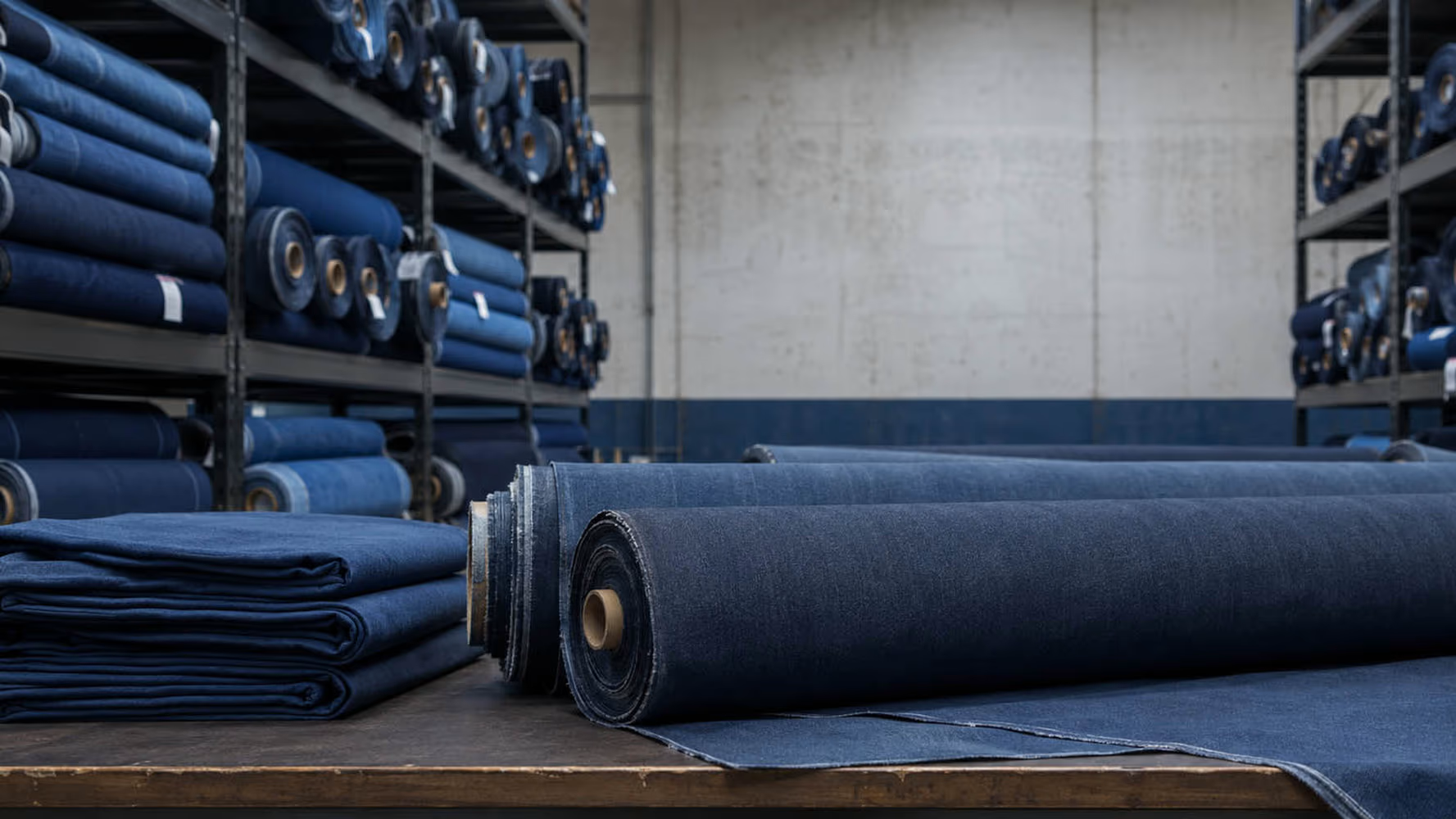
Orta Anadolu Ticaret ve Sanayi İşletmesi T.A.Ş., one of Türkiye’s long-established denim manufacturers, has officially announced that it will discontinue production at its facilities in Kayseri.
According to the company’s announcement dated September 11, 2026, production activities at the Kayseri facilities were suspended on the same day, while all production facilities are scheduled to close on October 12, 2026.
For Türkiye’s textile industry, however, this is much more than the closure of another manufacturing facility.
Orta Anadolu was founded in 1953, giving the company a 73-year industrial history. Since 1986, it has supplied denim to major international brands, making its name closely associated with the development of Türkiye as one of the world’s important denim and textile manufacturing centres.
Its Kayseri operation is also listed by the company as its manufacturing base in the city.
When a company with this history, international customer base and accumulated manufacturing expertise concludes that its existing operating model is no longer sustainable, the industry should pay attention.
Why Is Orta Anadolu Closing Its Kayseri Facilities?
In its official announcement, Orta Anadolu described the decision as “extremely difficult” and said it followed comprehensive efforts to reduce costs, improve operational efficiency and evaluate restructuring alternatives.
The company identified several pressures facing the global textile sector:
weakening global demand, rising operational and financing costs, supply-chain fluctuations and changing trade dynamics.
Ultimately, according to the company, these conditions made its current operational model unsustainable.
The company also said it intends to work closely with stakeholders during the closure process and fulfil existing commercial obligations responsibly.
The announcement marks the end of a remarkable manufacturing chapter in Kayseri — and potentially the beginning of a much larger conversation about the future of textile production in Türkiye.
This is Not Just the Story of One Company
It would be easy to treat the Orta Anadolu announcement simply as corporate news.
That would miss the bigger story.
Many of the problems identified by the company are the same pressures textile and apparel manufacturers across Türkiye have been discussing for several years.
High labour costs, inflation, expensive financing and increasing competition from lower-cost manufacturing countries have placed considerable pressure on Turkish producers.
An article published by İHKİB in July described the previous three years for Turkish textile exporters as a period dominated by struggle, citing sharply higher labour costs, inflation, financing expenses and growing competition from lower-cost production locations.
These pressures are particularly damaging in sectors where international buyers remain highly price-sensitive.
Türkiye has historically offered European buyers an attractive combination: proximity, manufacturing know-how, vertical integration, flexibility, relatively short delivery times and sophisticated textile infrastructure.
But proximity cannot compensate indefinitely for a widening production-cost disadvantage.
And Orta Anadolu’s decision brings that reality into sharper focus.
The Export Numbers Show an Industry Under Pressure
Türkiye remains a textile powerhouse. The scale of the industry should not be underestimated.
In the first six months of 2026, Türkiye exported approximately $5.6 billion in textiles and raw materials and another $6.9 billion in apparel, bringing the combined total to around $12.5 billion.
Together, textile and apparel represented approximately 9.2% of Türkiye’s total exports during the period.
But both textile and apparel exports declined by approximately 1% year-on-year in the first half of 2026.
The decline may appear relatively modest, and June actually showed a strong year-on-year improvement. There are therefore signs of resilience within the sector.
Employment data also showed a slight improvement, with approximately 852,000 people employed across textile and apparel, while textile capacity utilisation reached 70.4% in June 2026.
So this is not a story of an industry disappearing.
It is a story of an industry undergoing an increasingly difficult structural adjustment.
And that distinction matters.
Read More: Turkish Textile Exports Reach $3.7 Billion in First Four Months of 2026
Türkiye Is Losing Part of Its Cost Advantage
The underlying competitiveness problem becomes clearer when production costs are examined.
A recent academic analysis of Türkiye’s garment industry found that rising labour, energy and financing costs, combined with macroeconomic conditions, have weakened manufacturers’ ability to compete internationally and restricted their capacity to invest in upgrading.
The study estimates labour costs for Turkish garment manufacturers at around $660 in 2025, compared with approximately $150 in Vietnam and $120 in Bangladesh.
For highly differentiated, technologically sophisticated or premium products, a manufacturer can potentially absorb some of this disadvantage through innovation, speed, quality and service.
For basic and highly price-sensitive products, the equation becomes much more difficult.
That is why the Orta Anadolu announcement should concern the wider industry.
A company with decades of manufacturing experience and access to global customers still concluded that its existing production model could not continue sustainably under current economic conditions.

Egypt and North Africa Are Becoming Part of the Equation
Perhaps one of the most important changes taking place around Türkiye is geographical.
Turkish manufacturers are increasingly evaluating production beyond the country’s borders.
Egypt has emerged as a particularly important destination.
Recent research into Türkiye’s garment industry identifies lower labour costs and Egypt’s trade arrangements with major markets as important factors encouraging Turkish manufacturers to establish or shift production there. It also notes growing competition for Türkiye from Egypt, Morocco and Tunisia, which combine lower production costs with proximity to Europe.
This creates an uncomfortable reality.
Türkiye spent decades building one of the Mediterranean region’s most sophisticated textile ecosystems.
Today, some of the industrial knowledge developed inside that ecosystem is helping companies evaluate how to produce more competitively elsewhere.
This does not mean Turkish textile manufacturing will simply migrate to Egypt.
But it does mean manufacturers now have alternatives.
And when the economics become sufficiently unfavourable, capital eventually follows economics.
Read More: Turkish Textile Industry Warns New US Tariff Threatens Export Competitiveness
A Dangerous Loss Goes Beyond Machines and Buildings
Factory closures have another consequence that is difficult to measure in export statistics.
Industrial knowledge disappears with them.
A textile mill is not merely a building filled with machinery.
It represents decades of experience accumulated among technicians, engineers, operators, production managers, R&D teams, quality specialists and suppliers.
When a manufacturing facility closes, restarting that ecosystem later is considerably more difficult than switching machines back on.
Skilled employees move into other industries.
Experienced technicians retire.
Young people choose other professions.
Suppliers lose customers.
Technical knowledge becomes fragmented.
And eventually an industrial cluster becomes weaker.
That is why the closure of a 73-year-old manufacturer deserves attention beyond the immediate financial implications.
The Industry Is Sending Mixed Signals
Interestingly, Orta Anadolu’s announcement comes at a moment when industry leadership has also expressed optimism.
Speaking at Texhibition Istanbul on September 10 — just one day before Orta Anadolu announced the suspension of production — Türkiye Exporters Assembly President Mustafa Gültepe said he believed the difficult period for textiles was behind the sector and expressed confidence that competitiveness would strengthen in the coming period.
These two developments are not necessarily contradictory.
Some textile segments are showing resilience. Technical textile exports increased slightly during the first half of 2026, woven fabric exports grew 2%, yarn exports increased 0.5%, and exports to markets including the United States showed notable growth.
But individual factory closures demonstrate that recovery is far from uniform.
Some companies and product categories may successfully reposition themselves.
Others may decide that manufacturing under the existing model is no longer economically viable.
The question is which side of that restructuring will ultimately become larger.

Türkiye Cannot Win a Race Based Only on Price
The Orta Anadolu case also reinforces a difficult conclusion for Türkiye.
Returning to a business model based primarily on competing with Asia or North Africa on production costs may no longer be realistic.
Türkiye’s future textile strategy therefore has to move increasingly towards areas where price is only one component of the purchasing decision.
That means more investment in:
high-value textiles, technical textiles, advanced denim, automation, digital manufacturing, functional materials, sustainable production, recycling, traceability, design and rapid-response manufacturing.
Türkiye still possesses enormous advantages.
It has one of the world’s deepest textile supply chains, experienced entrepreneurs, sophisticated machinery, substantial dyeing and finishing expertise, strong design capabilities, proximity to Europe and decades of experience working with international brands.
Losing that ecosystem would be extremely costly.
But having an ecosystem does not guarantee that it will remain competitive.
From Mass Production to Higher-Value Manufacturing
The transformation facing Türkiye may therefore be more fundamental than a temporary downturn.
For decades, the country successfully combined competitive manufacturing costs with proximity to Europe and a comprehensive textile supply chain.
The cost component of that formula has weakened.
Türkiye now needs to extract substantially more value from the other components.
A Turkish factory cannot always be cheaper than a factory in Bangladesh, Egypt or another emerging manufacturing location.
But it can potentially be faster, more automated, more innovative, more flexible, more sustainable and technologically superior.
This is likely to become increasingly important for the companies that remain.
The industry may have little choice but to move from conventional, margin-sensitive production towards areas where Turkish engineering, know-how, design and speed can justify higher prices.
Read More: Top Towel Manufacturers in Turkey: Inside the Global Success of Turkish Towels
Kohan Textile Journal Analysis: A Warning That Should Not Be Ignored
The closure of Orta Anadolu’s Kayseri production facilities should not be interpreted as evidence that Türkiye’s textile industry is collapsing.
The country remains one of the world’s major textile manufacturing and exporting nations, and recent data also contain positive signals.
But neither should the announcement be dismissed as an isolated corporate restructuring.
A 73-year-old manufacturer closing production after concluding that its operating model is no longer sustainable is a warning signal.
Türkiye’s textile industry appears to be entering one of the most significant restructuring periods in its modern history.
The key question is no longer simply whether exports rise or fall by one or two percentage points next quarter.
The more important questions are structural.
- Can manufacturers generate sufficient margins to continue investing?
- Can financing become accessible enough to support automation and sustainability upgrades?
- Can Türkiye retain textile production rather than increasingly exporting its manufacturing expertise and capital?
- Can the industry move quickly enough from cost-sensitive commodity manufacturing towards higher-value production?
And perhaps most importantly:
- How many other established Turkish textile manufacturers are currently making the same calculations that Orta Anadolu has just made?
The answer will help determine whether the current period becomes a temporary industrial correction — or the beginning of a deeper geographical shift in textile manufacturing away from Türkiye.
For a country whose textile industry has taken decades to build, the cost of finding out too late could be enormous.











