






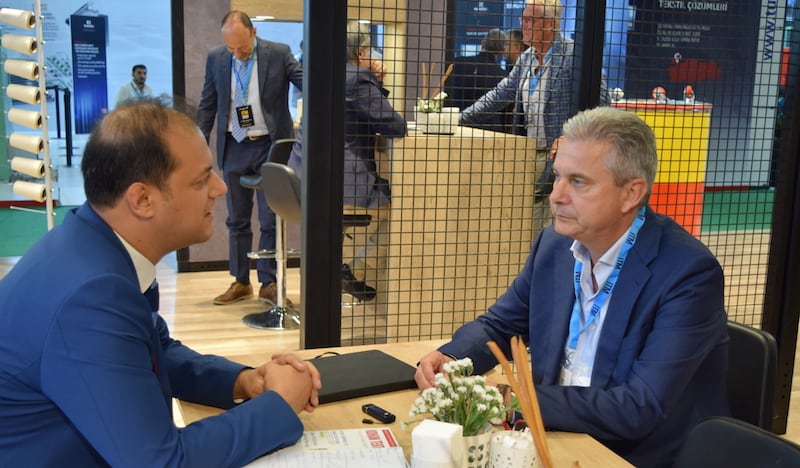
For modern spinning mills and nonwoven manufacturers, raw material contamination is a constant and costly threat. Even the smallest foreign matter can rupture fibers, halt high-speed production lines, and compromise end-product quality. At the ITM 2026 Exhibition in Istanbul, Behnam Ghasemi, Editor-in-Chief of Kohan Textile Journal, sat down with Mr. Renato Gerletti, General Manager of Loptex Italy, to discuss the company’s pioneering optical sorting systems and the shifting macro-economic landscape of global textile markets.
Founded in 1994, Loptex brings over 30 years of specialized expertise in engineering, developing, and selling automated sorter systems designed to eliminate contaminants from natural, synthetic, artificial, and recycled fibers.
Polarized Light: Shattering the Invisible Barrier in Defect Detection
While traditional optical systems struggle to identify transparent and semi-transparent polypropylene or plastics intermingled with raw fibers, Loptex has developed a breakthrough technology to address this precise industry challenge.
“Our latest technology incorporates a specialized sorter module utilizing polarized light,” Mr. Gerletti explained. “This technology allows the system to instantly detect transparent plastics and packaging materials across natural, artificial, and synthetic fiber blends, eliminating defects that were previously invisible to standard sensor systems.”
This engineering milestone allows spinning and nonwoven facilities to optimize their raw material yields and maintain flawless purity standards, an essential capability as the industry shifts further into highly sensitive recycled fiber applications.

A Quarter-Century Commitment to the Turkish Textile Grid
Turkey remains an exceptionally vital hub for Loptex’s international market footprint, with the company maintaining an active, continuous presence in the country for more than 26 years.
“Loptex officially entered the Turkish textile market in the year 2000,” Mr. Gerletti noted. “Our overarching goal in this highly specialized, quality-focused region has always been clear: to systematically expand our business, drive equipment sales, and provide exceptional technical service to our local customer base. Turkey is an essential market where we strive to continuously reinforce our position as one of the leading contamination control providers.”
Read More: An Accessible World Show Window For Textile Technology Manufacturers And Investors: ITM 2026
Navigating the Global Equipment Slowdown
“Currently, the global textile machinery sector is navigating a highly critical, depressed moment,” Mr. Gerletti stated candidly. “It is a challenging environment for all equipment manufacturers to launch new initiatives or secure rapid investment. However, these market contractions are temporary. Business cycles naturally experience up-and-down periods, and we firmly project that by next year, global textile market conditions will significantly improve.”
The African and Middle Eastern Landscape
Analyzing regional market shifts across Africa and the Middle East, Loptex sees specialized pockets of long-term development:
- Egypt’s Ascendancy: Egypt is steadily consolidating its position as the next major textile manufacturing hub. The local industry is increasingly viewed across Europe as a premium regional epicenter for spinning and processing development.
- The Middle Eastern Footprint: Within the broader Middle East, Pakistan remains an important, high-volume market. Concurrently, Iran holds distinct future potential for technological upgrades, though other parts of the region are currently not displaying significant near-term commercial potential.
Editor’s Insight: The Strategic Necessity of Sorter Intelligence
In the spinning prep phase, contamination control is the ultimate baseline for plant profitability. If a piece of transparent wrapping film escapes detection in the blowroom, it is subsequently shredded into thousands of microscopic fragments that contaminate thousands of meters of yarn, leading to catastrophic dye defects in the final fabric.
Loptex’s development of polarized light technology at ITM 2026 demonstrates that the fight against foreign matter has entered a digital phase. For premium spinning hubs like Turkey, or expanding industrial setups in Egypt, integrating intelligent optical sorters isn’t merely a mechanical upgrade—it is a vital financial safeguard. In a suppressed global market where every millimeter of yarn counts toward survival, Loptex provides the exact automated defense system required to maximize spinning floor efficiency.











